 Property
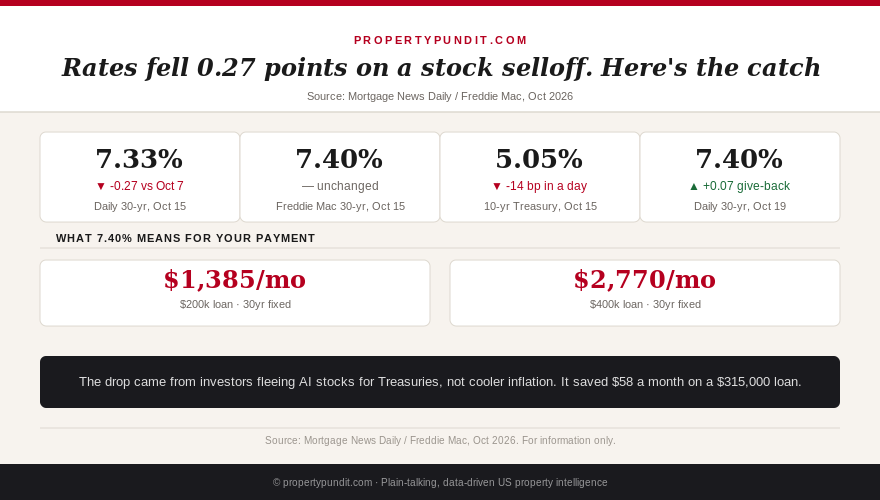
You've had a rate tracker open in a browser tab for what feels like three years, and this week it finally moved your way. Mortgage News Daily's 30-year fixed index fell about 0.27 percentage points between October 7 and October 15 (Mortgage News Daily, October 16, 2026), the sharpest slide in months. If you earn around $112,000 and keep getting priced out by a few hundred dollars a month, that looks like a door opening.
Before you celebrate, look at what caused it. Rates didn't fall because inflation cooled; September CPI came in at 3.7% against a 3.6% forecast (Yahoo Finance, October 15, 2026). They fell because investors dumped AI-linked stocks and ran into Treasury bonds. The 10-year Treasury yield dropped 14 basis points in a single day on October 15, to 5.05% (Yahoo Finance, October 15, 2026), and mortgage rates follow that yield. By October 19 the daily index was back at 7.40% (Mortgage News Daily, October 19, 2026), handing back about 0.07 of the move.
The slide was worth $58 a month on a $315,000 loan: real money, but small, and it came from fear rather than good news. Freddie Mac's weekly survey, the benchmark this site uses, still read 7.40% on October 15, unchanged from the prior week (Freddie Mac PMMS, October 15, 2026), so the official number hasn't caught up yet. Here's the mechanism, the payment math, and what to do with a window that may not stay open.
Get this in your inbox every Friday.
One email. The number that matters and what it means for you.
Why a stock selloff lowers mortgage rates
Mortgage rates don't follow the Federal Reserve's target rate day to day. They follow the 10-year Treasury yield, because lenders price home loans against the bond market. When investors get scared and sell stocks, a lot of that money lands in Treasuries. More buyers push bond prices up and yields down, and mortgage quotes drift down with them.
That's what happened on Thursday, October 15. Chip stocks fell after South Korea's KOSPI index dropped 7% overnight, with worries centered on how AI companies will finance their spending, and CoreWeave's credit default swaps hit a record that implied roughly 60% odds of default within five years (Yahoo Finance, October 15, 2026). The 10-year yield fell more than 10 basis points on its way to a daily decline that was on track to be the biggest since February. Two Yahoo Finance reports from that day put the move at 5.05% and 5.09%, so treat it as roughly 5.1%. For comparison, the yield hit 5.34% on October 1, the highest in 24 years (Yahoo Finance, October 3, 2026), so the October 15 level sits about 0.25 points below the peak.
Mortgage News Daily's author linked the week's decline to concerns about tech companies and possible signs that AI spending may slow, while saying it was too early to draw firm conclusions (Mortgage News Daily, October 16, 2026). Rates did not follow tech stocks lower on Friday, October 16, and rising oil prices may have limited the bond rally.
So what for you: this rate relief came from a bond rally driven by nervous investors, which means it can reverse as fast as it arrived, so treat it as a window and not as a new floor.
What 0.27 points is worth in dollars
Take a $350,000 house with 10% down, a $315,000 loan and a 30-year fixed rate. Here is the principal-and-interest payment at three rates from the past two weeks, plus the highest price you could afford at each rate if you hold housing costs to 28% of a $112,000 income ($2,613 a month) and assume $450 a month for property tax and insurance.
| Daily 30-year rate | Date (Mortgage News Daily) | P&I on $315,000 | Change vs 7.40% | Price ceiling at 28% |
|---|---|---|---|---|
| About 7.60% | October 7 (my arithmetic from the reported 0.27 drop) | $2,224 | +$43 | $340,432 |
| 7.40% | October 19, matching Freddie Mac on October 15 | $2,181 | n/a | $347,165 |
| 7.33% | October 15, the low | $2,166 | -$15 | $349,573 |
The October 7 to October 15 swing is $58 a month, or $698 a year. A $350,000 house was $427 over the ceiling at the low, $2,835 over at 7.40% and $9,568 over at 7.60%. So the dip was big enough to rescue a house priced within about $10,000 of your limit and nowhere near big enough to rescue one priced $30,000 above it. If you want the mental shortcut for this math, see the payment-per-$100,000 rule.
So what for you: price your search at what you can afford at 7.40%, because that's where both Freddie Mac and the daily index sit today, and treat any day below it as a bonus.
Why you shouldn't count on it lasting
The same day the 10-year dropped, September producer prices rose 1.3%, the largest monthly gain since March 2022 (Yahoo Finance, October 15, 2026). Yields had jumped the day before after the hot CPI report, then reversed on the selloff. Strategists are pricing at least one more Fed hike this year: as of that Thursday morning markets gave a 72% chance that the Fed holds at its October meeting, and Macquarie, UBS and Goldman Sachs expect a pause in October followed by a hike in December (Yahoo Finance, October 15, 2026). The Fed's target range is 3.75% to 4.00% after its September 16 hike. I covered the odds in the Fed odds explainer.
Here's what a swing back up looks like against a swing down, on the same $315,000 loan:
| If the 30-year rate goes to | P&I on $315,000 | Change vs 7.40% |
|---|---|---|
| 7.65% (yields rebound, December hike) | $2,235 | +$54 |
| 7.40% (today) | $2,181 | n/a |
| 7.15% | $2,128 | -$53 |
| 6.90% | $2,075 | -$106 |
| 6.40% | $1,970 | -$211 |
The downside of waiting for a bigger selloff is bigger than the payment table suggests. Rates fall hardest when the economy looks weakest, and September payrolls rose by only 29,000 with unemployment at 4.2% (Bureau of Labor Statistics, October 2026). A deeper drop would probably arrive alongside layoffs and tighter credit, which is a hard time to qualify for a loan or negotiate a raise. A full one-point drop would save $211 a month, but it would take far more than one scary week in tech.
So what for you: don't plan a purchase around a second selloff, because the conditions that would deliver it are the ones that make buying riskier for you personally.
What to do this week
If you're under contract and haven't locked, the choice is simple: the rate on the table is the best one you've seen in two weeks. Ask your lender to lock today, and ask whether the lock includes a float-down option that lets you take a lower rate once if the market improves. The float-down guide covers what to ask and what it costs.
If you're still shopping, get written Loan Estimates from at least three lenders on the same day. Quotes lag the bond market and lenders reprice at different speeds, so a day when yields have just fallen is a good day for comparison. Set your price limit at the 7.40% ceiling and keep the gap between the three rate gauges in mind: the survey, application and quote rates don't always agree.
If you're waiting for a better rate before you start, use the mortgage calculator on this site to see your payment at 7.40%, at 6.90% and at 7.65%. If the house only works at the middle number, you're not waiting for a rate, you're waiting for a price cut or a raise, and those are separate decisions.
So what for you: lock what you can afford at 7.40% rather than gambling that a market scare repeats itself on your closing timeline.
What this means for you
The math points toward budgeting at 7.40% and treating anything lower as a gift. If your target house fits under the 28% line at today's rate, a $58 monthly improvement is a reason to get an offer in and lock, not a reason to hold out for more. If it only works at 6.90% or lower, this week didn't change your answer; it showed how much of the rate story is driven by headlines you can't control.
Most people who run these numbers end up with the same conclusion: refinancing later is the escape hatch if rates fall, but it's not a plan, because a refinance costs money and rates might not fall. Buy the house you can carry at today's rate, and let any drop below it pay you back later.
Frequently asked questions
Why do mortgage rates fall when the stock market falls?
Mortgage rates track the 10-year Treasury yield. When investors sell stocks out of fear, they buy Treasuries, which pushes bond prices up and yields down, and lenders cut mortgage quotes to match. On October 15, 2026 the 10-year fell 14 basis points to about 5.05% as AI-linked stocks sold off (Yahoo Finance).
How much did the October rate drop save on a mortgage?
About $58 a month on a $315,000 loan. Mortgage News Daily's 30-year index fell roughly 0.27 points between October 7 and October 15, 2026, which cuts principal and interest from about $2,224 to $2,166. By October 19 the index was back at 7.40%, which gives back $15 of the saving.
Will mortgage rates keep falling if tech stocks keep dropping?
Not reliably. Rates fell on October 15 because investors fled to bonds, but September CPI was 3.7% and producer prices rose 1.3%, so inflation could push yields back up. Macquarie, UBS and Goldman Sachs expect a Fed hold in October and a hike in December (Yahoo Finance, October 15, 2026).
Should I lock my mortgage rate now or wait?
If you have a house under contract that fits your budget at 7.40%, lock now and ask about a float-down option. Waiting for a deeper selloff means betting on weaker jobs and tighter credit; a one-point drop would save $211 a month on $315,000, but nothing in this week's data points to it.