 Property
If you're pre-approved around $400,000 with 20% down, you've probably seen 7.28% in the headlines and then watched a lender quote you something higher. The lender isn't padding the number. Three respected surveys now disagree by 25 basis points, and on a $320,000 loan that disagreement is worth $55 a month. The 10-year Treasury, the yield these rates follow, touched 5.36% on Wednesday, its highest since April 2002 (Yahoo Finance, October 7, 2026), which is why the gap is leaning one direction.
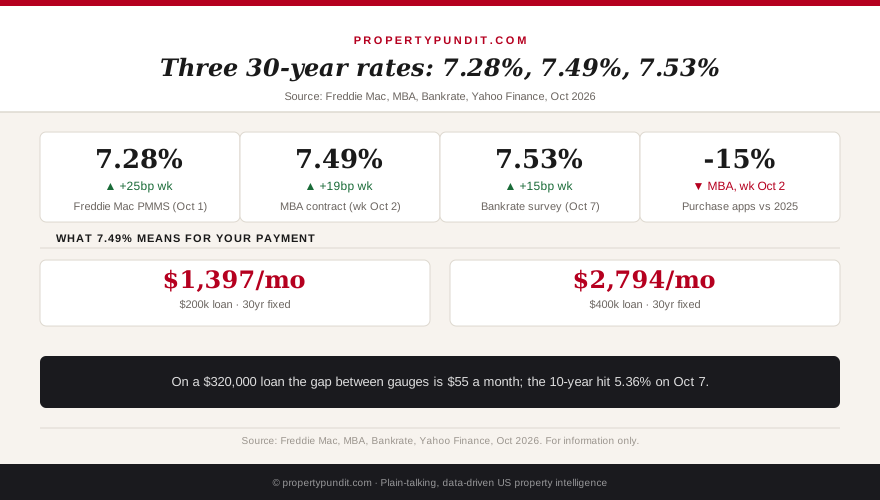
Freddie Mac's Primary Mortgage Market Survey put the 30-year fixed at 7.28% for the week ending October 1, up from 7.03% the week before and 6.34% a year earlier, the highest reading since November 2023 (Freddie Mac PMMS, October 1, 2026). The Mortgage Bankers Association's contract rate for the week ending October 2 was 7.49%, up from 7.30% (MBA Weekly Applications Survey, released October 7, 2026). Bankrate's weekly lender survey, published Wednesday, found 7.53%, up from 7.38% a week earlier and 6.78% four weeks ago (Bankrate, October 7, 2026).
Freddie Mac's next reading is due Thursday, October 8 at midday Eastern time, after this piece was written, so treat the first number below as last week's official figure and not as today's.
Get this in your inbox every Friday.
One email. The number that matters and what it means for you.
Three surveys, three answers, one $55 spread
| Gauge | What it measures | 30-year rate | Payment on $320,000 | Versus Freddie Mac |
|---|---|---|---|---|
| Freddie Mac PMMS | Weekly average, week ending Oct. 1 | 7.28% | $2,189 | - |
| MBA contract rate | Applications, week ending Oct. 2 | 7.49% | $2,235 | +$46 a month |
| Bankrate lender survey | Quotes gathered Oct. 7 | 7.53% | $2,244 | +$55 a month |
| Freddie Mac, one year ago | Week ending Oct. 2, 2025 | 6.34% | $1,989 | -$200 a month |
The dollar gap looks small until you remember it repeats for 360 months: $55 a month is about $655 a year and about $19,650 over a full 30-year term on the same loan. The bigger number is the one in the last row. Against a year ago, the Freddie Mac rate alone adds $200 a month to a $320,000 loan, and the MBA rate adds $246. What it means for you: budget with the highest of the three, because the lender you call will quote something near it.
Why the same week produces three rates
Timing does most of the work. Freddie Mac's figure covers the week ending October 1, the MBA's covers the week ending October 2, and Bankrate's survey landed on October 7. In that stretch the 10-year yield climbed from about 5.24% on September 28 to 5.34% on October 1 and 5.36% on Wednesday (Yahoo Finance, October 3 and October 7, 2026; our October 1 yield piece), so a survey taken later sees a higher rate than one averaged over earlier days.
Methods differ too. The MBA reports a contract rate on conforming loans with an 80% loan-to-value ratio, which matches our 20%-down example, while Freddie Mac's number is a weekly average built from loan applications and is the one most newspapers print (Freddie Mac and MBA survey methodology; see also our explainer on what the headline rate assumes). Bankrate's number comes from a survey of large lenders' quotes on the day. None of the three is wrong. They answer slightly different questions on different days.
What it means for you: the gap between the weekly average and the latest quote is a rough read on where the next official print is leaning, not a promise. If you're deciding whether to lock this week, the quote in your inbox is more useful than the headline.
What pushed the 10-year to a 24-year high
The 10-year reached 5.36% on Wednesday and the 30-year Treasury hit 5.73%, its highest since May 2002, as global bond yields rose and Brent crude traded near $100 to $102 a barrel (Yahoo Finance, October 7, 2026). Inflation is the backdrop: consumer prices ran 3.4% in August, well above the Fed's 2% target (Bankrate, October 7, 2026).
The Fed's September meeting minutes, released Wednesday afternoon, showed officials leaning toward another hike, with language that one "would likely be appropriate by year end" (Yahoo Finance, October 7, 2026). Markets priced only about a 17% chance of a hike at the next meeting, so the minutes confirmed a path more than they announced a surprise. Our October 7 piece explains why mortgage rates follow the 10-year and not the Fed's target.
What it means for you: the hike that matters to your payment is the one already in the 10-year yield. If bond yields ease, rates can fall without any Fed action, and if oil keeps climbing, they can rise without one.
What a 7.49% rate did to demand
The MBA's survey for the week ending October 2 showed total applications down 4.2% on a seasonally adjusted basis. Purchase applications fell 2% from the week before and sat 15% below the same week last year, while refinance applications dropped 8% for the week and 56% from a year earlier (HousingWire reporting on the MBA survey, October 7, 2026). The refinance share of applications slipped to 37.0% from 38.3%, and adjustable-rate mortgages held at 10.3% of applications. FHA loans were 16.4% of applications and VA loans 11.8%.
MBA economist Joel Kan summed it up: "Very few homeowners have an incentive to refinance at these rates." Buyers are leaning on adjustable and government-backed loans, and fewer of them are applying at all. What it means for you: weak demand gives you negotiating room on price and seller credits, even though the rate itself is working against you.
What moving costs a 3.8% homeowner
If you own at 3.8%, the question isn't whether 7.49% is high. It's what moving costs you each month. Take a $320,000 loan, the same balance as a $400,000 purchase with 20% down.
| Loan on a $400,000 home, 20% down | Rate | Principal and interest | Versus 3.8% loan |
|---|---|---|---|
| Your existing 3.8% loan | 3.80% | $1,491 | - |
| New loan at the Freddie Mac rate | 7.28% | $2,189 | +$698 |
| New loan at the MBA rate | 7.49% | $2,235 | +$744 |
| New loan at the Bankrate rate | 7.53% | $2,244 | +$753 |
| Stress test: 25 more basis points | 7.78% | $2,299 | +$808 |
Moving from a 3.8% loan to a 7.49% loan on the same amount adds $744 a month, or $8,931 a year, before taxes, insurance or the larger price most upgrades involve. The rule of thumb from our payment-per-$100,000 piece moves from $684 per $100,000 at 7.28% to $699 at 7.49%, so every extra $50,000 you borrow costs about $349 a month. Our cost-to-move analysis walks through the full trade.
What it means for you: unless a job, a family change or a real space problem forces the move, the $744 monthly premium is the price of selling now. Keep the 3.8% loan and revisit when the 10-year retreats.
What this means for you
If you're buying, size the payment at 7.78%, not 7.28%. That stress test puts principal and interest on a $320,000 loan at $2,299, which is $110 above the headline figure, and if you can still afford it, a quote that lands near 7.5% won't surprise you. Ask each lender for a written quote at the same loan amount and 20% down, and lock only when you've compared them. If you're a homeowner at a low rate, the data say staying put is the cheaper option.
Frankly, I'd watch Thursday's Freddie Mac print less for the number itself than for how close it gets to the 7.49% MBA reading. A reading near 7.4% to 7.5% would say the headline rate has caught up with the quotes you're already seeing.
Frequently asked questions
Why is my mortgage quote higher than the Freddie Mac rate?
Freddie Mac reports a weekly average, and quotes reflect the day you call. The MBA measured 7.49% and Bankrate 7.53% against Freddie Mac's 7.28%, a gap worth $55 a month on a $320,000 loan. Your credit, points and down payment also move the quote.
What is the current 30-year mortgage rate?
Freddie Mac's latest published reading is 7.28% for the week ending October 1, 2026, the highest since November 2023. The MBA contract rate was 7.49% for the week ending October 2, and Bankrate's survey found 7.53% on October 7. Freddie Mac's next reading is due October 8.
Will the Fed raise rates again this year?
The September minutes show officials leaning toward one more hike by year end, but markets priced only about a 17% chance of a hike at the next meeting. Mortgage rates follow the 10-year Treasury, which hit 5.36% on October 7, more than the Fed's target rate.
Should I sell a 3.8% mortgage home and buy at 7.49%?
Not unless you have to move. The same $320,000 balance costs $2,235 a month at 7.49% versus $1,491 at 3.8%, a $744 monthly premium, or $8,931 a year, before any price increase. Keep the low rate and revisit when the 10-year retreats.