 Property
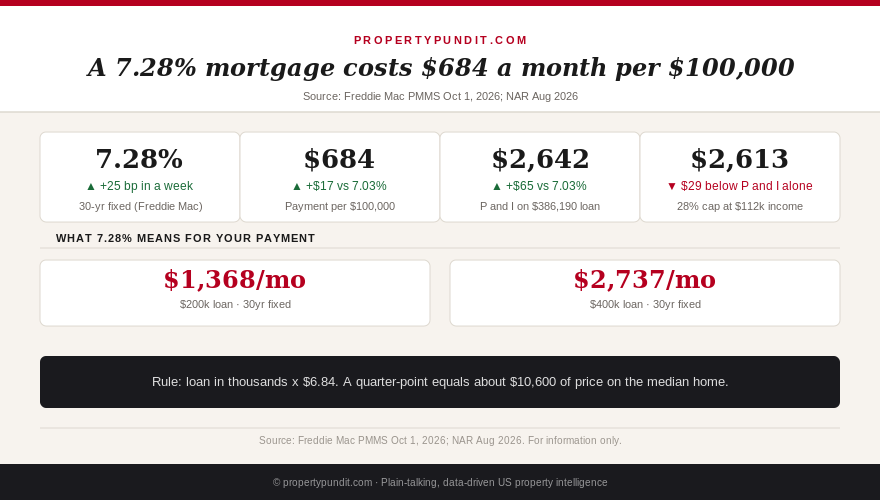
At 7.28%, every $100,000 you borrow costs $684.21 a month in principal and interest on a 30-year fixed loan (Freddie Mac PMMS, October 1, 2026). That one number lets you size any mortgage in your head: a $386,190 loan is 3.86 hundred-thousands, and 3.86 times $684 is about $2,642 a month. You don't need a calculator app, a lender, or a pre-approval to know whether a house is inside your budget.
If you're 34, earning $112,000, and watching rates climb for six straight weeks, this rule is the fastest way to stop guessing. The 30-year rate was 7.03% a week earlier and 6.58% on July 23 (Freddie Mac PMMS, September 24 and July 23, 2026). The 10-year Treasury yield hit 5.34% on October 1, its highest level in 24 years (Yahoo Finance, October 3, 2026), and the Federal Reserve raised its target range to 3.75%-4.00% on September 16. Freddie Mac's next reading lands Thursday, October 8. Whatever it says, the table below will turn it into dollars in about five seconds.
Get this in your inbox every Friday.
One email. The number that matters and what it means for you.
Where does $684 come from?
Lenders use a payment factor: the monthly principal-and-interest cost of each $1,000 borrowed at a given rate over 30 years. At 7.28% that factor is $6.84. Multiply it by the number of thousands in your loan and you have the payment. The spreadsheet formula behind it is the standard amortization equation, payment = loan × (monthly rate × (1 + monthly rate)^360) ÷ ((1 + monthly rate)^360 − 1), but you only have to run it once per rate, and the answer scales perfectly with loan size. A $200,000 loan costs exactly twice what a $100,000 loan does.
Here is the card to keep, computed for a 30-year fixed loan at rates that have actually appeared in 2026:
| 30-year rate | Payment per $100,000 | On a $386,190 loan |
|---|---|---|
| 3.80% (a pandemic-era owner) | $466 | $1,799 |
| 6.58% (Freddie Mac, July 23) | $637 | $2,461 |
| 7.03% (Freddie Mac, September 24) | $667 | $2,577 |
| 7.28% (Freddie Mac, October 1) | $684 | $2,642 |
| 7.50% (if the climb continues) | $699 | $2,700 |
| 8.00% (stress test) | $734 | $2,834 |
The loan size in the right-hand column is a 10% down payment on the $429,100 national median existing-home price (NAR, August 2026). Compare the 3.80% row with today's: $218 a month per $100,000. On a $300,000 balance, it's $1,398 at 3.8% versus $2,053 at 7.28%, a $655 monthly gap worth $7,857 a year, which is why a homeowner holding a 3.8% loan isn't in a hurry to sell and why so few listings hit the market. What it means for you: write the 7.28% row on a sticky note and use it before you open a single listing.
Does the median home fit a $112,000 income?
Run the rule on the median house. A 10% down payment on $429,100 leaves a $386,190 loan, and 3.8619 × $684.21 = $2,642 a month. The classic 28% guideline caps total housing cost at $2,613 a month on a $112,000 income ($112,000 × 28% ÷ 12). Principal and interest alone are $29 over that cap, before a dollar of property tax, insurance, or mortgage insurance. The median home doesn't fit, and you found that out without leaving your chair.
Now flip the rule around to find the price you can afford. Assume $450 a month for property tax and homeowners insurance (an illustrative figure; yours will vary by county and coverage). That leaves $2,163 for principal and interest. Divide by $6.84 per $1,000 and the loan comes out to roughly $316,200. At 10% down, that's a purchase price near $351,300, and that's before mortgage insurance, which would trim it further. At 6.58% in July the same budget supported about $377,100. Rates alone have taken roughly $25,800 off your price ceiling in ten weeks.
| 30-year rate | Max loan | Max price at 10% down |
|---|---|---|
| 6.58% | $339,400 | $377,100 |
| 7.03% | $324,200 | $360,200 |
| 7.28% | $316,200 | $351,300 |
| 7.50% | $309,400 | $343,800 |
The so-what is blunt. At $112,000, a median-priced house is about $78,000 above where the 28% rule lands today, so the search band is roughly $320,000 to $350,000, not the national median.
What is a quarter-point worth in dollars of price?
The same factor tells you what a rate move is worth. A quarter-point cut, from 7.28% to 7.03%, saves $65 a month on a $386,190 loan. A half-point saves $130, and a full point saves $257. Those numbers are useful on their own, but the better trick is converting them into price: how much would a seller have to cut to give you the same payment relief?
On the median house, a quarter-point equals about $10,600 of price, or 2.5% of $429,100. A half-point equals about $21,100 (4.9%). A full point equals about $41,700 (9.7%). That's the exchange rate between a rate buydown and a price cut. Sellers offered concessions on 44.7% of August sales, a record for that month (Redfin, September 2026). If a seller offers you $10,000 toward a rate buydown or a $10,000 price reduction, you're being offered roughly the same monthly relief either way, and the choice comes down to how long you'll keep the loan and what the buydown actually costs. What it means for you: when a quote comes back 0.25 points higher, ask for roughly $10,000 off to break even.
How do you use the rule to check a lender's quote?
Take the loan amount on your Loan Estimate, multiply the thousands by the factor for the rate on the page, and compare it to the principal-and-interest line. On a $386,190 loan at 7.28% you should see about $2,642. If the lender's number is $2,900, the rest is something other than principal and interest (mortgage insurance, taxes, or a different loan term) or the rate on the page isn't the rate you were quoted. This catches the single most common mix-up in first quotes: comparing one lender's principal-and-interest figure against another lender's total payment.
The rule also prices discount points quickly. One point costs 1% of the loan, or $3,862 on $386,190. If it buys a quarter-point cut worth $65 a month, break-even is 59 months. Median homeowner tenure is 12 years (Redfin, 2026), so a buyer who plans to stay that long clears break-even with years to spare, while someone who might move in three years doesn't. For a 15-year loan, the factor changes: at the 6.60% 15-year rate (Freddie Mac PMMS, October 1, 2026) it's $877 per $100,000, so use that row, not the 30-year one.
Where the rule stops working
The $684 figure covers principal and interest only. It excludes property tax, homeowners insurance, mortgage insurance, and HOA dues, which are the pieces that make a mortgage payment bigger than the calculator's answer. It assumes a fixed rate for 30 years, so it doesn't apply to an adjustable-rate loan after its reset. And it uses Freddie Mac's survey rate, which assumes a borrower putting 20% down with strong credit. Daily trackers ran higher: Mortgage News Daily reported 7.37% on October 2, about nine basis points above the survey. If your quote is 7.50%, use the 7.50% row. The rule is only as accurate as the rate you feed it.
Two more cautions. First, the factor is a monthly number, so annual cost is just 12 times it: $2,642 a month is $31,704 a year in interest and principal on the median house. Second, early payments are mostly interest. In month one of a 7.28% loan, about $2,343 of the $2,642 is interest, which is why the balance barely moves in the first few years.
What this means for you
Do the three-step check before you tour anything. First, multiply your income by 28%, divide by 12, and subtract your best estimate of tax and insurance; that's your principal-and-interest ceiling. Second, divide that ceiling by $6.84 and multiply by 1,000; that's your maximum loan at today's 7.28%. Third, add your down payment to get a price band. At $112,000 of income and 10% down, that band tops out near $351,000, and you should shop below it if you want a cushion for the rate moving another quarter-point before you lock.
If Thursday's Freddie Mac reading jumps again, redo step two with the new factor rather than trusting the headline. If it eases, treat a quarter-point as worth about $10,600 of price and decide whether that changes your target. And if you're ever unsure whether a lender's quote makes sense, run the rule first; it takes ten seconds and has never been wrong about arithmetic.