 Property
You locked in a 3.8% mortgage years ago, and every time you price a move-up, the new payment makes you wince. This week hands you two dated events that can change that number: the September CPI report at 8:30 a.m. ET today (October 14) and the Fed's October 28 meeting. Markets put about 80% odds on a Fed hold at that meeting, and about 85% on a higher fed funds rate by December. If you're buying in the next two months, those two odds matter more than any headline about the Fed "pausing."
I wrote this before the CPI release, so check the print against the consensus numbers below. The numbers on the board and the payment math don't depend on the print: on a $400,000 loan, every quarter-point is about $68 a month.
This piece uses the Freddie Mac rate of 7.40% (October 8, 2026) as its baseline, since the next weekly reading doesn't post until Thursday, October 15.
Get this in your inbox every Friday.
One email. The number that matters and what it means for you.
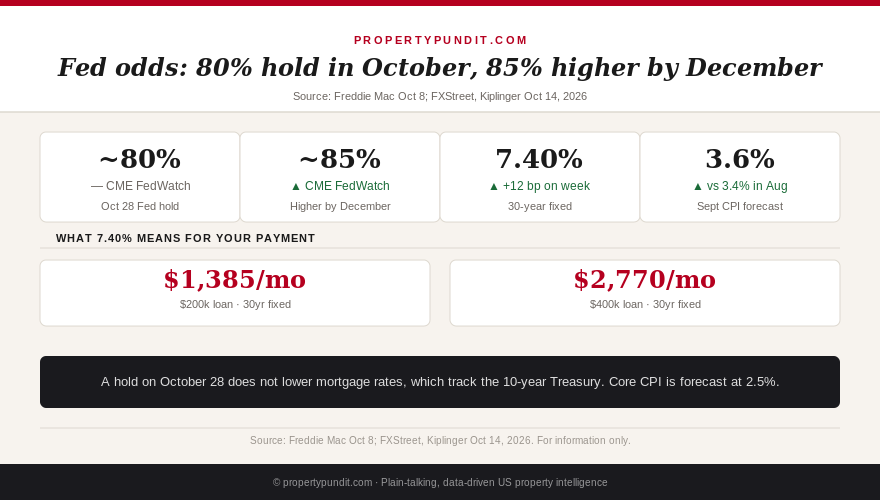
The five numbers on the board this week
| Number | Latest | Context |
|---|---|---|
| September headline CPI (consensus) | 3.6% year over year, +0.6% for the month | August was 3.4% and +0.4% (FXStreet, Kiplinger, October 14, 2026) |
| September core CPI (consensus) | 2.5% year over year, +0.2% for the month | August core was 2.4% (FXStreet, October 14, 2026) |
| Fed holds on October 28 | About 80% | CME FedWatch via FXStreet; Capital.com via Kiplinger, October 14, 2026 |
| Fed funds rate higher in December | About 85% | Target range is 3.75% to 4.00% after the September 16 hike (CME FedWatch via FXStreet) |
| Freddie Mac 30-year fixed | 7.40% | 7.28% a week earlier, 6.30% a year earlier (Freddie Mac, October 8, 2026) |
The gap between headline CPI at 3.6% and core at 2.5% is 1.1 points, and the usual explanation is energy: Wells Fargo, quoted by Kiplinger, expects a sharp September rise in gasoline prices. Bond traders watch whether that energy cost leaks into core. A core reading at or below 2.5% supports the market's current hold-then-hike script; a hotter core reading raises the odds of a move sooner. For you, core is the number to read first when the report lands, because it's the one the Fed will act on.
Why an 80% hold doesn't mean a steady mortgage rate
Mortgage rates follow the 10-year Treasury yield, not the fed funds rate, and the 10-year was near 5.24% on October 9 (Mortgage News Daily). The October 7 analysis showed the Fed's target a quarter-point lower than a year ago while the 30-year mortgage rate was 94 basis points higher. A hold on October 28 changes none of that. The hike on September 16 barely moved mortgage rates the next morning because the market had priced it in days earlier, the same mechanism explained in the September 15 piece.
What moves rates is a surprise relative to consensus. On September 10, a producer-price report came in hot and the 10-year jumped 12 basis points in a single session to about 4.95% (Treasury yields reported September 14). If a 12-basis-point jump carried straight through to a 30-year mortgage at 7.40%, it would add $33 a month on a $400,000 loan. That's a small number for one day, and it compounds: the 30-year rate has risen 64 basis points since Freddie Mac's 6.76% reading on September 10, which costs $172 a month on the same loan, or $2,070 a year.
Daily lender surveys show how quickly quotes can change. NerdWallet's October 13 average for a 30-year loan was 7.32% APR, down 9 basis points in a day and 11 over the week, as oil fell on new Russian supply. That is APR-based and not directly comparable to the Freddie Mac survey, but the direction shows how much the quote depends on the week's inflation news. Your takeaway: a Fed hold won't lower your rate; only a soft inflation print might, and you can't schedule your closing around one.
What a quarter-point costs on a $400,000 loan
| 30-year rate | Principal and interest | Change from 7.40% | Change per year |
|---|---|---|---|
| 7.15% | $2,702 | -$68 | -$815 |
| 7.40% (Freddie Mac, October 8) | $2,770 | $0 | $0 |
| 7.65% | $2,838 | +$69 | +$822 |
| 7.90% | $2,907 | +$138 | +$1,652 |
These are illustrations, not forecasts. The payments are principal and interest only, so tax, insurance and any PMI come on top. The table has a useful asymmetry: markets price the next Fed move as up, not down, so the 7.65% and 7.90% rows are more likely to appear in your lender's quote than the 7.15% row. If you want the shortcut, the payment-per-$100,000 rule gives the same numbers in your head. In practice, a lender quote that moves a quarter-point costs you about $816 a year per $400,000, and that's the figure to hold against any lock fee.
What the odds mean if you hold a 3.8% rate
Take a homeowner with a $300,000 balance at 3.8%. The principal and interest payment is $1,398. Sell, repay the balance, and borrow $400,000 at 7.40% for the next house, and the payment becomes $2,770, a gap of $1,372 a month or $16,460 a year before you count the price difference between the houses. That gap is what keeps 3.8% owners in place, and it's why the three-gauge comparison from last week put a dollar value on staying put.
Now apply the odds. If December's rate is likelier to be higher than lower, waiting for a better payment has a negative expected value for a move-up that you plan to make anyway. If your move depends on the rate falling, a quarter-point drop saves $68 a month, which closes 5% of the $1,372 gap. For you, the lock-in penalty outweighs any realistic rate move this year, so a move-up has to be justified by the house, not by timing the rate.
What I'd do with this week's odds
My call: if you have a purchase closing within the next 45 to 60 days, ask your lender for a written lock quote today, including the cost of a 30, 45 and 60-day lock and any float-down option, and lean toward locking. The math points that way because the downside case (a hotter CPI, then a hike by December) costs $69 to $138 a month, while the upside case (a soft print and a quarter-point drop) saves $68. You're risking about the same dollars either way, but the odds are not symmetric.
If you're a year out, the odds matter less than your budget. Run your payment at 7.90%, and if it still fits under 28% of gross income, you can wait without being squeezed. If it doesn't, the answer is a cheaper house or a larger down payment, and no Fed meeting will change that. The closing costs guide is worth a read before you compare lock fees against a buydown.
What I couldn't verify
The September CPI result wasn't available when I wrote this, so every CPI figure above is a consensus forecast, not a reading. The 80% and 85% odds come from CME FedWatch as reported by FXStreet on October 14 and from Capital.com as cited by Kiplinger, not from CME directly, and they change daily. The 10-year yield of 5.24% is Mortgage News Daily's October 9 figure. The NerdWallet quote is an APR-based average and not comparable to the Freddie Mac survey. The lock and float-down costs are lender-specific, so I haven't put numbers on them.
Frequently asked questions
Will the Fed raise rates on October 28?
Markets put about 80% odds on a hold at the October 28 meeting, according to CME FedWatch as reported on October 14, 2026. The same data puts about 85% odds on a higher fed funds rate by December. The Fed raised its target to 3.75% to 4.00% on September 16.
Do mortgage rates follow the Fed funds rate?
Not directly. They track the 10-year Treasury yield, which was near 5.24% on October 9. A year ago the Fed's target was a quarter-point higher and the 30-year mortgage rate was 6.30%; today the target is lower and the rate is 7.40%.
How much does a quarter-point change my mortgage payment?
About $68 a month per $400,000 borrowed, or $816 a year. At 7.65% instead of 7.40%, principal and interest rises from $2,770 to $2,838. A half-point adds $138 a month.
Should I lock my mortgage rate before the Fed meeting?
If you're closing within 45 to 60 days, lean toward locking. The market prices the next Fed move as up, and a lock removes the $69 to $138 a month risk. Get the lock cost and any float-down terms in writing first.