 Property
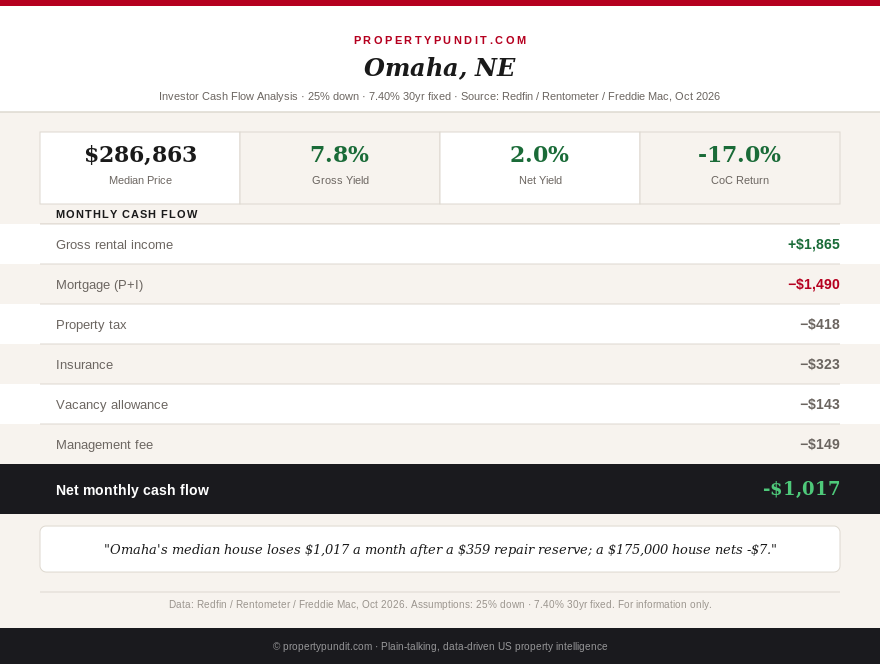
You're weighing a third rental, and someone told you Omaha is the Midwest's safe bet: prices up 2.5%, homes gone in 19 days. The cash flow disagrees. At the October 8 Freddie Mac rate of 7.40%, a median-priced Omaha house ($286,863) loses $1,017 a month on a 25% down payment, and a Lincoln median house ($316,790) loses $1,379. In August the same two markets lost $684 and $888.
The one price that works is near $174,000. A $175,000 Omaha house at the same $1,865 rent nets -$7 a month, as close to break-even as Nebraska gets, and it sits 39% below Omaha's median. Rent for a house that cheap will probably be lower than $1,865, so treat that number as a ceiling for the deal, not a listing you can go buy.
This is the third Nebraska pass of the year. The numbers use the method of the recent state passes: 25% down, a 30-year fixed at 7.40% (Freddie Mac, October 8, 2026), the county effective property tax rate, an Omaha-based insurance estimate, 8% management, one month of vacancy a year, and a 1.5% annual maintenance reserve.
Get this in your inbox every Friday.
One email. The number that matters and what it means for you.
Nebraska cash flow at 7.40%, market by market
| Market | Price | Rent | Full payment | Net cash flow | Coverage | Break-even rent |
|---|---|---|---|---|---|---|
| Omaha (median house) | $286,863 | $1,865 | $2,231 | -$1,017 | 0.84 | $3,071 |
| Lincoln (median house) | $316,790 | $1,728 | $2,440 | -$1,379 | 0.71 | $3,363 |
| Omaha ($175,000 entry house) | $175,000 | $1,865 | $1,361 | -$7 | 1.37 | $1,873 |
Prices are Redfin median sale prices: Omaha $286,863 (September 2026, up 2.5% year over year) and Lincoln $316,790 (August 2026, up 5.6%). Rents are Rentometer three-bedroom house averages: $1,865 in Omaha (May 12, 2026) and $1,728 in Lincoln (May 13, 2026). The $175,000 entry house is a price point I chose, not a listing. "Full payment" means principal, interest, property tax and insurance; "coverage" is rent divided by that payment.
The entry house shows why coverage alone misleads. Its 1.37 coverage looks comfortable, yet its -$7 result means it still doesn't pay you after management, vacancy and repairs. The same lesson came out of the Montana pass a day earlier. Your takeaway: underwrite net cash flow after the reserve, not the coverage ratio a lender quotes.
Why Omaha's loss grew by $333 a month since August
August's published result was -$684 for Omaha and -$888 for Lincoln. Re-running both through today's method and inputs one step at a time shows where the change came from:
| Step | Omaha | Lincoln |
|---|---|---|
| August result as published | -$684 | -$888 |
| Today's method (management, vacancy, reserve) | -$412 | -$423 |
| Rate 6.69% to 7.40% | -$103 | -$108 |
| New price | +$17 | -$116 |
| New rent | -$13 | +$12 |
| Insurance re-sourced | +$178 | +$144 |
| October result | -$1,017 | -$1,379 |
The biggest step is method, not market. August took a flat 13% haircut off rent for management and vacancy and carried no repair line. Today's method takes 8% for management, then one month of vacancy a year, then a 1.5% reserve of the purchase price: $359 a month in Omaha and $396 in Lincoln. That change alone costs $412 and $423 a month. The 7.40% rate adds $103 and $108 compared with the 6.69% used in August (Freddie Mac, August 6).
Prices moved less than you might expect. Omaha's median of $289,000 (Redfin, three months ending June) became $286,863 in September, while Lincoln's $302,000 (three months ending May) became $316,790 in August. The Lincoln step is partly a change in time window. For you, the method change explains more than the rate does, so a deal that looked marginal in August on the old method deserves a fresh underwrite before you act on it.
Insurance is the one input that moved in your favor
August used Nebraska's statewide average premium of $6,015 a year (Ramsey Solutions, 2026), or $501 a month, for every city. This pass uses an Omaha figure instead: Insurify's $4,056 a year for a $300,000 dwelling. Scaled to each purchase price, that's $3,878 a year ($323 a month) in Omaha and $4,283 ($357) in Lincoln. Nebraska Extension's Eric Hunt told Rural Radio Network on May 4, 2026 that most Nebraska counties average above $4,000 a year, citing a Wall Street Journal analysis, which fits the lower figure.
That makes Nebraska the opposite of Montana, where a re-sourced insurance quote made every result worse. Here it adds $178 a month back in Omaha and $144 in Lincoln. It remains a large cost: Nebraska and its neighbors have had the highest home insurance rate increases in the country over ten years, and the risk is hail across the eastern half of the state. Test the sensitivity:
| Insurance assumption | Omaha net | Lincoln net |
|---|---|---|
| Statewide average, $6,015 a year | -$1,195 | -$1,576 |
| Omaha-based estimate (used here) | -$1,017 | -$1,379 |
| Estimate minus 30% | -$920 | -$1,272 |
Even a landlord quote 30% below my estimate leaves Omaha down $920 a month. The estimate is a homeowner average scaled to price, not a landlord (DP-3) quote, and land isn't insured, so it may overstate the premium. The message for you is to shop the policy before you shop the property, but no premium turns a median-priced Nebraska house into a cash-flow asset.
Property tax: the school credit reaches landlords
I carried the county effective rates from the earlier passes: 1.75% in Douglas County (Omaha) and 1.66% in Lancaster County (Lincoln), from propertytaxrates.org (2026). That's $418 a month on the Omaha median house and $438 on the Lincoln one. Each quarter-point of rate is worth about $60 a month in Omaha.
Nebraska's LB 34 school tax credit is the useful detail for rental owners. It cuts school district property taxes by 30% on the tax statement itself, and Nebraska Department of Revenue guidance says whoever paid the county treasurer claims it, including a landlord or an LLC. Only the school district slice qualifies, not bonds or voter-approved overrides, so the cut to the whole bill is smaller than 30%. I couldn't confirm whether the county rates above already net it out. Your takeaway: pull the actual tax statement on any parcel and check that the credit shows on it before you rely on a seller's number.
Omaha versus Lincoln: the two cities have switched places
Lincoln's median house now costs $29,927 more than Omaha's, yet rents $137 a month less. That's why Lincoln loses $362 a month more than Omaha on the same 25% down payment. Redfin's latest data shows two different markets:
| Redfin measure | Omaha (Sept 2026) | Lincoln (Aug 2026) |
|---|---|---|
| Median sale price | $286,863 (+2.5%) | $316,790 (+5.6%) |
| Median days on market | 19 (up 2) | 21 (up 3) |
| Sale-to-list price | 99.1% | 99.4% |
| Homes with price drops | 30.7% (up 1.5 points) | 23.6% (up 4.6 points) |
| Homes sold | 1,360 (down 5.8%) | 1,148 (down 0.4%) |
Statewide, Redfin shows a $321,661 median (August 2026, up 5.5%), 1,682 homes sold (down 3.7%), 29 days on market and 2.0 months of supply. Those are tight numbers for a seller, and they explain why prices haven't fallen. Tight supply also means a buyer has little bargaining power to negotiate toward the roughly $174,000 that works. For you, the price growth is real and the cash flow isn't: you'd be buying appreciation, and paying for it monthly.
What price breaks even?
At 7.40% with the rents above, break-even prices come out to about $174,000 in Omaha and about $163,000 in Lincoln. Those are 39% and 49% below each city's median. The entry-house case holds only if the rent holds: a $175,000 house renting for $1,600 instead of $1,865 nets about -$230 a month. Ask for rent comps on the street before you trust either price, and check the roof age first, because hail is the cost most likely to break a thin margin.
If rates fell to 6.50%, the Omaha median would still lose $887 a month. Rates alone won't rescue the median house. The earlier August pass reached the same verdict on a different basis, and the Louisville versus Omaha comparison shows what an owner-occupant pays to live in Omaha rather than rent it out. Your takeaway: if a Nebraska seller won't come near $174,000, treat the deal as an appreciation bet and size it that way.
Can appreciation cover the loss?
Here is the generous test. Take each city's latest year-over-year price change, apply it to the purchase price for a year, and add the principal you pay down in month one:
| Market | Cash flow | Price change per month | Principal paid per month | Total per month |
|---|---|---|---|---|
| Omaha (+2.5%) | -$1,017 | +$598 | +$163 | -$256 |
| Lincoln (+5.6%) | -$1,379 | +$1,478 | +$180 | +$279 |
Lincoln passes on paper, which is the surprise: the market with the worst cash flow is the only one where price growth outruns the carry. The test ignores selling costs. At 6% of the price, selling costs $17,212 in Omaha and $19,007 in Lincoln; spread over a five-year hold, that's $287 and $317 a month, which moves Omaha to -$543 and Lincoln to -$38. Median prices also mix what happened to sell and aren't a repeat-sale index, so a 5.6% gain isn't a forecast. In short, Lincoln needs 5.6% growth for five straight years just to break even, and that's a bet, not a yield.
What this means for you
My call: at 7.40%, skip the median Omaha and Lincoln house as a cash-flow play. You'd fund $12,204 a year in Omaha or $16,548 in Lincoln, on top of $71,716 or $79,198 down. If you want Nebraska, underwrite only a house near $174,000 or lower in Omaha, with documented rent of at least $1,873, a roof you've had inspected, and a landlord insurance quote in hand. Anything above that price is an appreciation purchase, and Lincoln is the stronger one on the numbers above.
Two things can improve the math. A seller credit used for a rate buydown helps your monthly figure more than the same dollars off the price. And a verified LB 34 credit on the tax statement trims the largest fixed cost. Check the lender side with the DSCR loan guide before you pay for an appraisal. For a state where the landlord math looks different, see the Mississippi pass.
What I couldn't verify
Several inputs are carried, scaled or dated. The county tax rates are 2026 averages, not parcel bills, and I don't know whether they already net out LB 34. Insurance is scaled from one Omaha homeowner figure (Insurify, undated 2026) and assumes Lincoln pays the same percentage of value; neither is a landlord quote. Rents are May 2026 Rentometer house averages, and Lincoln's price is August while Omaha's is September. The $175,000 house is hypothetical. I also didn't refresh Bellevue or Grand Island this pass, so the August figures for those two markets still stand as published.
Frequently asked questions
Is Nebraska a good state for rental investors in 2026?
Not on cash flow at today's rates. At 7.40%, the Omaha median house loses $1,017 a month and the Lincoln median house loses $1,379 on 25% down. Nebraska offers a 30% school tax credit that reaches landlords, but insurance and rates outweigh it.
What price makes an Omaha rental break even at 7.40%?
About $174,000, assuming $1,865 rent, 25% down, 8% management, one month of vacancy and a 1.5% maintenance reserve. A $175,000 house nets -$7 a month. If rent on a house that cheap is $1,600, the result is about -$230 a month.
Does Nebraska's LB 34 school tax credit apply to rental property?
Yes. Nebraska Department of Revenue guidance says whoever pays the county treasurer claims the credit, including a landlord or an LLC. It cuts school district property taxes by 30% but excludes bonds and voter-approved overrides, so the total bill falls by less than 30%.
Why does Lincoln lose more than Omaha?
Lincoln's median house costs $29,927 more than Omaha's but rents for $137 a month less. At 7.40% that produces a loss of $1,379 a month against $1,017. Lincoln's 5.6% price growth is the offset, and it nearly covers the loss over a five-year hold.