 Property
You went to Nebraska for the property tax relief. Every out-of-state investor forum thread about the Midwest in the last eighteen months has mentioned it: the state finally did something about the tax bills that made Omaha unworkable, a 30% cut on the school district portion, applied automatically, no form to file. So you ran the numbers on a $289,000 Omaha rental, saw the tax line drop, and thought you had found something. Then you called for an insurance quote and the number came back at four hundred and something a month, and you assumed the agent had misheard you.
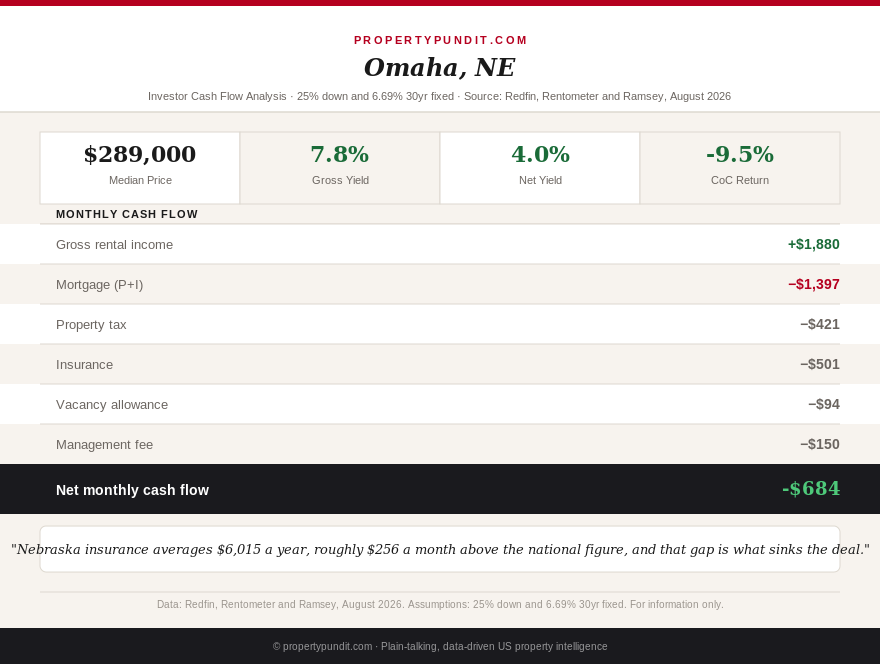
They had not. The average Nebraska homeowners policy now runs $6,015 a year, about $501 a month, against a national average of $2,948 (Ramsey Solutions state averages, 2026; Insurify national figure, March 2026). That $256-a-month gap versus the rest of the country is larger than the entire property tax cut on most Nebraska rentals. Nebraska gave with one hand and the hail took it back with the other, and almost nobody underwriting Nebraska deals has repriced the insurance line.
Here is the part that matters: at national-average insurance, an Omaha median rental would carry a debt service coverage ratio of 0.91. At Nebraska's actual insurance cost, it's 0.81. That single line item is worth a tenth of a point of DSCR, which is the difference between a lender saying "close, bring more down" and a lender saying no.
Get this in your inbox every Friday.
One email. The number that matters and what it means for you.
What Nebraska actually costs in August 2026
Start with the price, because Nebraska is a state where the sources disagree loudly. Redfin puts the statewide median at $308,400, and $320,000 across 7,235 closings over the trailing six months. Zillow's Home Value Index puts the statewide typical value at $276,477. That's an 11% to 16% spread depending on which pair you compare, and it's not a data error: Redfin measures closed sale prices, which are dominated by Omaha and Lincoln, while Zillow values the entire housing stock including thin western counties where almost nothing trades. We hit the same divergence pattern in Mississippi and Iowa, and the rule holds here: in a state with two dominant metros and 90 sparse counties, the closed-sale median describes the metros and the index describes the state.
At the metro level the numbers are firmer. Omaha closed at a median $289,000 over the three months ending June 2026, up 5.0% year over year, with homes going in around 14 days and averaging two offers (Redfin, June 2026). Lincoln closed at $302,000 over the three months ending May 2026, up just 0.6%, sitting 26 days on market against 18 a year earlier (Redfin, May 2026). Grand Island's most recent monthly median was $250,000. Omaha is genuinely tight; Lincoln has cooled to something close to flat. If you're shopping the state on a screen, that 5.0% versus 0.6% gap tells you the two markets are no longer moving together, and you should stop treating a Nebraska comp as a Nebraska comp.
The tax cut is real, and it's smaller than the headline
LB 34, passed in Nebraska's 2024 special session, took the school district property tax credit off the income tax return and put it straight onto the property tax statement, cutting school district taxes by 30% for every property owner. Relief under the act is set at a minimum of $808 million for tax year 2026, growing at least 3% a year (Nebraska Department of Revenue; Nebraska Legislature, LB 34). LB 34 also caps local property tax asking growth starting in fiscal 2026 at the greater of zero or an inflation measure, which slows the ratchet that made Nebraska bills notorious.
Two things investors get wrong about it. First, the credit is parcel-based, not owner-occupant-based: the Department of Revenue's guidance is that whoever paid the tax to the county treasurer claims it, expressly including a lessor and a pass-through entity, so your LLC-held rental gets the same treatment as the house next door. That puts Nebraska alongside Montana, where the 2026 reform we covered in the Montana spotlight extended the reduced homestead rate to qualifying long-term rentals rather than penalizing them. Second, only the school district slice qualifies. School bonds, voter-approved levy overrides and educational service units are excluded, so 30% off school taxes is meaningfully less than 30% off your bill.
Even after the credit, Douglas County's effective rate lands around 1.75%, with a median bill of $4,295 on a $245,800 home (propertytaxrates.org, 2026). Lancaster County runs about 1.66%, Sarpy about 1.69%. On a $289,000 Omaha rental that's roughly $421 a month in tax. So take the relief for what it's: a genuine improvement that still leaves Nebraska well above the national average effective rate. Budget the 1.7% you can see on the statement, not the pre-credit number and not a hopeful one.
The line item nobody underwrites
Insurance is where Nebraska deals die, and the trend is worse than the level. Insurify measured Nebraska premiums up 20% since 2023, with another 13% increase projected by the end of 2026, and a 25% average jump in the most recent single year (Insurify, via Grist and Flatwater Free Press, March 2026). On projected 2026 premiums Nebraska ranks as the fourth most expensive state in the country. Ramsey's 2026 state averages put the annual figure at $6,015, second only to Oklahoma. Those two sources use different methods and land in different places, so treat $6,015 as the planning number and get a bound quote before you go firm.
The physical reason is straightforward. Nebraska sits in Hail Alley. Lincoln and Omaha have both absorbed repeated damaging windstorms in the last five years, and the April 2024 tornado flattened homes in Elkhorn on Omaha's western edge. In March 2026 four large wildfires burned more than 824,000 acres in the western half of the state, including the Morrill Fire at 643,074 acres across five counties, the largest documented fire in Nebraska history.
The regulatory reason is the one investors miss. Nebraska lets insurers set premiums at market rates without needing prior approval from a state regulator, and there's no cap. Legislators ran two interim studies on rising premiums last year and produced no recommended legislation. Compare that with the property tax file, where the legislature moved $808 million. One of your two biggest fixed costs has an active political constituency and a relief act attached; the other has neither. Underwrite Nebraska assuming the insurance line keeps climbing double digits and the tax line doesn't fall again.
The four markets, priced honestly
Standard terms throughout: 25% down, 30-year fixed at 6.69% (Freddie Mac PMMS, August 6, 2026), county effective property tax rate, insurance at the $6,015 statewide average, 8% management and 5% vacancy against gross rent.
| Market | Median price | PITI | 3BR rent | Monthly cash flow | DSCR |
|---|---|---|---|---|---|
| Omaha (Douglas, 1.75%) | $289,000 | $2,320 | $1,880 | −$684 | 0.81 |
| Bellevue (Sarpy, 1.69%) | $273,244 | $2,207 | $1,800 | −$641 | 0.82 |
| Grand Island (~1.50%) | $250,000 | $2,022 | $1,650 | −$587 | 0.82 |
| Lincoln (Lancaster, 1.66%) | $302,000 | $2,379 | $1,714 | −$888 | 0.72 |
Rent sources: Omaha 3-bedroom $1,880 and Lincoln 3-bedroom $1,714 (Rentometer, 2026); Grand Island single-family median $1,650 (Rentometer, May 2026); Bellevue estimated at $1,800 for a 3-bedroom single-family, which is the softest figure in the table and the one to verify locally first. Grand Island's county rate is carried at the statewide approximation of 1.50% rather than a verified Hall County figure, so treat that row as directional.
Nothing here clears DSCR 1.0, which is the floor most DSCR lenders will write to at all, let alone the 1.25 that gets you the good pricing. Read our DSCR loan guide if that threshold is new to you. Lincoln is the standout failure: it costs $13,000 more than Omaha and rents for $166 a month less, which is what happens when a university and state-government town's prices keep pace with a metro whose rents don't. If you're choosing between the two Nebraska metros on cash flow, Omaha wins on every line, and it is not close.
Where the state does work
Two situations pencil, and neither is the median.
The first is east Omaha under $200,000. Our earlier Nebraska modeling put a $190,000 Omaha property at roughly breakeven after management and vacancy, and that still holds directionally at 6.69%, though the insurance repricing pushes true breakeven closer to $175,000 than $190,000. The catch is stock quality: sub-$175,000 Omaha means older roofs, and an older roof in Hail Alley is exactly what carriers now price punitively or decline outright. Get the roof age before you get the inspection.
The second is Bellevue and the Offutt corridor in Sarpy County. Offutt Air Force Base and US Strategic Command anchor more than 10,000 military and civilian personnel, and Basic Allowance for Housing gives you a tenant pool whose rent is federally indexed rather than tied to local wage growth. That doesn't fix the cash flow, but it does fix the vacancy assumption, which is worth more than it looks on a spreadsheet built for a market with real tenant turnover risk. If your thesis is durability of occupancy rather than monthly yield, Sarpy is the only Nebraska submarket that supports it.
The wider employer base is genuinely strong, and it's why Omaha keeps appreciating at 5% with 14 days on market. Berkshire Hathaway, Union Pacific, Mutual of Omaha and Kiewit are all headquartered there. Nebraska's top individual income tax rate also fell to 4.55% for 2026 and is scheduled to reach a 3.99% flat rate in 2027 (Office of Governor Jim Pillen; LB 754). For a leveraged rental with depreciation, the income tax line is usually near zero anyway, so this matters more on your exit and on any non-passive Nebraska income than it does on monthly cash flow.
The call
Frankly, if you're buying Nebraska for cash flow in August 2026, the math points the other way. A negative $587 a month in the least bad market isn't a rounding error you cover with a rent bump; it's $7,044 a year of your own money going in, on an asset appreciating 5% in one metro and 0.6% in the other. Most people who run these numbers with the real insurance figure end up either dropping the price target to sub-$175,000 or moving the search to a state where the tax and insurance stack isn't doing this much damage. Our county-level yield map shows where the same $289,000 buys a positive number, and the Missouri spotlight two states south is the nearest market where a metro core still clears breakeven.
Nebraska is a hold-for-appreciation state with an unusually good employment base and an unusually bad weather-cost profile. That's a legitimate thesis. Just don't tell yourself it's a cash flow thesis, and don't build the model on a $150-a-month insurance assumption you carried over from Indiana. Pull one real quote on one real address before you do anything else; in this state it will move your answer more than the rate will.