 Property
You're a Nashville renter on $112,000 a year, and the 7.03% mortgage rate has you scanning Midwest cities where a house still costs under $300,000. Louisville and Omaha look like twins: Redfin puts the typical sale price at $295,000 in one and $289,000 in the other. Omaha is cheaper by $6,000, so you lean toward it before you've priced a single bill. Then you add property tax and insurance, and the cheaper city costs $246 more every month.
Here's the full monthly breakdown for the median home in each city, and the two line items that flip the result. It's the same trap we found when insurance decided Kansas City versus Omaha, only this time property tax joins it.
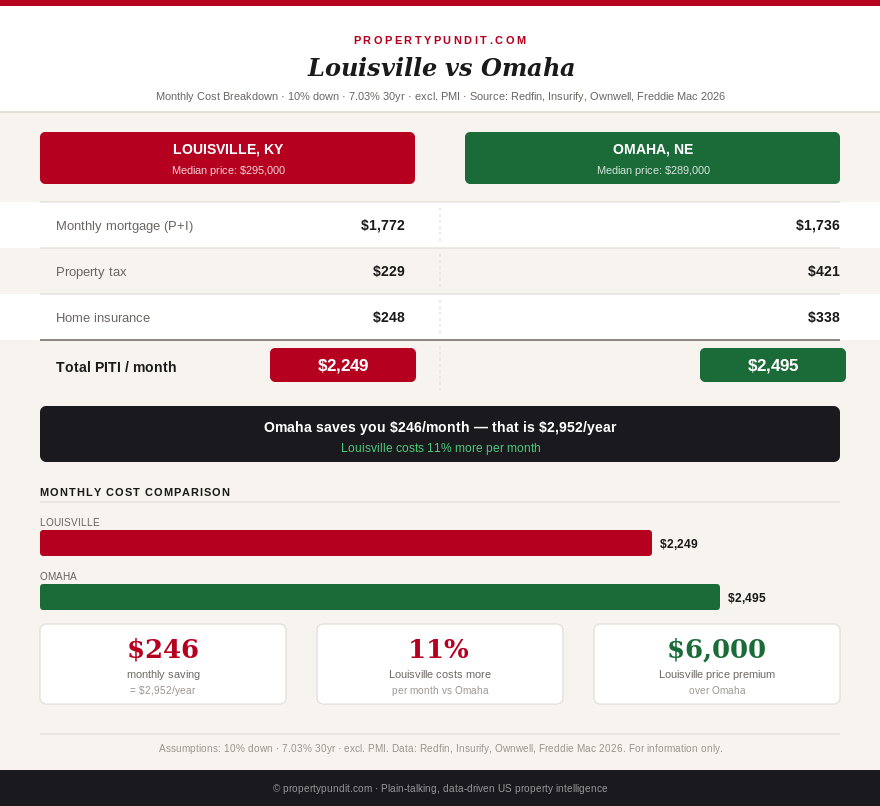
The sticker price barely separates them
Louisville's median sale price was $295,000 in May 2026, up 2.5% year over year (Redfin, Greater Louisville). Omaha's was $289,000 for the three months ending June 2026, up 5.0% (Redfin). Both are spring readings from the same source, which keeps the comparison fair. A newer Louisville MLS report shows $290,000 in August, up 9.4% (The Morning Bergeron, September 2026), so the two sources disagree on Louisville's growth. I use the Redfin figure and flag the gap, and the conclusion below survives either number.
At 10% down and Freddie Mac's 7.03% rate (September 24, 2026), the loans are $265,500 and $260,100. Principal and interest come to $1,772 in Louisville and $1,736 in Omaha. Omaha saves $36 a month on the mortgage. If you stop here, Omaha wins, and plenty of buyers do stop here. Don't, because the next two lines change the answer.
Property tax and insurance flip it
Jefferson County, which holds Louisville, carries an effective property tax rate around 0.93%. Douglas County, which holds Omaha, runs about 1.75% (Ownwell and PropertyTaxRates.org, 2026). On these two prices, that's about $229 a month in Louisville and $421 in Omaha. That's $192 a month, more than five times Omaha's $36 mortgage advantage.
Insurance adds more. Insurify's 2026 quotes for a $300,000 dwelling with a $1,000 deductible are $2,973 a year in Louisville and $4,056 in Omaha. That's $248 versus $338 a month. Nebraska ranks fifth in the nation for homeowners insurance rate increases, with premiums up 35% between 2021 and 2024 (Insurify). Hail and wind are driving that, according to the same source.
| Monthly cost (10% down, 7.03%) | Louisville, KY | Omaha, NE |
|---|---|---|
| Median price | $295,000 | $289,000 |
| Loan amount | $265,500 | $260,100 |
| Principal and interest | $1,772 | $1,736 |
| Property tax | $229 (0.93%) | $421 (1.75%) |
| Homeowners insurance | $248 | $338 |
| Principal, interest, tax, insurance | $2,249 | $2,495 |
| Mortgage insurance (0.95% a year) | $210 | $206 |
| All-in monthly cost | $2,459 | $2,701 |
| Income needed at 28% of gross | $105,400 | $115,800 |
Omaha's cheaper sticker price is erased and then some: $246 more a month for principal, interest, tax, and insurance, or about $2,950 a year. Mortgage insurance is a wash, which trims the all-in gap to $242. What this means for you: when you compare two cities, compare the monthly total, not the price tag.
Get this in your inbox every Friday.
One email. The number that matters and what it means for you.
Which city fits a $112,000 income
A common lender rule of thumb caps housing costs at 28% of gross income. On $112,000 that's $2,613 a month. Louisville's all-in $2,459 fits with about $154 of room. Omaha's $2,701 overshoots by $88. Lenders will often stretch past 28% if the rest of your debts are light, so Omaha isn't impossible, but it starts you with no cushion for repairs or a premium increase at renewal.
The mortgage insurance line assumes a 0.95% annual rate, a typical figure for a credit score between 700 and 719 (a rate we used in our FHA versus conventional comparison). A higher score lowers it and a lower score raises it, and the cities differ by only $4 on that line, so your score won't change the ranking.
What Omaha buyers get for the extra $2,950 a year
Omaha's case rests on growth and speed. Redfin shows Omaha prices up 5.0% against 2.5% in Louisville, which on these medians would be about $14,450 versus $7,375 in a year. That's a real argument if the trend holds, and the extra carrying cost of roughly $2,950 would be more than covered. The problem is the Louisville MLS figure above, which shows the opposite, and a single year of price growth isn't a forecast for either city.
Supply points the other way. Louisville's inventory is loosening: 2.92 months of supply in August, up from 2.30 a year earlier, with active single-family listings up 32.1% to 2,536 (The Morning Bergeron, September 2026). Omaha ran 1.3 months of supply with 22 days on market (Houzeo, an undated 2026 snapshot, so treat it as directional). Louisville gives a buyer more negotiating room. As an illustration, a 3% price cut on Louisville's $295,000 median saves about $67 a month across principal, interest, tax, and mortgage insurance, bringing the all-in cost to roughly $2,392. In Omaha's tighter market, a 3% cut is likely a harder ask, so negotiate in Louisville before you pay for growth in Omaha.
Would a lower rate close the gap?
No. At 6.00%, Louisville's principal, interest, tax, and insurance fall to about $2,068 and Omaha's to about $2,319, so the gap stays at roughly $250 (it actually widens by a few dollars). A full point of rate relief saves about $180 a month in either city, because the difference between them comes from tax and insurance, which your lender doesn't control. If you're waiting for rates to fall so Omaha pencils, the wait won't fix it.
What would? A lower price or a lower tax bill. Omaha's median would need to drop to about $259,000, roughly $36,000 or 12% below Louisville's, for the all-in monthly cost to match. Nebraska's LB 34 credit also cuts school district property taxes by 30% for most owners (Nebraska Department of Revenue guidance, 2026), so your actual Omaha bill could land below the 1.75% county figure. Get the real bill for the address before you let that credit tilt your decision. Even at 1.5%, the all-in cost is $2,641, still $182 above Louisville's $2,459.
What this means for you
On a $112,000 income, Louisville is the better buy on monthly cost. It fits under a 28% housing ratio, it carries lower tax and insurance, and its rising inventory gives you room to negotiate. Choose Omaha only if you've got a job there, you plan to stay at least seven years, and you've got an extra $250 a month of slack. Before you commit to either city, get a written insurance quote on the specific address and ask the county for the actual tax bill, because both numbers here are citywide averages. Then ask your lender for a Loan Estimate that shows all four lines together.