 Property
You're an investor with a couple of rentals already, and someone told you Great Falls was the one place in Montana where a rental still paid. They were right in August: this site found exactly one combination that cleared zero, a house under $260,000 netting +$56 a month. At the October 8 Freddie Mac rate of 7.40%, with a maintenance reserve and a realistic insurance bill, that same house loses $537 a month.
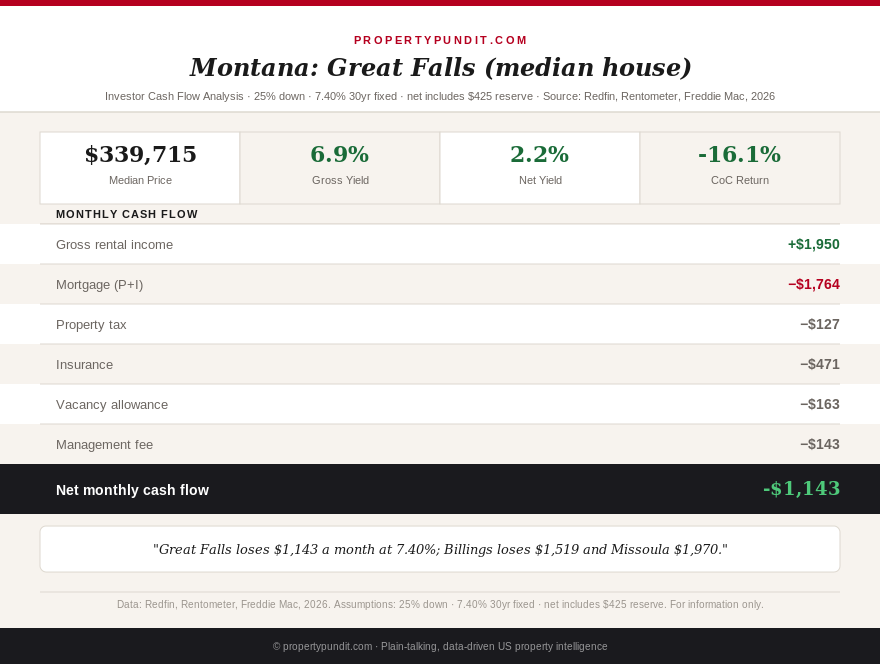
Move up to the Great Falls median house and the loss is $1,143 a month. Billings loses $1,519 and Missoula $1,970 on a 25% down payment. This is the third Montana pass of the year, and no market in the state now pays for itself on cash flow.
The numbers use the same method as the recent state passes: 25% down, a 30-year fixed at 7.40% (Freddie Mac, October 8, 2026), the Montana tier property tax rate, 8% management, one month of vacancy a year, and a 1.5% annual maintenance reserve.
Get this in your inbox every Friday.
One email. The number that matters and what it means for you.
Montana cash flow at 7.40%, market by market
| Market | Price | Rent | Full payment | Net cash flow | Coverage | Break-even rent |
|---|---|---|---|---|---|---|
| Billings | $389,900 | $2,016 | $2,731 | -$1,519 | 0.74 | $3,817 |
| Missoula | $525,000 | $2,660 | $3,557 | -$1,970 | 0.75 | $4,997 |
| Great Falls (median) | $339,715 | $1,950 | $2,363 | -$1,143 | 0.83 | $3,305 |
| Great Falls ($260,000 entry house) | $260,000 | $1,950 | $1,857 | -$537 | 1.05 | $2,587 |
Prices are Redfin median sale prices: Billings $389,900 (three months ending August 2026, up 0.6% year over year), Missoula $525,000 (three months ending August 2026, down 10.3%), and Great Falls $339,715 (June 2026, flat; that is the latest month Redfin's page showed for the city). The $260,000 entry house is the price point from the August pass, not a listing. Rents are Rentometer three-bedroom averages: Billings $2,016 for all property types (October 14, 2026), Missoula $2,660 for single-family houses (May 13, 2026), and Great Falls $1,950 for single-family houses (February 10, 2026). "Full payment" means principal, interest, property tax and insurance; "coverage" is rent divided by that payment.
The entry house shows the trap. Its coverage of 1.05 clears the 1.0 line some lenders want, yet it still loses $537 a month once management, vacancy and the maintenance reserve come out. Compare the same test on a Missouri rental and you get the same lesson. Your takeaway: underwrite net cash flow, not coverage.
Why the profitable combination turned negative
Re-running August's Great Falls entry house through today's method, before any market changes, costs $238 before any market change, which takes the published +$56 to -$182. Three more changes took it to -$537:
| Step | Great Falls $260K entry | Great Falls median | Billings | Missoula |
|---|---|---|---|---|
| August result as published | +$56 | -$54 | -$654 | -$1,124 |
| Today's method (reserve, management, vacancy) | -$238 | -$440 | -$562 | -$721 |
| Rate 6.69% to 7.40% | -$93 | -$109 | -$144 | -$188 |
| New price | $0 | -$252 | +$93 | $0 |
| New rent | +$28 | +$28 | +$140 | +$436 |
| Insurance re-sourced | -$290 | -$316 | -$391 | -$373 |
| October result | -$537 | -$1,143 | -$1,519 | -$1,970 |
Two of those steps are method, not market. August's pass took an "effective rent" haircut of 12.5% and no separate maintenance line; today's method adds a 1.5% reserve, which costs $325 a month on the entry house and $425 on the median Great Falls house. The rate move cost another $93 to $188. The price step for the Great Falls median is partly a change of yardstick: August used a Zillow typical-home value of $305,137, while this pass uses Redfin's median sale price of $339,715, which is what a buyer closing this month would meet. For you, the method change and the insurance re-sourcing explain most of the swing, so a deal that looked fine on the August method deserves a fresh underwrite before you act on it.
Insurance is the biggest swing: $184 became $570 in Billings
August's pass assumed insurance at 0.55% of the home's value a year, which was $184 a month on a Billings house. This pass re-sources it. MoneyGeek (rates updated October 13, 2026) puts the Montana average at $4,814 a year for a $250,000 dwelling policy and Billings at $5,375, or $448 a month. Montana carriers have been repricing for wildfire and hail; Insurify reported an 18% rise in Montana home insurance costs in 2025.
MoneyGeek lists no Missoula or Great Falls figure, so I scaled its statewide coverage tiers ($7,161 at $500,000 and $9,201 at $750,000) to each purchase price, and multiplied Billings by its 1.12 premium to the state average. That produces $570 a month in Billings, $614 in Missoula and $471 in Great Falls (and $409 on the $260,000 entry house). Treating the purchase price as the dwelling coverage overstates the premium, because land isn't insured, and these are homeowner averages rather than landlord (DP-3) quotes.
Test it: if a real landlord quote comes in 30% lower, the results improve by $171 in Billings, $184 in Missoula and $141 in Great Falls. Billings would still lose $1,348. The message for you is that insurance is the input most worth shopping, and it still can't rescue a median-priced Montana house at 7.40%.
The tax break a landlord can lose by missing March 1
Montana's tier system is the state's best feature for rental owners. A residence rented for periods of 28 days or more, for at least seven months of the year, can qualify for the homestead rates (Missoula Current and a September 2026 Montana tax guide): 0.76% of value up to $378,000, 0.90% on value from $378,000 to $756,000, and 1.90% flat for property that doesn't qualify (Montana's 2026 tier thresholds are set against the $378,000 residential median). Those percentages convert market value to taxable value; the local mill levy then applies on top. I used levies carried from the August pass: about 550 mills for Billings, 622 for Missoula and 592 for Great Falls.
The catch is the calendar. The application window for 2026 closed March 1, and the guide notes landlords get no appeal fallback the way owner-occupants do. Here is what a missed filing costs in this table:
| Market | Monthly tax with homestead rate | Monthly tax at 1.90% flat | Extra per month |
|---|---|---|---|
| Billings | $137 | $340 | +$203 |
| Missoula | $217 | $517 | +$300 |
| Great Falls | $127 | $318 | +$191 |
A short-term rental never qualifies, so a vacation-rental strategy pays the 1.90% rate from day one. Before you underwrite any Montana parcel, ask the seller for the classification on the actual tax bill. Listings that quote last year's taxes describe a system that no longer exists, a point the August Montana pass flagged. Your takeaway: confirm enrollment on the parcel, because a $200 to $300 monthly error moves a deal from bad to worse.
Missoula: prices fell 10.3% and the loss is still the largest
Missoula's median sale price of $525,000 is down 10.3% from a year earlier (Redfin, three months ending August 2026). Homes took 62 days to sell against 54 a year ago, and 289 sold in August, up 5.9%. That is a market where sellers are giving ground, and the cash flow is still -$1,970 a month, or $23,646 a year, on a $131,250 down payment.
The reason is arithmetic. A $525,000 purchase carries a $3,557 monthly payment, and a three-bedroom house rents for about $2,660. To break even you'd need rent of $4,997, or a price near $267,400, roughly 49% below today's median. A 10% price drop doesn't come close to closing that gap. If you're watching Missoula for a bargain, the price to wait for is around half the current one, so don't hold your breath.
What Montana's statewide numbers hide
Statewide, the median sale price is $518,211, up 0.7% year over year, with 1,042 homes sold (up 5.6%) and a median 83 days on market (Redfin, September 2026). Redfin's state page lists 8,437 homes for sale. Those figures blend Big Sky and Whitefish resort property with Great Falls, where a median house costs about $340,000. The three markets in this article behave differently: Billings sells in 60 days (down from 63 a year ago, Redfin August 2026), Missoula in 62 (up from 54), and Great Falls took 52 days in June, nine more than a year earlier.
Great Falls is the thinnest of the three, and its Redfin figures are the oldest, so treat its price as the least certain input. For you, the statewide median says almost nothing about any one deal; underwrite the city, then the street.
Can appreciation cover the loss?
Here's the generous test. Take the latest year-over-year change in each city's median price, apply it to the purchase price for a year, and add the principal you pay down in month one:
| Market | Cash flow | Price change per month | Principal paid per month | Total return per month |
|---|---|---|---|---|
| Billings (+0.6%) | -$1,519 | +$195 | +$221 | -$1,103 |
| Missoula (-10.3%) | -$1,970 | -$4,506 | +$298 | -$6,178 |
| Great Falls (0.0%) | -$1,143 | $0 | +$193 | -$950 |
No market passes. Median prices mix what happened to sell, so they aren't a repeat-sale index, and Missoula's figure shows the risk of a thin market rather than a forecast for any one house. Even the best case here, Great Falls, loses $950 a month after counting principal, and the table ignores the 6% to 8% cost of selling. If your reserves are already committed to two properties, a third with negative carry is a position you fund out of pocket.
What this means for you
My call: at 7.40%, skip Montana as a cash-flow play. If you want exposure anyway, the only combination worth tracking is a Great Falls house priced near $192,000 or lower, which is where the median-rent math breaks even; the $260,000 entry house would need rent of $2,587, about 33% above the $1,950 used here. At $537 a month, you'd be pre-funding $6,444 a year before repairs beyond the 1.5% allowance.
Two things can narrow the gap. Seller credits toward a rate buydown cost the seller less than a price cut and improve your monthly figure directly. And a real DP-3 landlord insurance quote, plus written proof of homestead-rate enrollment, replaces the two inputs here that move results by hundreds of dollars. Compare the lender side too, using the DSCR loan guide and the county yield map, before you spend money on an inspection. For a state with better landlord math on paper, see the Mississippi pass, which has its own problems.
What I couldn't verify
Five inputs are carried, estimated or dated, and a firm underwriting number should replace each. The mill levies (550, 622 and 592) are carried from the August pass rather than read off a current tax bill. Insurance is scaled from MoneyGeek averages, not landlord quotes. The Billings rent covers all property types, and Rentometer's own text puts larger homes at $2,100 to $2,400, so Billings may be understated by up to $384 a month (which would still leave it at -$1,195). Missoula's rent is from May and Great Falls' from February. Great Falls prices are Redfin's June figure. Redfin's sale-to-list ratios were inconsistent across these pages, so I left them out.
Frequently asked questions
Is Montana a good state for rental investors in 2026?
Not on cash flow. At 7.40%, the Great Falls median house loses $1,143 a month, Billings $1,519 and Missoula $1,970 on 25% down. The state has no sales tax and offers a lower property tax rate to long-term rentals, but neither closes the gap.
Which Montana city has the best rental cash flow?
Great Falls is the least negative, with rent coverage of 0.83 at the median price and 1.05 on a $260,000 entry house. Even the entry house loses $537 a month after management, vacancy and a 1.5% maintenance reserve. It was +$56 in August before the rate, reserve and insurance changes.
Do Montana landlords get the lower property tax rate?
Long-term rentals can. A home rented for periods of 28 days or more, for at least seven months a year, can qualify for the homestead tier rates, but the 2026 application window closed March 1 and landlords have no appeal fallback. A property that misses it is taxed on 1.90% of its value before the mill levy, which adds about $190 to $300 a month in these three cities.
What rent do I need to break even on a Billings rental?
About $3,817 a month on a $389,900 house with 25% down at 7.40%, versus the $2,016 used here. At today's rent, the purchase price would need to be near $194,900, about 50% below the median.