 Property
You've watched the daily rate sheet all week, and on Wednesday it finally printed a number that starts with 7.2 instead of 7.3 or 7.4. Now you're deciding whether that's a reason to call a lender or just another dip before the next climb. The honest answer is that the dip is real and small: Mortgage News Daily's 30-year index fell 0.08 points on November 4 to 7.22%, the first reading below 7.25% since September 22 (Mortgage News Daily, November 4, 2026).
Freddie Mac's weekly survey is the benchmark, and its latest published figure is still October 29's 7.24%. The next reading is due at noon Eastern today, so treat everything below as the picture going into that release, not after it.
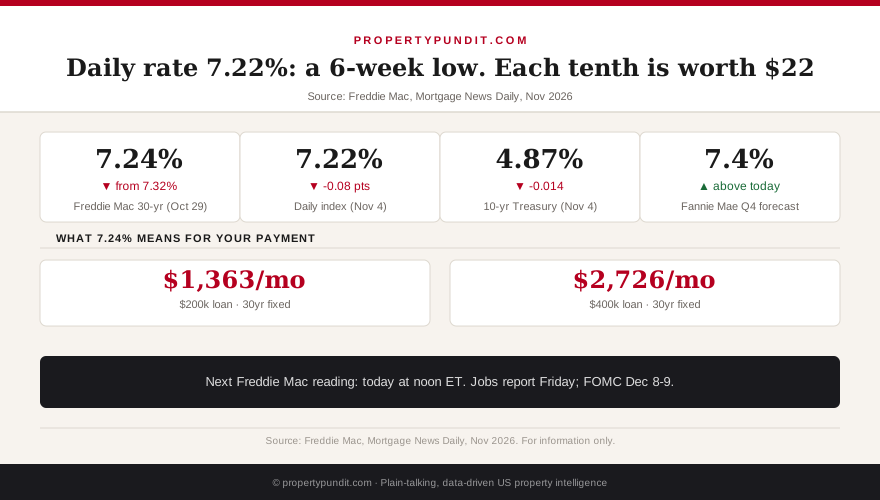
Four gauges, one tight range
Different trackers measure different things, and this week they're bunched within a few hundredths of a point. That's useful, because it means you can stop arguing about which number is "right" and focus on what the level costs.
| Gauge | 30-year rate | Date | What it measures |
|---|---|---|---|
| Freddie Mac PMMS | 7.24% | Oct. 29 | Weekly survey average, the official benchmark |
| Mortgage News Daily index | 7.22% | Nov. 4 | Daily composite of lender pricing |
| The Mortgage Reports daily average | 7.229% | Nov. 4, 8:32 a.m. ET | Conventional 30-year from partner lenders |
| 10-year Treasury yield | 4.87% | Nov. 4 (MND) | The bond mortgage rates tend to follow |
The weekly survey ran from 7.32% to 7.24% the prior week and sits well above the 6.17% of a year ago (Freddie Mac PMMS, October 29, 2026). The 15-year fixed was 6.60%. Mortgage News Daily credited the latest drop to election uncertainty clearing, trouble in a group of AI-infrastructure tech stocks and a sharp drop in fuel prices. Oil fell to $94.43 from $97.20 in The Mortgage Reports' market table.
The gap between the weekly 7.24% and the daily 7.22% is worth $5 a month on a $320,000 loan, which means the choice of gauge matters far less than the decision about when to commit. So if you're quoting yourself a payment, use 7.25% as a round planning number and stop there.
What a tenth, a quarter and a half point cost
Take a $320,000 loan, which is a $400,000 home with 20% down. Principal and interest on a 30-year fixed at 7.24% is $2,181 a month. The table shows how far a move in either direction changes that payment.
| 30-year rate | Monthly principal and interest | Change vs. 7.24% | Change per year |
|---|---|---|---|
| 7.74% | $2,290 | +$109 | +$1308 |
| 7.50% | $2,237 | +$56 | +$672 |
| 7.24% (Freddie Mac, Oct. 29) | $2,181 | baseline | baseline |
| 7.22% (daily index, Nov. 4) | $2,176 | -$5 | -$60 |
| 7.00% | $2,129 | -$52 | -$624 |
| 6.75% | $2,076 | -$105 | -$1260 |
Each 0.10 point moves the payment by about $22 on this loan. A quarter-point swing is roughly $55 a month, and the half-point drop that buyers keep hoping for is worth $105, which is the same math we ran in our look at how a half-point drop saves only $105 a month. Rates near 6.75% would take a long slide from here: the 30-year average was 5.98% in late February and has climbed 1.26 points since (Freddie Mac, as summarized by Meridian Macro Weekly, November 2026).
That means the weekly survey's slide from 7.32% to 7.24% is worth about $17 a month on this loan, so don't restructure a purchase around it.
Why the dip may not hold
Three things stand between you and a sustained slide. First, the Federal Reserve held its target range at 3.75% to 4% on October 28 by a 10-2 vote, and both dissenters wanted a quarter-point hike (Federal Reserve, October 28, 2026; see our breakdown of the two hike dissents). The next meeting is December 8 to 9. One macro newsletter reads the 3-month Treasury bill yield of 4.21% as consistent with markets pricing in at least one more hike inside three months (Meridian Macro Weekly, November 3, 2026). That's an interpretation, not a probability, but it points the same way as the dissents.
Second, Friday's jobs report lands at 8:30 a.m. Eastern (calendar per The Mortgage Reports). A strong print has tended to push yields up and mortgage quotes with them, so the week's good news can disappear in a morning.
Third, the professional forecasters aren't betting on relief. Fannie Mae's October 12 forecast has the 30-year at 7.4% for the fourth quarter and 7.5% in the first quarter of 2027, while the Mortgage Bankers Association's October 11 forecast has 7.3% and then 7.2% (as tabulated by The Mortgage Reports, November 4, 2026). Both sit at or above today's level. Cotality chief economist Selma Hepp put the squeeze plainly: affordability remains trapped, with rates easing only gradually while prices stay elevated on limited supply.
If you were hoping this week signals the start of a slide, the forecasts say plan for rates that look like today's, not for a drop.
Get this in your inbox every Friday.
One email. The number that matters and what it means for you.
Lock, float or sit still: the call
The math points toward a simple rule. If you have a signed purchase contract and the payment at roughly 7.25% fits your budget, lock it. Waiting for 7.00% means betting on another 0.22-point drop before Friday's data, December's meeting or a bad inflation report pushes the other way. A quarter-point rise costs about $55 a month on $320,000 and a quarter-point fall saves about the same, but the forecasts and the hike dissents tilt the odds toward the first. Our guide to locking versus floating a rate covers the lock periods and float-down options worth asking your lender about.
If you're still months from making an offer, do nothing today. A 0.02 point daily move is noise, and the useful work is tightening the budget so a 7.5% quote still fits. And if you hold a mortgage near 3.8%, nothing in this week's numbers gives you a reason to refinance; the real cost of leaving that loan is the one we put at $647 a month on a $300,000 balance in our piece on pending home sales hitting a record low.
Frankly, if you're buying within 60 days, lock the rate you can afford and move on; if you're not, the best use of this week is running your own payment at 7.50% and seeing whether you still sleep.
Frequently asked questions
What is the 30-year mortgage rate today? Freddie Mac's latest weekly average, published October 29, 2026, is 7.24%. Mortgage News Daily's daily index was 7.22% on November 4, 2026. Freddie Mac publishes its next reading Thursday, November 5.
How much does a 0.10 point change in mortgage rate cost per month? About $22 a month on a $320,000 30-year loan. A quarter point is roughly $55 a month and a half point is about $105.
Will mortgage rates fall in the rest of 2026? Forecasters expect little relief. Fannie Mae projects 7.4% for the fourth quarter and the Mortgage Bankers Association projects 7.3%, both from October forecasts.
Should I lock my mortgage rate now? If you have a signed contract and the payment at about 7.25% fits your budget, yes. Waiting for a lower rate risks a quarter-point rise costing about $55 a month on $320,000.