 Property
You've got a closing in a few weeks, or a rate quote sitting in your inbox, and yesterday's Fed decision made it harder to decide whether to lock. The Fed held steady, which sounds calm. Two of its voters wanted to raise rates instead, which doesn't. Here's what that does to your monthly payment, in dollars.
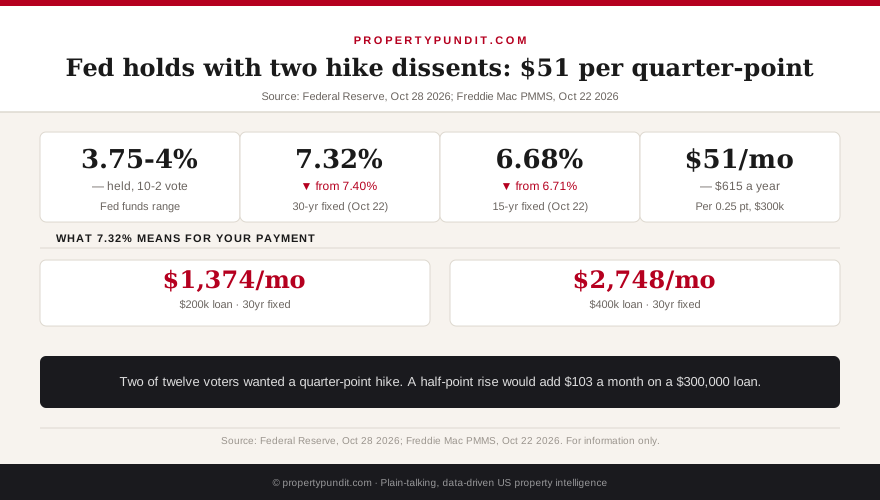
The Federal Reserve kept its target range at 3.75% to 4% on October 28, 2026, by a 10-2 vote. Lisa Cook and Beth Hammack dissented, preferring a quarter-point increase, and the statement said inflation "remains elevated" (Federal Reserve, October 28, 2026). The latest published mortgage figure is Freddie Mac's 7.32% 30-year for the week ending October 22, down from 7.40% and up from 6.19% a year earlier (Freddie Mac PMMS, October 22, 2026). Freddie Mac's October 29 survey publishes midday, after this article went up, so check it before you act.
Get this in your inbox every Friday.
One email. The number that matters and what it means for you.
What the Fed did, and why your rate may not care
Your 30-year mortgage rate follows long-term Treasury yields and investor demand for mortgage bonds, not the Fed's overnight rate directly. That's why a Fed hold doesn't hand you a lower quote. A hold with two votes for a hike matters less for the funds rate than for what it says about the next meeting: before the decision, markets put the chance of a hike at this meeting below 20%, and a survey of 100 economists expected one in December (Reuters and Bloomberg, October 2026). Two votes for it on the day suggest the committee is closer to acting than that pricing implied.
For you, that means the risk this week is a rate that stays high or edges up, and a cut that helps your payment before spring is not something the Fed gave you yesterday.
The payment math: $51 a month per quarter-point
Dollars matter more than percentages when you're deciding to lock. Here is what a quarter-point either way does to principal and interest on a 30-year fixed loan.
| 30-year rate | $300,000 loan | $400,000 loan |
|---|---|---|
| 7.07% (quarter-point lower) | $2,010 | $2,680 |
| 7.32% (Freddie Mac, October 22) | $2,061 | $2,748 |
| 7.57% (quarter-point higher) | $2,112 | $2,816 |
| 7.82% (half-point higher) | $2,164 | $2,885 |
Each quarter-point is $51 a month on $300,000, which is $615 a year and about $18,400 over 30 years if you keep the loan. A half-point against you is $103 a month. Those amounts are real, and they're also small next to the $663 gap between a new 7.32% loan and a 3.8% loan on the same $300,000 ($2,061 against $1,398).
So if your budget has $100 of slack, a half-point move won't break you, and if it doesn't, lock now.
Lock or wait: what the dissents change
The standard advice is to lock when a higher rate would hurt you more than a lower rate would help. Yesterday's vote tilts that toward locking, because the two dissents point to a harder committee, not a softer one. Waiting is a bet that rates fall before your closing date, and the information from the Fed this week was that they might not.
There's also the refinance escape hatch, and it's narrower than most people assume. Assume 2.5% closing costs on $300,000, or $7,500. A quarter-point drop saves $51 a month, so the refinance takes about 148 months, over 12 years, to pay back. A half-point drop to 6.82% saves $101 a month and pays back in about 74 months. The refi break-even math shows that you shouldn't count on refinancing to rescue a rate you could have avoided, and the half-point drop analysis runs the same test on a $312,300 loan.
The math points toward locking if you're closing within 60 days and your payment is already near your limit, because the upside from waiting is small and the downside lands on you.
A worked example: a $400,000 loan closing in 30 days
Say you're buying with a $400,000 loan and a quote of 7.32%. Your principal and interest is $2,748. If you float and the rate rises a quarter-point by closing, it becomes $2,816, which is $68 more a month and $816 more a year. If you float and it falls a quarter-point, you pay $2,680 and save the same amount. The odds on any one week are close to even, but the cost of being wrong isn't symmetric: a higher payment can push your debt-to-income ratio past a lender's limit and cancel the loan, while a lower one only makes you feel good.
That asymmetry is the practical reason to lock. A lender qualifies you at a particular payment, and a surprise of $68 or $136 a month is the type of gap that costs buyers a deal in the last week.
So if your approval was tight to begin with, that means lock today and put the saved worry toward your cash to close.
If you already hold a 3.8% loan
Nothing here gives you a reason to act. A new loan at 7.32% on $300,000 costs $663 more a month than your 3.8% loan would, and that gap would widen to $714 at 7.57%. A hike makes your old loan more valuable, not less, which is why a 3.8% mortgage is worth keeping unless a move is forced on you.
Frankly, if you're a homeowner thinking about selling to buy something bigger, price the new payment against the old one first, because most people who run these numbers end up renting the old house out or staying put.
What to watch before next Thursday
Check Freddie Mac's October 29 reading first. A fall below 7.32% would be a second weekly drop after the 7.40% reading. Then watch the 10-year Treasury yield through the week, since that moves mortgage bonds faster than any Fed statement. If your lender will lock for 45 to 60 days, ask what extending the lock costs, because that is the real price of waiting. For a closing-day cost check, the closing costs explainer lists what to expect.
The practical answer for you is to decide your maximum comfortable payment today, lock when a quote falls inside it, and stop reading rate headlines after that.
Frequently asked questions
What did the Fed do on October 28, 2026? The Federal Reserve kept its federal funds target range at 3.75% to 4% by a 10-2 vote. Lisa Cook and Beth Hammack dissented, preferring a quarter-point increase (Federal Reserve, October 28, 2026).
Will mortgage rates go up after the Fed meeting? Mortgage rates follow long-term Treasury yields, not the Fed's overnight rate directly. Freddie Mac's latest published 30-year rate is 7.32% (October 22, 2026), and the October 29 survey publishes midday.
How much does a quarter-point rate change cost per month? On a $300,000 30-year loan, each quarter-point is about $51 a month in principal and interest. On $400,000 it is about $68.
Should I lock my mortgage rate now? If you're closing within 60 days and your payment is already near your limit, the math points toward locking: a quarter-point rise costs $51 a month on $300,000, and a refinance after a small drop takes years to pay back.