 Property
You checked your rate quote this morning and it said 6.7%. Then you opened a housing news alert that said mortgage rates are at 6.55%. You didn't misread either number. You're staring at two different, both "official," weekly mortgage rate surveys that currently disagree by 14 basis points, and if you're trying to decide whether to lock a rate this week, that gap is not a rounding error. It's the difference between a plan and a guess.
Here's what's actually happening, why it's happening again this month, and which number should drive your decision if you have a closing date on the calendar.
Two official surveys, two different numbers
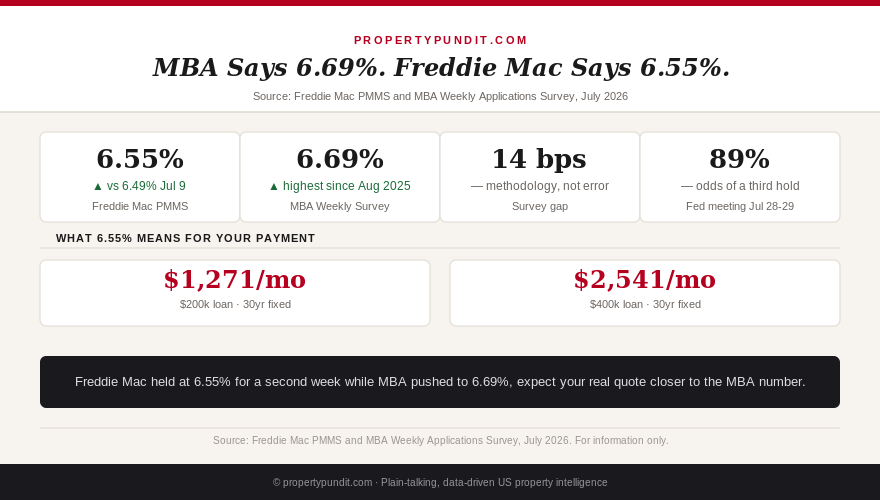
Freddie Mac's Primary Mortgage Market Survey (PMMS) is the number you see in most headlines. It's built from Freddie Mac's own Loan Product Advisor system, which pulls rate-lock data from lenders across the country from Thursday through the following Wednesday, then publishes the average every Thursday at noon ET. As of the July 16, 2026 reading, the 30-year fixed averaged 6.55%, up from 6.49% the week before. The 15-year fixed sits at 5.93%.
The Mortgage Bankers Association runs a separate weekly survey covering roughly 75% of the retail mortgage market, sampled through Friday rather than Wednesday. For the week ending July 17, 2026, the MBA's average 30-year conforming contract rate hit 6.69%, the highest reading since August 2025. That's not a typo, and it's not the same number restated. It's a different, wider sample measured over a different window. Two authoritative sources measuring two different things is exactly why the gap feels so disorienting if you don't know both exist.
If you're comparing quotes from three lenders this week and none of them match the number in the headline, this is why: the headline number was already a week old the moment it published, and it was never measuring the same lenders your loan officer is calling.
Get this in your inbox every Friday.
One email. The number that matters and what it means for you.
Why the gap keeps widening
This isn't the first time the two surveys have split this month. On July 16, the same pattern showed up at a smaller scale: MBA at 6.65% versus PMMS at 6.49%, a 16-basis-point gap. This week it's 6.69% versus 6.55%, a 14-basis-point gap that's essentially holding rather than closing. The driver both times is the same: renewed Iran-related oil price volatility pushing Treasury yields higher through the week, which the MBA's Friday-inclusive window captures more of than Freddie Mac's Wednesday cutoff does. This is a geopolitical rate move, not a Fed policy shift or a reaction to new inflation data. The Fed hasn't cut, and the next FOMC meeting on July 28-29 is priced at an 89% probability of a third straight hold, per CME FedWatch as of July 22.
Purchase applications actually rose 6% week over week even with the higher rate, per the MBA's July 22 release, while refinance applications slipped 2%. That tells you buyers aren't waiting for a number to feel "right" before they act. They're locking into whatever the market gives them, because a $440,600 median-priced home doesn't get cheaper while you wait for two surveys to agree.
What the 14-basis-point gap actually costs you
On a $350,000 loan, the difference between 6.55% and 6.69% works out to about $32 a month in principal and interest: roughly $2,224 at 6.55% versus $2,256 at 6.69%. That's real money, but it's not the number that should make or break your decision to lock. What matters more is that if you go into a rate shop this week assuming you'll land at 6.55% because that's the number in the news, you'll be negotiating from a number that's already off by a week and a survey's width. Assume your real quote lands closer to 6.6-6.7%, and treat anything under that as a genuinely good outcome rather than the baseline.
This is also where your credit score does more work than most buyers expect. A 40-60 basis point pricing spread between a 660 and a 760 FICO score is larger than the entire MBA-versus-PMMS gap discussed here, and it's the one part of your rate that you actually control before you apply.
The call: which number should you trust when you lock
Use Freddie Mac's PMMS for the headline: it's the standard benchmark for comparing this week to last month, last year, or the pandemic-era lows, and it's what every other data source on this site anchors to. But when you're actually shopping quotes and deciding whether to lock, weight the MBA figure and your own lender quotes more heavily, because they reflect a broader, more current slice of what real borrowers are being offered. If you have a closing date inside the next 30-45 days, the math still favors locking now rather than floating on the hope that a 14-basis-point survey gap resolves in your favor. It's being driven by an oil-price shock tied to an active conflict, not a data release that's due to reverse on a schedule. If you already locked with a float-down option, this is exactly the kind of week that option exists for.
If your closing is further out and you have real payment flexibility, the case for floating gets a little stronger, but it's a bet on de-escalation, not on the Fed. Know which bet you're making before you make it. Either way, budget for the fact that your closing costs won't move with the rate survey headline; those are locked in by your lender's fee schedule regardless of which number you quoted yourself against.
If you're already a homeowner watching this gap the way Priya does every week, the more useful move than chasing the "right" number is checking whether your current loan still needs mortgage insurance at all. A rate environment stuck near an 11-month high is exactly when canceling PMI early once you've crossed 80% loan-to-value can save you more per month than any survey gap will cost you.
Frequently asked questions
Why do mortgage rate surveys disagree? Freddie Mac's PMMS samples its own Loan Product Advisor rate locks Thursday through Wednesday and publishes Thursday at noon ET. The MBA's Weekly Applications Survey covers roughly 75% of the broader retail mortgage market through Friday, an extra day and a wider lender pool that catches mid-week rate moves the PMMS window misses.
Is 6.55% or 6.69% the real rate right now? Both are real; neither is "the" rate you'll personally get. Freddie Mac's 6.55% is the benchmark for headlines and year-over-year comparisons. The MBA's 6.69% reflects a faster-moving, broader read of actual applications, and it's the closer proxy for what a shopper will see quoted today.
When does the next official PMMS rate come out? Every Thursday at noon ET. The July 16, 2026 reading of 6.55% is the latest confirmed figure as this article went to press, with the next release due today.
Should I lock my rate this week or wait? If your closing date is inside 30-45 days, lock. The current gap is driven by a geopolitical oil-price spike, not a Fed move, and the Fed is expected to hold again on July 29. Waiting bets on a reversal that the data doesn't currently support.