 Property
You've held that 3.8% mortgage for years, you check Freddie Mac every Thursday, and a small voice keeps asking whether this is the month the numbers finally let you move. The latest housing data says the answer from most of the country is not yet. The National Association of Realtors reported on October 20 that its Pending Home Sales Index fell 7.3% in September to 66.0, the lowest reading in the index's history, and every region declined.
The reading matters to you even if you're not selling this year, because it tells you what the rest of the market is doing with the same decision you're stuck on.
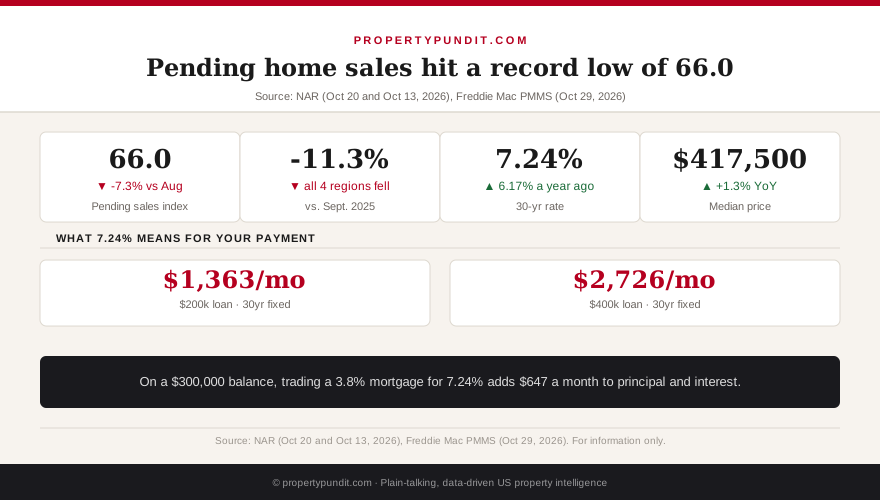
The number: 66.0, down 11.3% from a year ago
The index tracks signed purchase contracts that haven't closed yet, which makes it a leading indicator of existing-home sales one to two months out. A reading of 100 equals average contract activity in 2001, so 66.0 means signings are running about a third below that baseline (National Association of Realtors, October 20, 2026). The index covers roughly 40% of multiple listing service data each month, and NAR describes September as the lowest level since the series began.
| September 2026 | Index | vs. August | vs. Sept. 2025 |
|---|---|---|---|
| United States | 66.0 | -7.3% | -11.3% |
| Northeast | n/a | -4.2% | -9.4% |
| Midwest | n/a | -6.5% | -8.7% |
| South | n/a | -8.2% | -12.0% |
| West | n/a | -9.2% | -15.0% |
The West fell the most, down 9.2% on the month and 15.0% on the year, and even the Northeast, the strongest region, dropped 4.2%. NAR didn't publish regional index levels on the release page we checked, so the table shows only the percentage changes.
If you're waiting for a sign that buyers are coming back before you list, this isn't it; plan on the market staying slow through the fall. A seller who lists now should expect fewer showings and longer waits for offers, while a buyer has more room to negotiate on price and repairs.
A record-low index also doesn't mean prices are about to fall. Yun noted that limited distressed property supply is keeping prices steady even though mortgages are hard to get, which is why the national median is still edging up.
What NAR says caused it
NAR Chief Economist Lawrence Yun attributed the drop to "fast-rising mortgage rates" and added that buyers and sellers "may simply be holding back until mortgage rates move favorably." He also said rates "could be topping out," while cautioning that energy prices and the inflation they produce are highly uncertain.
The rate path backs that up. Freddie Mac's 30-year average was 7.24% on October 29, down from 7.32% the week before, but far above the 6.17% of a year earlier (Freddie Mac PMMS, October 29, 2026). The 15-year was 6.60%. The weekly figure had touched 7.40% on October 8, so the latest reading is a small step back from a high, not a return to the rates that fed the 2021 to 2022 refinance wave.
For you, the useful reading is that sellers are holding back for the same reason you are, and many of the sellers holding back likely have low rates just like yours.
What moving actually costs you
Here is the arithmetic behind the standoff. Say you owe $300,000 on a 30-year loan at 3.8% and you want to swap into a similar house with a new loan of the same size at 7.24%. Principal and interest rise from $1,398 to $2,044 a month, an increase of $647, or $7,759 a year, before you've paid a dollar more for the house.
| Loan balance | At 3.8% | At 7.24% | Monthly increase | Extra per year |
|---|---|---|---|---|
| $200,000 | $932 | $1,363 | +$431 | $5,173 |
| $300,000 | $1,398 | $2,044 | +$647 | $7,759 |
| $400,000 | $1,864 | $2,726 | +$862 | $10,346 |
Prices haven't given you much back. NAR's September existing-home median was $417,500, up 1.3% from a year earlier, with 4.8 months of supply (NAR, October 13, 2026). That supply level leans toward buyers, but a price that is still rising slightly means the monthly cost of moving hasn't fallen along with transactions. Our look at contracts that fell through in September shows the same strain from another angle.
That means a move that doesn't improve your life by about $650 a month is a move that loses you money, so the burden of proof sits on the reason for moving, not on the rate.
Why this isn't a refinance signal
A weak pending index sometimes makes people wonder whether rates will drop soon enough to refinance something. For a 3.8% loan, there is nothing to refinance into: no 30-year rate offered this year comes close to what you pay. The decision in front of you is keep, rent out or sell, and our breakdown of what it costs to leave a low-rate mortgage walks through each branch.
There is one path that does preserve a low rate. FHA, VA and USDA loans can be assumed by a buyer, which is the reason some sellers with those loans can price a home above a comparable listing. Whether that applies to you depends entirely on the loan type, and the assumable mortgage myth-buster covers what the buyer needs to bring to closing. If you hold a conventional loan, the due-on-sale clause rules it out.
If your loan is conventional and you have no pressing reason to move, the cheapest decision available to you is to do nothing and keep the payment.
Get this in your inbox every Friday.
One email. The number that matters and what it means for you.
What to do with this number
The math points toward staying put unless a life event forces the move. Frankly, if you're a rate watcher sitting on 3.8%, the record-low pending reading isn't a reason to act; it's evidence that nearly everyone in your position is making the same choice. Most people who run these numbers end up deciding that a $647 monthly penalty needs a very good reason, like a job, a growing family or a house that no longer works.
Set one trigger and stop checking every Thursday: decide the payment increase you can accept, and compare it to the Freddie Mac weekly average. If you've already settled on a number, our guide to locking versus floating a rate explains how to time the commitment once you do decide to buy.
The next NAR pending sales release, covering October, is scheduled for November 18, and the next Freddie Mac reading arrives Thursday, November 5. Neither is likely to change the $647 figure by much, so use the wait to decide whether the reason to move is worth that price.
Frequently asked questions
What is the Pending Home Sales Index? It is NAR's monthly measure of signed home purchase contracts that haven't closed yet. A reading of 100 equals average contract activity in 2001. September 2026 came in at 66.0, the lowest in the index's history (NAR, October 20, 2026).
Why did pending home sales fall in September 2026? NAR's chief economist attributed the 7.3% monthly drop to fast-rising mortgage rates, adding that buyers and sellers may be holding back until rates improve.
How much more would I pay to move from a 3.8% mortgage to 7.24%? On a $300,000 loan, principal and interest rise from $1,398 to $2,044 a month, an increase of $647 or $7,759 a year, based on Freddie Mac's October 29, 2026 average of 7.24%.
Should I refinance a 3.8% mortgage? No. At a 7.24% market average there is nothing to refinance into. Keep the loan unless you have a specific reason to sell or move.