 Property
In August you ran Portland at a $660 monthly loss and decided it was close enough to keep on the shortlist. Since then the 30-year rate has climbed from 6.65% to 7.32%, and the same house now loses $841 a month. If you've been telling yourself a couple more months of waiting would shrink the gap, the gap went the other way by $181.
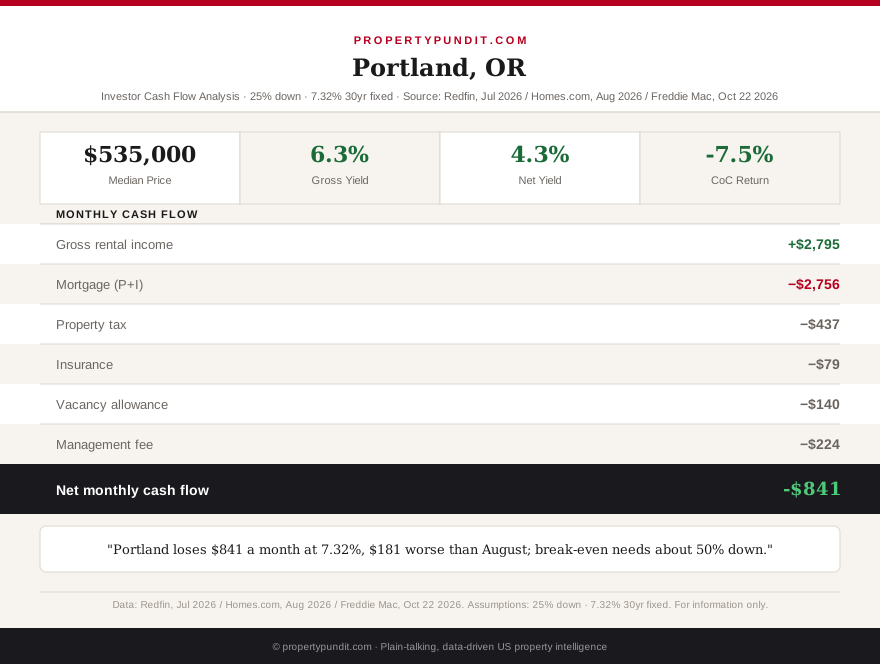
This is the third pass on Oregon. The August Oregon spotlight corrected the rent error from June; this one changes only the mortgage rate. Prices and rents are the latest verified figures from that pass (Redfin, July 2026; Homes.com 3-bedroom house rents, August 2026), and the rate is Freddie Mac's 7.32% for the week ending October 22, 2026 (Freddie Mac PMMS), against 6.65% on August 20.
Get this in your inbox every Friday.
One email. The number that matters and what it means for you.
Oregon at 7.32%: all three markets got worse
Same assumptions as August: 25% down, 5% vacancy, 8% property management, the same property tax and landlord insurance lines. Only the rate moved.
| City | Median price | P&I/mo | PITI/mo | Eff. rent/mo | Cash flow | DSCR | vs August |
|---|---|---|---|---|---|---|---|
| Portland | $535,000 | $2,756 | $3,272 | $2,432 | -$841 | 0.74 | -$181 |
| Salem | $450,000 | $2,318 | $2,750 | $1,790 | -$959 | 0.65 | -$152 |
| Eugene | $479,900 | $2,472 | $2,927 | $1,923 | -$1,005 | 0.66 | -$162 |
A rate rise of 0.67 points added $180 to Portland's principal and interest and nothing to its rent, which is the whole story. DSCR (effective rent divided by the full payment) fell from 0.79 to 0.74 in Portland, and the best market in the state is still 0.26 short of the 1.0 break-even, let alone the 1.25 most DSCR lenders require.
So if you're an investor who kept Oregon on a watch list because Portland looked close, it's now further from the line than it was when you added it.
What would make Portland work: every lever on one house
Rather than guess, here is what has to change on a $535,000 Portland house with $2,795 gross rent before the monthly number reaches zero. Each row changes one thing and holds the rest at the table's assumptions.
| Change one thing | Portland cash flow |
|---|---|
| As is: 25% down at 7.32% | -$841 |
| 40% down | -$289 |
| 50% down | +$78 |
| 60% down | +$446 |
| All cash, no mortgage | +$1,916 |
| Price falls to about $394,000 (down 26%) | $0 |
| Rent rises to about $3,761 (up 35%) | $0 |
| Rate falls to about 4.0% | $0 |
Notice how little help the market offers. A 26% price drop, a 35% rent jump, or a rate near 4% are each far outside anything the numbers suggest is coming, while a 50% down payment gets you to a $78 profit that a single repair erases. Salem and Eugene are worse still: even at 50% down they stay negative (-$186 and -$181), and they only turn positive around 60% down (+$123 and +$149).
That means Oregon only works for you as a cash or near-cash purchase, and at that point you're buying appreciation, not cash flow.
A worked example: the 50% down Portland buyer
Take the table's only profitable bank-financed case. You buy at $535,000 with $267,500 down and a $267,500 loan at 7.32%. Principal and interest is $1,838 a month, property tax is $437 and insurance $79, so the payment is $2,354 against $2,432 of effective rent. You keep $78 a month, or $936 a year, on $267,500 of your own cash, which is a 0.35% cash-on-cash return before closing costs, repairs and the 9.9% state tax.
For comparison, the same $267,500 earning a hypothetical 4% elsewhere would produce $10,700 a year. The house has to appreciate by about 2% a year just to match that, and by more once you count the transaction costs of getting in and out. That is the real price of making Oregon cash flow: you tie up a quarter of a million dollars to collect less than a thousand.
If you're considering the 50% down route, that means you're paying for appreciation up front, so price the bet before you place it.
The tax and rent-cap costs haven't moved
Nothing in the state's rules changed since the last pass. Oregon's top income tax rate is 9.9% and it applies to rental income and to gains on exit with no capital gains discount, and the statewide rent cap under SB 608 was 9.5% for 2026 when last checked against the state's published figure (Oregon Department of Administrative Services, August 2026). The cap rarely binds when rents are flat against prices, but it does limit how fast you can raise rent to catch up with a higher payment.
Landlord insurance remains the one cheap line, at roughly $800 to $1,100 a year for a Portland or Salem house depending on wildfire hazard zone (Steadily, 2026). It's why the table's damage comes almost entirely from the mortgage rate and the price, not from operating costs.
So if you're weighing Oregon against a state with no income tax, remember that the 9.9% rate takes a share of whatever profit survives, and today there's no profit to share.
Where Oregon sits against its neighbors
Washington and Nevada both skip a state income tax, which improves the after-tax result on rent that does come in. Neither fixes a purchase price that's too high for its rent, so run the same lever table on any house before you assume the tax advantage rescues it. For markets where the rent covers the payment without help, the single-family rental yield county map shows where to start.
For you, that means the question isn't Oregon versus its neighbors on tax, it's whether any house in any of them clears 1.0 at today's rate.
What an Oregon investor should do now
The math points toward leaving Oregon off the buy list until either the price or the rate changes by a lot. Frankly, if you're holding cash and choosing between Portland at $841 a month underwater and a Midwest market that covers its payment, most investors who run both sets of numbers end up with the second. If you already own in Portland, the case for holding rests on appreciation alone, so check what a sale would net after 9.9% state tax before you decide.
If you still want Portland, buy with 50% down or more, price it with the rent you can prove for a 3-bedroom house, and keep a reserve for the months the number goes red again.
Frequently asked questions
Is Portland a good place to buy a rental property in 2026? At Freddie Mac's 7.32% rate (October 22, 2026), a Portland house at the $535,000 median with 25% down loses about $841 a month after vacancy, management, taxes and insurance. It only reaches break-even with roughly 50% down or a price near $394,000.
Does Oregon have rent control? Yes. Oregon's SB 608 limits annual rent increases statewide. The 2026 cap was 9.5% when last checked against the state's published figure in August 2026.
What is Oregon's income tax on rental income? Oregon's top state income tax rate is 9.9%, applied to net rental income and to gains on sale as ordinary income, with no separate capital gains discount.
Can I get a DSCR loan for an Oregon rental? Rarely at today's prices. Portland's coverage ratio is 0.74, Salem's 0.65 and Eugene's 0.66 at 25% down, below the 1.0 to 1.25 most DSCR lenders want.