 Property
You've heard the pitch at every investor meetup and every "best states for landlords" roundup: Nevada has no income tax, no capital gains tax, and property tax growth capped low. So you pull up a Las Vegas listing, run it against the two properties you already own, and the cash flow comes back negative anyway. That's not a math error on your part. It's the gap between what Nevada's tax code advertises and what it actually protects, unless you know to ask for the protection by name.
Nevada's investor reputation and Nevada's investor math tell two different stories in 2026, and both are true at once. The tax advantages are real, cheaper than almost anywhere in the Southwest. The cash flow, at current prices and a 6.69% mortgage rate, is not there yet in any major Nevada market. What's new this year is a specific, filed-not-automatic tax break that most landlords in Clark County already qualify for by rent alone and simply never claim.
What Nevada actually gets right for investors
Clark County's effective property tax rate runs around 0.60%, among the lowest of any major metro in the country, versus a Texas average closer to 1.85% on a comparable property. There's no state income tax and no state capital gains tax, an advantage that accrues fully to Nevada residents rather than out-of-state investors, who still owe their home state tax on Nevada rental income in most cases. Homeowners insurance is unusually cheap too: Nevada averages somewhere between $1,309 and $1,633 a year depending on the source and coverage level, well under half the roughly $2,948 national average. One new wrinkle worth flagging: as of January 2026, Nevada insurers are permitted to exclude wildfire coverage from a standard policy. Vegas itself carries relatively low wildfire exposure, but if you're looking at hillside or urban-interface properties anywhere in the state, confirm wildfire is actually included before you bank on that cheap premium.
The 3% cap most landlords qualify for and never claim
Nevada's property tax abatement law caps annual growth in taxable value at 8% for most non-owner-occupied property. But there's a carve-out that gets far less attention than the headline 3% owner-occupant cap: a rental home qualifies for that same 3% cap, not the 8% one, if the rent charged sits at or below HUD's published fair market rent for the county and unit size. Clark County's most recently published fair market rent for a three-bedroom unit is $2,555 a month. Every Clark County rent used in this analysis, Las Vegas at $2,150, Henderson around $2,290, North Las Vegas near $1,950, sits comfortably below that line. In other words, if you own a typical single-family rental in the Las Vegas metro, you almost certainly already qualify. The catch is that the county will not apply the lower cap on its own. An owner has to file a Property Tax Cap Claim Form with the Clark County Assessor, and the deadline is June 30 of the tax year being claimed. Miss the filing and you default to the 8% cap on a property that, by rent alone, was always eligible for 3%.
What skipping the filing actually costs over time
The gap doesn't bite in year one, which is exactly why it's easy to ignore. It compounds. Take the Las Vegas example below, with a starting monthly tax bill of roughly $225. At a 3% annual cap, that grows to about $261 a month after five years. At the 8% cap that applies by default if you never file, the same tax line grows to about $330 a month over the same five years, a gap of roughly $69 a month, or close to $830 a year, purely for not submitting a form. On a deal that's already running negative monthly cash flow, as every market in this analysis is, that's a real, avoidable drag on an already thin margin, and it's the closest thing to free money Nevada's tax code offers a landlord who bothers to ask for it.
Get this in your inbox every Friday.
One email. The number that matters and what it means for you.
Las Vegas, Henderson, and North Las Vegas: the cash flow math
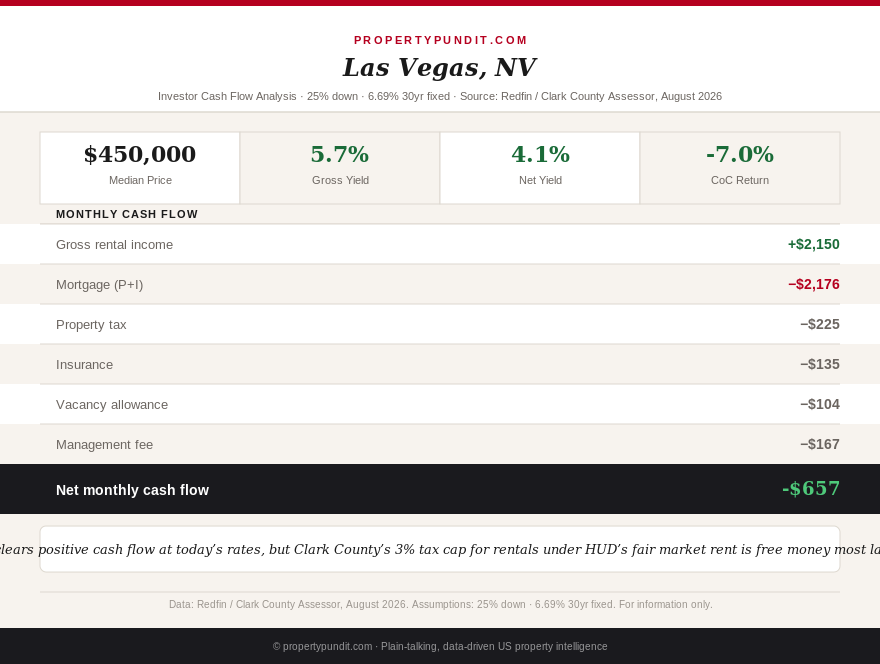
Las Vegas's three-month median sale price sits at $450,000, down 1.2% year over year, while last month's average price ran higher at $456,000, up 3.5% year over year (Redfin). The two figures diverge because one is a rolling three-month median skewed toward what's actually closing, and the other is a single month's average pulled up by a heavier mix of higher-end sales; neither is wrong, they're just measuring different slices of the same market. At the $450,000 median with 25% down and a 6.69% rate, principal and interest runs about $2,176 a month, property tax about $225, insurance about $135, for a PITI near $2,536. Against a typical $2,150 three-bedroom rent, effective rent after 8% management and 5% vacancy comes to about $1,879, leaving monthly cash flow around negative $657 and a DSCR of 0.85.
Henderson, the pricier, more established Clark County suburb, sits at a median of $494,731, essentially flat year over year. The higher price doesn't buy a better cash flow story: PITI runs close to $2,781 against roughly $2,290 in typical three-bedroom rent, for cash flow near negative $779 a month and a DSCR of 0.82. North Las Vegas remains the metro's cheapest entry point at an estimated $390,000, and it's the closest thing Clark County has to a floor: PITI near $2,206 against $1,950 in rent works out to roughly negative $502 a month and a DSCR of 0.88, still short of breakeven but the smallest gap of the three.
Reno's different story: appreciation outpaces cash flow
Reno, in Washoe County, tells a sharper version of the same story. One measure puts Reno's three-month median at $576,000, up a striking 8.7% year over year; another index shows $547,447, essentially flat at up 0.06%. That's a real divergence worth naming rather than picking one, and it likely reflects the same recent-sales-mix effect seen in Las Vegas, just more pronounced given Reno's smaller transaction volume. At the higher $576,000 figure with 25% down, PITI lands near $3,237 a month against typical three-bedroom rent in the $2,400 to $2,500 range, for cash flow around negative $1,096 and a DSCR of 0.76, the weakest of any market in this analysis. Reno is the clearest appreciation-over-cash-flow case in the state: the fastest-growing home values, and the worst monthly math to hold them.
The investor verdict
No Nevada market examined here clears positive cash flow or a 1.0 DSCR at today's prices and rates. North Las Vegas comes closest by virtue of its lower entry price, not any structural advantage. Nevada's actual case for an investor in 2026 is the same one it's always been: tax efficiency and appreciation, not day-one income. Zero income tax, zero capital gains tax, a genuinely low and cappable property tax rate, and below-average insurance combine to make the holding costs unusually light for a state with this level of price appreciation, the same structural setup that works for investors running the DSCR loan math on a longer time horizon rather than immediate income. Frankly, if you're already holding through negative monthly cash flow on the appreciation thesis, filing the property tax cap claim every year is the one lever in this whole analysis that costs nothing and only helps. Most landlords who run this comparison against a market like Texas, where there's no equivalent rent-based cap at all, end up treating Nevada's filing requirement as the cheapest edge available to them this year, not a footnote.
Nevada joins Montana as a second state this year where the real story isn't the tax rate on the county website, it's the filing most landlords never make. If you're comparing markets by county-level yield rather than sale price alone, build the claim-filing step into your annual calendar the same way you'd track a lease renewal, because in both states it's worth real money for a few minutes of paperwork.