 Property
You have been refreshing a rate tracker app for three days, watching the number creep from 6.9% toward 7%, and telling yourself the real damage happens Wednesday afternoon when the Federal Reserve announces its decision. It doesn't. By the time Fed Chair Kevin Warsh steps to the podium at 2:30 p.m. Eastern, most of what the bond market expects him to say is already baked into the rate your loan officer quoted you this morning. The meeting itself is closer to a formality for mortgage pricing than the moment of truth it feels like.
That gap between what people fear and what actually moves their monthly payment is the thing worth untangling before you decide whether to lock. Here is what has already happened, what Wednesday can and can't still do to your rate, and what 25 basis points is actually worth in dollars.
Your rate answers to the Treasury market, not the Fed
The Fed's benchmark rate, the federal funds rate, is an overnight lending rate between banks. It has no direct line to your 30-year mortgage. Fixed mortgage rates track the 10-year Treasury yield instead, because a 30-year loan behaves economically more like a long-term bond than an overnight loan, and lenders price mortgage-backed securities off that same long end of the yield curve. The relationship holds fairly steady: the 30-year fixed rate has run roughly 170 to 200 basis points above the 10-year Treasury for most of 2026, currently about 193 basis points as of the September 10 reading.
That is why a Fed decision moves your rate only indirectly. What actually matters is whether Wednesday's outcome changes what bond investors expect the Fed to do over the next two to three years, not what happens at 2 p.m. Wednesday itself. If the decision matches what the market has already priced in, the 10-year yield, and your rate with it, may barely move at all. Your rate has already adjusted to the expected news, not the news itself. That is the sentence worth remembering before you check that tracker app again.
What already happened this week
Thursday's producer price report on September 10 came in hot, up 0.4% for the month and 5.4% year over year, and the 10-year Treasury jumped 12 basis points in a single session on the news. That single move did more to your mortgage rate than anything the Fed has said publicly all month. Friday's consumer price report held headline inflation at 3.4% year over year with a cooler 2.4% core reading, which offered a little relief, but it wasn't enough to undo the PPI spike.
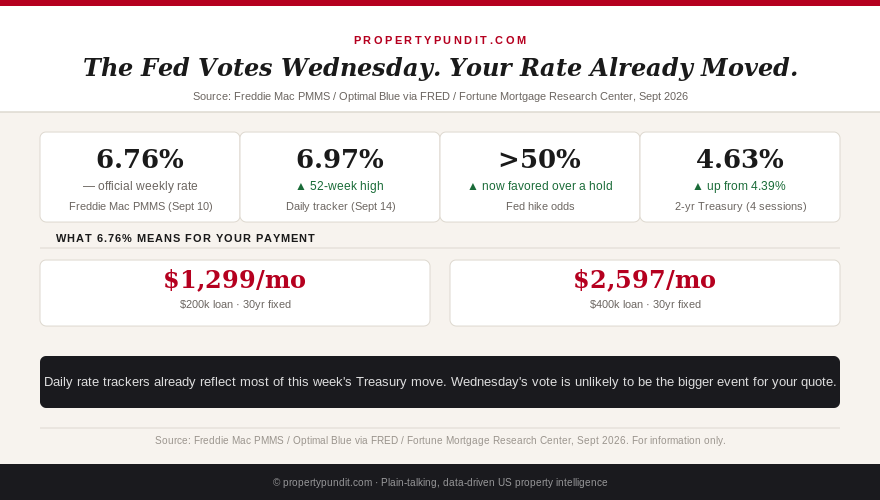
The result: Optimal Blue's tracker hit a 52-week high of 6.88% on September 10, and Fortune's Mortgage Research Center tracker showed 6.968% on September 14, both well above the official Freddie Mac PMMS reading of 6.76% from September 10. That is roughly a 21-basis-point gap between the weekly survey number you see in headlines and the real-time number lenders are actually quoting, wider than the 5 to 15 basis point gap that has been typical through most of 2026. The two-year Treasury, which reacts fastest to Fed expectations, has climbed from 4.39% to 4.63% in the four sessions leading into this week, a market-level signal that traders now see a hike, not a hold, as the more likely outcome Wednesday. Whatever rate is sitting in your inbox right now already reflects most of that shift, which is the piece worth knowing before you decide whether to lock or wait.
Hike, hold, or cut: what each outcome actually does to your rate
A quarter-point hike that matches what the market has priced in should leave your rate close to where daily trackers already sit, since the move already happened in the bond market over the past week. A hike would only jolt rates meaningfully higher if it came with language suggesting more hikes are coming than the market currently expects, or if the vote split surprised traders (three regional presidents dissented in favor of a hike at the July meeting, so a similarly hawkish tone isn't itself news).
A hold is the outcome that would actually move your rate right now, and it would likely move it down. Given that hike odds have run as high as 50% to 65% in recent readings, a hold would surprise the market and could pull the 10-year yield, and mortgage rates with it, back toward the 6.7% to 6.8% range. A cut is essentially off the table this month; prediction markets have priced it near 1%, so it isn't a scenario worth planning around.
The real cost of 25 basis points
Numbers make this concrete. On the national median-priced home, $429,100 as of NAR's August report, with a 10% down payment (the actual median for first-time buyers per NAR's data, not the 20% most people assume), the loan amount is $386,190. At today's official 6.76% rate, principal and interest runs about $2,508 a month. At 7.01%, a quarter point higher, that same loan costs about $2,572 a month, a $64 difference. Over a year, that is $768, real money, but not the kind of shock that should be driving a decision made in a panic on Tuesday night.
The more important number is the one already sitting in your loan officer's quote: daily trackers at 6.88% to 6.97% mean a chunk of that 25-basis-point move has already happened, whether or not the Fed does anything Wednesday at all.
Get this in your inbox every Friday.
One email. The number that matters and what it means for you.
What this means for your rate lock
If your credit score and down payment already qualify you for a rate you can live with, the math favors locking before Wednesday rather than floating past it. We walked through how your credit score actually shapes that quoted rate back in May, and it still applies here: two borrowers watching the same Fed meeting can be offered rates 50 basis points apart based on nothing but their score. The asymmetry this week is what matters most: a hike that matches expectations likely leaves your rate close to where it's now, while a hawkish surprise could push daily trackers meaningfully past 7%. There is comparatively little upside sitting on the sidelines waiting for a rate cut that prediction markets say has about a 1% chance of happening.
We covered the mechanics of locking versus floating in more detail when hike odds first jumped sharply back in July, including the float-down fee math and what a closing cost statement actually includes once you factor in a rate-lock extension. If you're more rate-sensitive than most, it's also worth knowing that some buyers are responding to this exact uncertainty by shifting toward adjustable-rate loans rather than fixed ones; ARM applications just hit a five-week high as the gap between fixed and adjustable rates widened. That trade isn't right for everyone, but it's evidence that other buyers are reaching the same conclusion you might be: the fixed-rate market has already done most of its moving for September, and waiting on the Fed specifically isn't the lever it feels like.
Frankly, if you're within a few weeks of closing and sitting on a rate you can afford, the math points toward locking now rather than gambling on a hold that markets currently think is the less likely outcome. Most buyers who run these numbers end up locking before a Fed meeting with hike odds this elevated, not after.
Common questions
Does the Federal Reserve control mortgage rates?
Not directly. The Fed sets the federal funds rate, an overnight bank-to-bank lending rate. Mortgage rates track the 10-year Treasury yield instead, because a 30-year mortgage behaves more like a long-term bond than an overnight loan. The Fed's decisions move mortgage rates only indirectly, by shifting what investors expect for inflation and growth over the next decade.
What happens to mortgage rates if the Fed hikes in September 2026?
Less than most people expect. Daily rate trackers already sit at 6.88% to 6.97%, well above the official 6.76% Freddie Mac reading from September 10, because bond markets priced in most of the hike odds days before the vote. A hike that matches expectations would likely leave rates close to where they already are. A surprise hold is actually what could move rates, and it would likely push them down.
Should I lock my mortgage rate before the Fed meeting?
If you have a rate you can afford in hand, locking before Wednesday removes the tail risk of a hawkish surprise, since a hike beyond what markets expect could push daily trackers past 7%. Floating only makes sense if you're comfortable losing the bet, because the more likely outcomes are a small move or no move at all, not a rate cut.
Why is my mortgage rate quote higher than the Freddie Mac rate I see in the news?
Freddie Mac's PMMS is a weekly average of top-tier borrower quotes collected earlier in the week, published on Thursdays. Daily trackers and individual lender quotes reflect the bond market in real time, plus your specific credit score, down payment, and loan type. In a week when Treasury yields are moving fast, like this one, the gap between the two numbers can widen to 20 basis points or more.