 Property
Iowa looks like the cash-flow answer that a 7.28% mortgage rate has been hiding from you. The state's prices are still low, Davenport's median jumped 9.2% in a year, and gross yields of 7.8% to 8.9% look healthy on paper. Then you add a real maintenance reserve, and all three of Iowa's largest rental markets lose money every month: about $561 in Des Moines, $652 in Davenport, and $718 in Cedar Rapids. If you're deciding where to put a down payment, that gap between the headline and the paycheck is the whole story.
This is our third pass on Iowa, after the June 2 first pass and the July 22 second pass. The mortgage benchmark has moved since then: Freddie Mac's 30-year fixed rate reached 7.28% on October 1, 2026, up from 7.03% the week before and the highest reading since November 2023 (Freddie Mac PMMS, October 1, 2026). I underwrote each market with 25% down, an 8% management fee, one month of vacancy a year, and a 1.5% annual maintenance reserve.
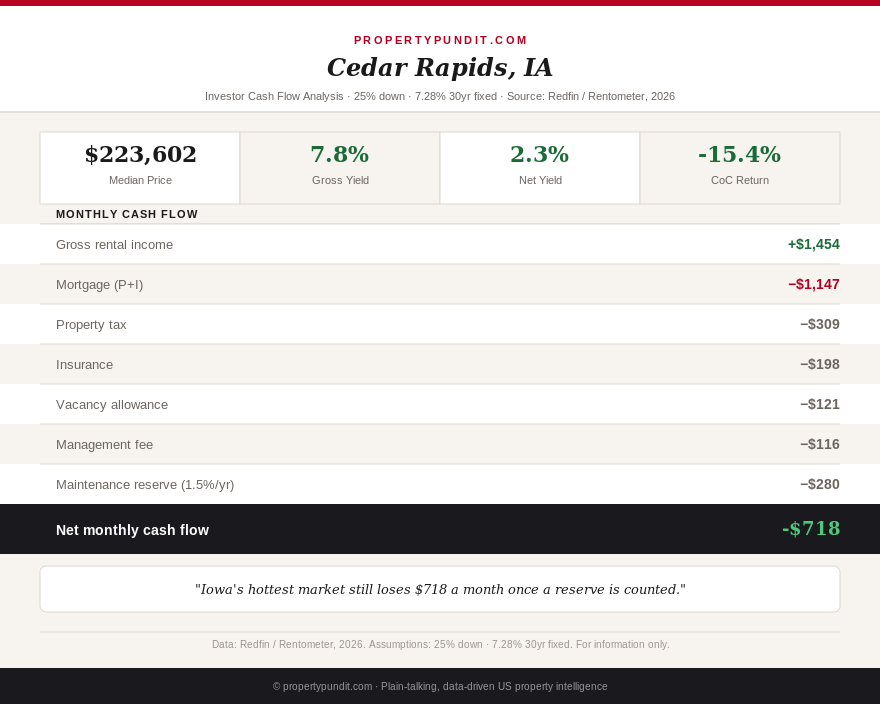
Cedar Rapids: 6 days on market and a $718 monthly loss
Iowa is a hot market by Midwest standards. Redfin's July 2026 statewide data shows a median sale price of $264,448, up 7.9% year over year, with a median of 37 days on market and 4.0 months of supply (Redfin, July 2026). Cedar Rapids runs hotter than the state. Its August median sale price was $223,602, up 4.7%, with 676 homes sold (up 7.1%), a median of 6 days on market, a 99.9% sale-to-list ratio, and 42.5% of homes selling above list price (Redfin, August 2026). Landlords bidding in a market like that have almost no room to negotiate.
The rent is the weakest input in this model, so I'll say so up front. Rentometer's Cedar Rapids figure for a three-bedroom house is $1,454 on average with a $1,412 median, but the data is dated January 2026 (Rentometer). Treat it as a placeholder and get a current comparable before you offer. On a $223,602 purchase with 25% down, the loan is $167,702 and principal and interest at 7.28% run $1,147. Tax at Linn County's 1.66% effective rate (carried from our July pass; Linn County Auditor, 2026) adds $309, and insurance at MoneyGeek's $2,381 Iowa average adds $198. That's a $1,655 payment against $1,454 of rent, a debt-service coverage ratio (rent divided by the payment) of 0.88. After management ($116), vacancy ($121), and the reserve ($280), the property loses about $718 a month. Break-even rent is about $2,312, which is 59% above today's rent.
| Monthly line item | Des Moines (city) | Cedar Rapids | Davenport |
|---|---|---|---|
| Median price | $220,000 | $223,602 | $218,355 |
| Rent (3-bedroom house, Rentometer) | $1,630 | $1,454 | $1,502 |
| Principal and interest (25% down, 7.28%) | $1,129 | $1,147 | $1,121 |
| Property tax (effective rate) | $323 (1.76%) | $309 (1.66%) | $328 (1.80%) |
| Insurance | $198 | $198 | $188 |
| Management (8%) | $130 | $116 | $120 |
| Vacancy (one month a year) | $136 | $121 | $125 |
| Maintenance reserve (1.5% a year) | $275 | $280 | $273 |
| Net cash flow | -$561 | -$718 | -$652 |
| Debt-service coverage | 0.99 | 0.88 | 0.92 |
| Break-even rent | $2,301 | $2,312 | $2,282 |
| Gross yield / net yield | 8.89% / 3.10% | 7.80% / 2.30% | 8.25% / 2.57% |
| Cash-on-cash return | -12.2% | -15.4% | -14.3% |
The Des Moines column uses a $220,000 city median carried from our July pass; the next sections explain why that number needs a caution label. What it means for your decision: Cedar Rapids is a real market with real demand, and its price is about 59% too high for the rent it commands, so treat it as an appreciation hold, not an income property.
Get this in your inbox every Friday.
One email. The number that matters and what it means for you.
Davenport: up 9.2% in a year and still $652 a month under water
Davenport is the market most likely to tempt you, because the growth numbers are the best in the state. Redfin's August 2026 data shows a $218,355 median sale price, up 9.2% year over year, with 409 homes sold (up 5.2%), a median of 12 days on market (6 days faster than a year ago), and price per square foot up 16.0% to $152 (Redfin, August 2026). Our July pass used a $188,000 figure, so part of this swing is a better price source rather than a market jump.
Rentometer's June 2026 data puts a three-bedroom house at $1,502 on average with a $1,400 median. On the average, principal and interest at 7.28% are $1,121 on a $163,766 loan. Scott County's 1.80% effective tax rate, the highest of the three markets, adds $328, and MoneyGeek's Davenport insurance figure of $2,256 a year adds $188. The payment is $1,636, the coverage ratio is 0.92, and after management ($120), vacancy ($125), and the reserve ($273) the house loses about $652 a month. Use the $1,400 median rent instead and the loss grows to about $738. Break-even rent is about $2,282, which is 52% above the average.
A 16.0% jump in price per square foot against a 9.2% jump in median price is worth a second look. Gaps like that can mean the mix of homes sold changed rather than that every house gained 9%, the same pattern we documented in our appreciation luxury-skew explainer. Davenport also carries a major flood risk: Redfin estimates 12% of properties face severe flooding over 30 years (Redfin, 2026), and a standard homeowners policy doesn't cover flood. Before you buy there, check the specific address against FEMA's flood map and price a flood policy if it's in a zone. What it means for you: Davenport's growth is real on paper, but a 9.2% median gain is a reason to verify the comparable sales, not a reason to skip the cash-flow math.
Des Moines: an $84,000 disagreement between two prices
Des Moines is the hardest Iowa market to price today, and I'd rather show you the problem than hide it. Our July pass used a $220,000 median from Redfin. The Redfin city page I could reach this week was stale, so I couldn't refresh it. A mid-2026 market review that republishes Redfin data puts the Des Moines median sale price at $304,007, up 1.5% year over year, with 1,016 homes sold (up 4.2%), 4,605 active listings (up 8.6%), and median days on market up 9.3 days to 51.2 (Stacker, 2026). The gap is about $84,000. My best guess is that one figure covers the city and the other the wider metro, but I can't confirm that, so I ran both.
At $220,000, Des Moines loses about $561 a month on the $1,630 Rentometer house rent (July 16, 2026), with a coverage ratio of 0.99. At $304,007, the loan is $228,005, principal and interest are $1,560, tax at 1.76% (Polk County Assessor, 2026) is $446, and the payment is $2,204 against the same rent. Coverage falls to 0.74 and the property loses about $1,221 a month. Break-even rent is $3,089, which is 90% above today's rent. Either way Des Moines loses money, and the only open question is whether you'd lose $561 or $1,221 a month. Pull six months of sold comparables for the exact neighborhood before you model anything. What it means for you: don't trust a citywide median in a market this size, and don't make an offer until you've priced the specific house.
What changed since July, in order of size
Our July 22 second pass showed Des Moines at about -$90 a month, Cedar Rapids at about -$66, and Davenport at about -$187. Today's figures are $471, $652, and $465 a month worse. In every market the largest single item is the one July's model didn't have, the 1.5% maintenance reserve: $275 in Des Moines, $280 in Cedar Rapids, and $273 in Davenport. That is 58%, 43%, and 59% of each swing. The higher rate adds only about $81, $68, and $69. The remainder, about $115 in Des Moines, $304 in Cedar Rapids, and $123 in Davenport, comes from updated prices, rents, and a current insurance quote.
That ordering matters if you're rebuilding a spring spreadsheet: a missing maintenance line hurts more than a rate move. A recovery in rates won't rescue the numbers either. At 6.00%, Des Moines improves to about -$422, Cedar Rapids to -$576, and Davenport to -$514. Even a 4.00% mortgage leaves them at about -$220, -$371, and -$314. What it means for you: don't underwrite an Iowa deal around a rate cut. The Fed raised rates 25 basis points on September 16, and we already walked through the Treasury math behind a rate that may not fall soon.
The tax and insurance bills most Iowa spreadsheets get wrong
Iowa's 2026 homestead law, SF2472, replaced the old credit with an exemption worth 10% of taxable value, capped between $5,500 and $20,000, and it requires owner-occupancy for at least six months a year. Investors can't claim it, which is why the tax rates I used already reflect the non-homestead rate. Iowa is also bringing back a separate multiresidential property class for buildings with three or more units from January 1, 2027, phased in at about 6% above the standard residential rollback over two years (Iowa Legislature, 2026). That doesn't touch a single-family rental, but it matters if you're eyeing a duplex or fourplex. Rental income is taxed at Iowa's flat 3.8% rate, in effect since January 1, 2025 (Iowa Department of Revenue).
Insurance is the quieter problem. Insurify's March 2026 report put Iowa's average homeowners premium at $2,802, up 28% in 2025 (the third-largest increase nationally) and 54% over two years, with another 4% projected by the end of 2026 (Insurify via KCRG, March 18, 2026). MoneyGeek's figure is lower at $2,381 a year, and its quotes range from $1,711 at Auto-Owners to $3,673 at Farm Bureau for identical coverage (MoneyGeek, 2026). Use Insurify's $2,802 and each market loses about $35 to $45 more a month. The bigger lesson is the $1,962 spread between the cheapest and most expensive carrier, which is worth more than any rate move. What it means for you: get three written quotes for the exact address before you trust any cash-flow figure, including mine.
The yield picture, and whether appreciation covers the loss
The gross yield (annual rent divided by price) is the number DSCR lenders advertise: 8.89% in Des Moines, 7.80% in Cedar Rapids, and 8.25% in Davenport. After operating costs, the net yield drops to 3.10%, 2.30%, and 2.57%. After the mortgage, the cash-on-cash return is -12.2%, -15.4%, and -14.3% on down payments of $55,000, $55,900, and $54,589. These are the numbers a lender's marketing page leaves out.
Trailing appreciation tells a different story by market. Davenport's 9.2% gain is worth about $20,089 a year on $218,355, against an annual carrying loss of $7,824. Cedar Rapids' 4.7% gain is about $10,509 against an $8,616 loss. Des Moines at 2.3% (Redfin, 2026) is about $5,060 against a $6,732 loss. Selling costs of roughly 6% ($13,000 to $13,400 on these prices) would eat more than a year of that gain in each case. I don't treat trailing appreciation as a forecast, and Davenport's mix-shift question above makes its number the least reliable of the three. What it means for you: if you buy in Iowa, you're paying $6,700 to $8,600 a year to hold an appreciation bet, so size it like one.
What this means for you
If you're weighing an Iowa rental, budget for a loss of about $560 to $720 a month at today's rate, or roughly $6,700 to $8,600 a year, and underwrite the property as an appreciation hold. The math points toward Cedar Rapids or Davenport only if you can buy well below the median, because break-even at current rents would take prices 33% to 41% lower or rents 41% to 59% higher. If you're determined to buy, start with Davenport, where appreciation currently outruns the carry, and verify the comparables and the flood zone first. If you already own in Iowa, shop your insurance at every renewal, check that your tax rate isn't the owner-occupied one, and make sure your spreadsheet has a reserve line.
Before you make any offer, pull the seller's actual tax bill, get a written insurance quote on the specific address, and price the reserve at 1.5% of the purchase price. For the full lender-side picture, read our DSCR loan guide, and compare this result with Indiana's third pass, where the same rate and reserve produced losses of $622 to $832 a month. Until Iowa rents rise by 40% or more or prices fall by a third, this is a state to hold for the appreciation, not the paycheck.