 Property
You've got two rentals already, and every broker call this year has pitched you the same story: leave the coasts to the appreciation chasers and go find a boring, cheap Midwest market where the numbers still work. Iowa shows up on almost every "affordable cash flow state" list you've scrolled past, and on paper it looks the part, a $253,549 statewide median, a fresh flat income tax, and none of the coastal drama. Before you wire an earnest money deposit on that logic alone, run the actual PITIA math on Iowa's three largest cities, because the state's reputation for cheap, easy cash flow doesn't hold up once you price in each county's real property tax bill.
Iowa's median sale price reached $253,549 in May 2026, up 2.4% year over year (Redfin, 2026). That number sits well below the $440,600 national median (NAR, June 2026), which is exactly why the state keeps landing on affordability roundups. Iowa also finished its multi-year tax overhaul this year: individual income tax is now a flat 3.8%, down from a graduated system that used to top out above 8%, and it applies to rental income the same way it applies to wages (Iowa Department of Revenue, 2026). None of that tells you what actually happens to your specific rental's cash flow once the county treasurer sends the bill.
Des Moines: the biggest metro, and the biggest price tag
Des Moines, in Polk County, carries a median sale price of $220,000, up 2.3% year over year (Redfin, 2026). Polk County's effective property tax rate runs 1.76%, among the highest in the state (Polk County Assessor, 2026). At 25% down and 6.55%, that's a $165,000 loan, a $1,048 principal-and-interest payment, $323 a month in property tax, and roughly $110 in insurance, for a PITI of $1,481. Against an estimated $1,650 monthly rent for a 3-bedroom single-family home, that's a DSCR of 1.11, technically above the 1.0 lender minimum. Once you subtract an 8% management fee and a standard one-month vacancy allowance, net cash flow lands around -$90 a month.
Des Moines passes the loan-level DSCR test a lender cares about and still fails the cash-flow test that determines whether the property pays you or costs you every month. That gap alone should tell you which number to trust before you sign anything.
Cedar Rapids: the smallest loss on the board
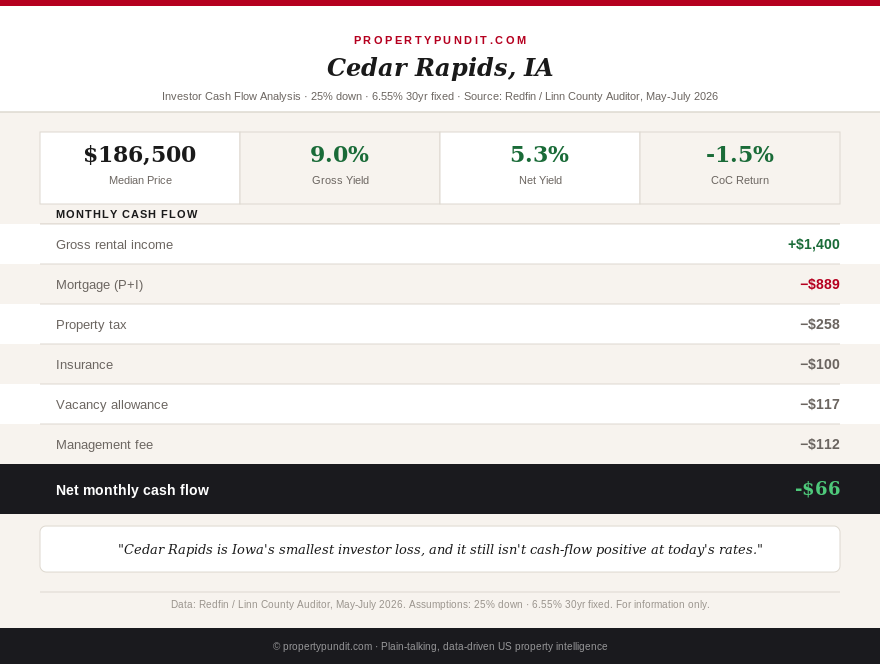
Cedar Rapids, in Linn County, has a median sale price of $186,500, up 3.6% year over year, the fastest-appreciating of Iowa's three largest metros (Redfin, 2026). Linn County's effective property tax rate is 1.66%, meaningfully lower than Polk County's (Linn County Auditor, 2026). At 25% down, the loan is $139,875, principal and interest run $889, property tax adds $258, and insurance is roughly $100, for a PITI of $1,247. Against an estimated $1,400 monthly rent, DSCR comes in at 1.12, and net cash flow after management and vacancy settles at roughly -$66 a month, the smallest loss of any Iowa metro in this analysis.
If you're set on an Iowa entry point, Cedar Rapids is the one that gets you closest to break-even today, not the state capital most out-of-state investors default to first. Every figure above already nets out an 8% property management fee, which is the piece of the math out-of-state buyers most often forget to model.
Get this in your inbox every Friday.
One email. The number that matters and what it means for you.
Davenport: the cheapest price, the costliest tax bill
Davenport, in Scott County, has a median sale price of $188,000, down slightly (-0.9% year over year), the only one of the three actually softening (Redfin, 2026). On price alone it looks like the value play. Then the tax bill lands: Davenport's median effective property tax rate is 1.80%, the highest of any city examined here, well above both Polk and Linn counties (Ownwell, Scott County Treasurer, 2026). At 25% down, that's a $141,000 loan, a $896 principal-and-interest payment, $282 a month in property tax, and roughly $105 in insurance, for a PITI of $1,283. Against an estimated $1,300 monthly rent, DSCR barely clears 1.01, and net cash flow after management and vacancy falls to roughly -$187 a month, the worst of the three despite the lowest sticker price.
A lower purchase price does not automatically mean a better deal. Davenport is the clearest proof in this state that you have to underwrite the actual county tax rate before the price tag, not after.
The homestead trap and the 2027 rule change coming for multifamily
Iowa replaced its old Homestead Tax Credit with a new Homestead Tax Exemption this year under SF2472, worth 10% of a home's taxable value, capped between $5,500 and $20,000. It requires the owner to be an Iowa resident who occupies the property for at least six months of the year, which rules out every investor by design (Iowa Legislature, 2026). Every effective rate cited above already reflects the non-homestead reality you'd actually pay.
If you're considering a small multifamily building instead of a single-family rental, there's a second change worth knowing about now, and it echoes a pattern we've flagged before with HOA special assessments quietly breaking DSCR math. Starting with valuations set January 1, 2027, Iowa is reinstating a separate "multiresidential" property class for buildings with three or more units, phased in at roughly 6% above the standard residential rollback rate over two years (Iowa Legislature, 2026). That does not touch a single-family rental, but if a duplex-to-fourplex deal is part of your Iowa plan, model the 2027 rate now instead of the current one, or you'll underwrite a tax bill that's already scheduled to rise.
What the math says for your next move
None of Iowa's three largest metros clear positive cash flow at today's 6.55% rate and 25% down, even with the state's low sticker prices and new flat income tax working in your favor everywhere except the property tax line. The math points toward one of two paths if Iowa still interests you: push for a higher down payment or a below-median entry point in Cedar Rapids specifically, where the gap to break-even is smallest, or treat this state as an appreciation-and-rate-cut play rather than an immediate cash-flow purchase. Frankly, if you're underwriting a deal on Iowa's advertised affordability alone without checking the specific county's effective rate, you're one property tax bill away from an unpleasant surprise on a deal you thought already worked.