 Property
In July, Fort Wayne was the last Indiana market where a rental still made money: our second pass showed about +$14 a month on a $210,000 house. Today the same market loses about $622 a month. Nothing broke in Fort Wayne. Prices held at $214,900, the rate climbed to 7.03%, and a line our earlier passes left out, a 1.5% annual maintenance reserve, added $269 a month by itself. If you own or are eyeing an Indiana rental, that same change is hitting your spreadsheet.
This is our third pass on Indiana, after the June 1 first pass and the July 21 second pass. At Freddie Mac's 7.03% benchmark (September 24, 2026), with 25% down, an 8% management fee, one month of vacancy a year, and the maintenance reserve, both markets we modeled lose money every month: about $832 in Indianapolis and $622 in Fort Wayne.
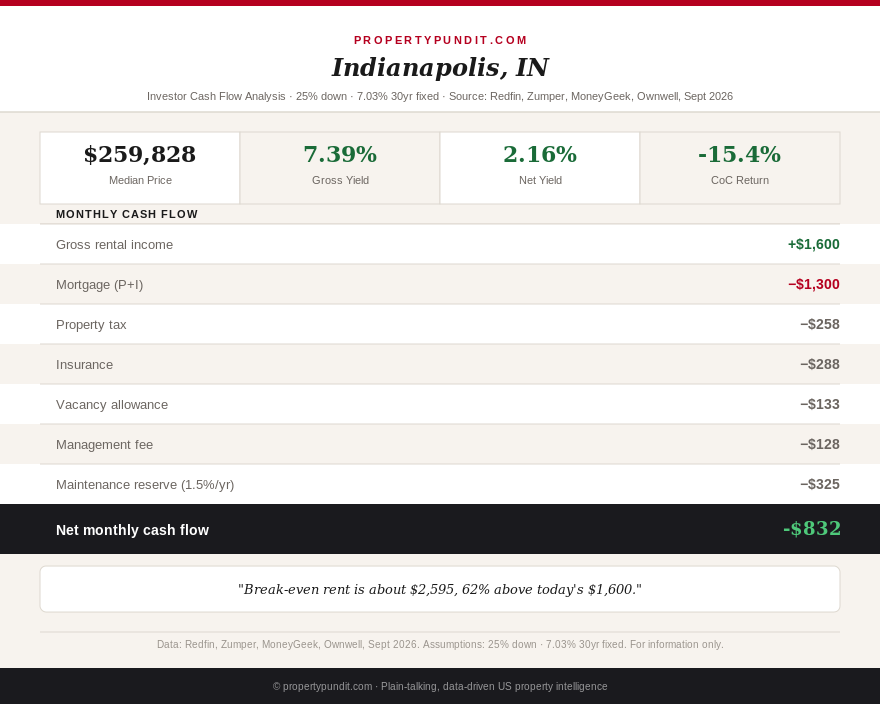
Indianapolis: 3.9% price growth, 24 days on market, and an $832 monthly loss
Redfin's August 2026 data puts the Indianapolis median sale price at $259,828, up 3.9% year over year, with 3,433 homes sold (up 6.5%), 24 days on market (6 days slower than a year ago), and homes selling at 98.0% of list (Redfin, August 2026). It's a competitive market that has cooled a little. Chicago leads incoming migration with 368 net movers between April and June, which is consistent with the story in our Illinois spotlight, where taxes and insurance eat half the rent.
The rental math is where it breaks. Zumper's September 2026 data shows the median house rent at $1,600, unchanged from a year ago. On a $259,828 purchase with 25% down, the loan is $194,871 and principal and interest run $1,300. Tax at Ownwell's 1.19% Marion County rate adds $258, and insurance at MoneyGeek's $3,459 a year for Indianapolis adds $288. That's a $1,846 monthly payment against $1,600 of rent, a debt-service coverage ratio (rent divided by the payment) of 0.87. After the manager ($128), vacancy ($133), and the reserve ($325), the property loses about $832 a month. Break-even rent is about $2,595, which is 62% above today's rent.
| Monthly line item | Indianapolis | Fort Wayne |
|---|---|---|
| Median price | $259,828 | $214,900 |
| Rent (Zumper house median, Sept 2026) | $1,600 | $1,350 |
| Principal and interest (25% down, 7.03%) | $1,300 | $1,076 |
| Property tax | $258 (1.19%) | $170 (0.95%) |
| Insurance | $288 | $237 |
| Management (8%) | $128 | $108 |
| Vacancy (one month a year) | $133 | $112 |
| Maintenance reserve (1.5% a year) | $325 | $269 |
| Net cash flow | -$832 | -$622 |
| Debt-service coverage | 0.87 | 0.91 |
| Break-even rent | $2,595 | $2,093 |
The lesson for your decision: Indianapolis is a good market and a bad cash-flow rental. Strong demand and a loose tenant pool don't fix a price that is 62% too high for the rent it commands.
Get this in your inbox every Friday.
One email. The number that matters and what it means for you.
Fort Wayne: from +$14 to -$622 in three months
Fort Wayne is the cleaner before-and-after case because the July pass was the only Indiana model that cleared. The Houzeo median is $214,900 with 0% change from a year earlier, 30 days on market, and 1.7 months of supply; Redfin's March figure was $215,000, down 2.3%, with days on market up from 21 to 30 (Houzeo, 2026; Redfin March 2026 via Propcash). Prices are flat, which makes the swing easy to read. From +$14 in July to -$622 now is a $636 deterioration. The reserve explains $269 of it. Removing the reserve leaves Fort Wayne at about -$353, so the other $367 came from the higher 7.03% rate, a current insurance quote, and a lower rent input.
On rent, one honest caution. July's pass used about $1,500 from Rent.com and RentCafe. Zumper's September figures are $1,350 for houses and $1,375 for three-bedrooms, up 9% year over year. The two sources measure different slices of the market, so some of that $150 gap is a source difference, not a decline. Even at $1,500 of rent, Fort Wayne loses about $496 a month, and its DSCR improves only to 1.01. If you're underwriting Fort Wayne, get a rent comparable for the exact street, not a citywide number.
What changed since July, in order of size
The reserve is the single largest item, and it applies to both markets. Indianapolis moved from about -$85 in July (at a $260,000 price, before the reserve existed in our model) to -$832 now, a $747 swing. Of that, $325 is the reserve and the remaining $422 comes from today's inputs: the 7.03% rate, the current insurance quote, and the $1,600 rent. In Fort Wayne the reserve is $269 of a $636 swing.
If you're modeling off a spring spreadsheet, rebuild it with a maintenance line and a current insurance quote before you trust any cash-flow figure. Those two inputs moved more than the interest rate did. Dropping the rate from 7.03% to 6.00% would recover only about $132 a month in Indianapolis (to -$700) and about $110 in Fort Wayne (to -$512). Even a 4.00% mortgage leaves Indianapolis about $462 a month negative. Don't underwrite a recovery that rates alone can't deliver.
The tax cap and the insurance bill nobody budgets for
Indiana's property tax looks cheap on paper: the state average is 0.74% (Tax Foundation, 2026) and Ownwell puts Marion County at 1.19% and Allen County, home to Fort Wayne, at 0.95%. Two cautions apply to landlords. First, those figures blend owner-occupied homes that receive homestead deductions, which rentals don't get. Indiana's constitutional circuit breaker caps rental residential property at 2% of assessed value, so the realistic ceiling for an Indianapolis landlord is about $433 a month of tax, not $258. At that ceiling the Indianapolis loss widens to about $1,008 a month. Second, owner-occupant exemptions are a common feature of state tax systems (our Idaho spotlight covered the same trap), and they quietly understate the rate an investor pays. Before you offer on any Indiana property, ask the county for the previous owner's tax bill and check whether it included a homestead deduction.
Insurance is the other surprise. MoneyGeek's 2026 figures put Indianapolis at $3,459 a year and Fort Wayne at $2,843, and the same analysis notes that a 1980-built home costs about 79% more to insure than a 2020-built one ($3,294 versus $1,840 a year). Indiana's tornado exposure keeps premiums firm. Older, cheaper rental stock, the kind that looks best on a rent-to-price ratio, is exactly where the insurance bill climbs. Get a quote on the exact house before you trust its rent-to-price ratio.
The yield picture, and whether appreciation covers the loss
Gross yield (annual rent divided by price) is 7.39% in Indianapolis and 7.54% in Fort Wayne, which is the kind of figure that shows up in DSCR lender marketing. After operating costs, the net yield, or cap rate, drops to about 2.16% in Indianapolis and 2.54% in Fort Wayne. After the mortgage, cash-on-cash return is about -15.4% in Indianapolis on a $64,957 down payment and -13.9% in Fort Wayne on $53,725.
The one bright spot is Indianapolis appreciation. At the trailing 3.9%, the house gains about $10,133 a year, which roughly matches the $9,984 a year the property loses to carrying costs, before the roughly 6% it costs to sell. Fort Wayne's flat price offers no such cover: its $7,464 annual loss is pure cost. I don't treat trailing appreciation as a forecast, but it explains why investors keep buying Indianapolis anyway. If you buy there, you're paying about $10,000 a year to hold a bet on appreciation, so size it like a bet.
What this means for you
If you're weighing an Indiana rental, underwrite it as an appreciation hold and budget for a loss of roughly $622 to $832 a month, or about $7,500 to $10,000 a year, at today's rates. Fort Wayne loses less, so if you're determined to buy, start there, and don't pay a price that assumes the higher $1,500 rent. If you already own in Indiana, protest your assessment every cycle, shop insurance at every renewal, and make sure your own spreadsheet carries a reserve line. Before you make any offer, pull the seller's actual tax bill, get a written insurance quote on the specific address, and price the reserve at 1.5% of the purchase price.
Evansville ($165,950 median in March 2026, per Houzeo) isn't modeled here because I couldn't find a current rent figure, and I'd rather leave a market out than guess its rent. Until rents rise by 55% to 62% or prices fall by a comparable amount, Indiana is a place to hold property for the appreciation, not the paycheck.