 Property
You've probably seen the headline by now: foreclosures are up 21% this year. Maybe a friend forwarded it with a "told you to wait" text, or it landed in your feed right after you finally worked up the nerve to email a lender about pre-approval on your $78,000 salary. A number like that lands hard when you're already nervous about buying your first home. It sounds like the opening chapter of something you've read about but never lived through: 2008. Here's the number behind that headline, where it actually comes from, and what it changes about your plans this week. Short answer: less than you think.
The number everyone's sharing
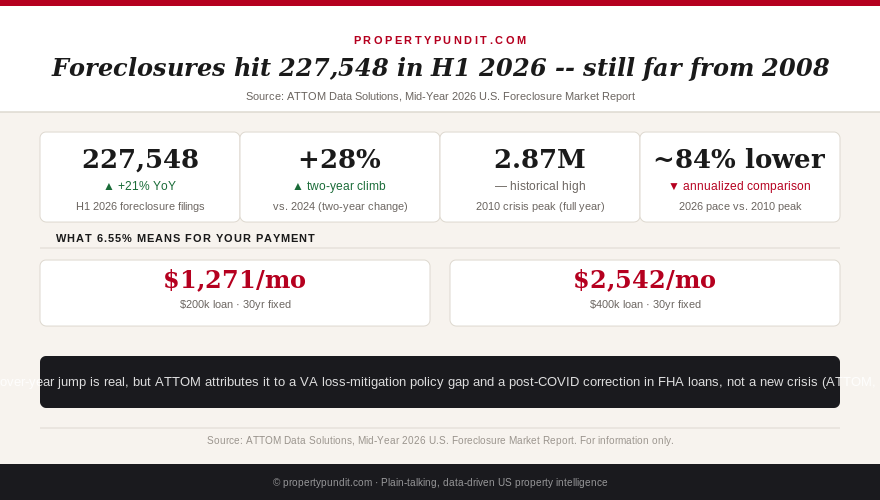
ATTOM Data Solutions, the foreclosure data source cited by nearly every housing outlet, counted 227,548 U.S. properties with a foreclosure filing (a default notice, a scheduled auction, or a completed bank repossession) in the first half of 2026. That's up 21% from the same six months in 2025, and up 28% from 2024, according to ATTOM's Mid-Year 2026 U.S. Foreclosure Market Report, released July 16, 2026. Foreclosure starts alone climbed 18%, and completed repossessions (REOs) jumped 33%.
Those are real, verified increases, not a rounding error or a one-state anomaly. But a percentage increase only tells you the direction of a trend, not its size relative to anything you'd actually recognize as a crisis. So what for you: before a 21% headline changes your buying timeline, you need the number it's being measured against, not just the number itself.
Get this in your inbox every Friday.
One email. The number that matters and what it means for you.
Why foreclosures are actually climbing
Two specific, mostly unrelated things are driving this, and neither one is "the economy is collapsing."
The first is a VA-loan-specific policy gap. The Department of Veterans Affairs discontinued its VA Servicing Purchase (VASP) program, which used to let loan servicers buy a struggling VA loan out of the pipeline and offer the veteran a reduced modified payment. VASP is gone, and the VA hasn't finished building its replacement loss-mitigation option, so veterans who fall behind right now have fewer off-ramps than they did a year ago. That's a bureaucratic gap, not evidence that veteran homeowners have suddenly become less able to pay their mortgages.
The second is what ATTOM's own analysts call "a correction to more normal activity" in FHA loans. Foreclosure activity was artificially suppressed for years by COVID-era forbearance programs and foreclosure moratoriums. Those protections are gone, and loans that would have defaulted back in 2021 or 2022 in a typical year are defaulting now instead, several years late. Layer on rising insurance premiums and property tax bills (see our breakdown of the average $2,157 escrow shortfall hitting homeowners this year), and you get more borrowers who can service the mortgage itself but can't absorb the full cost of ownership. So what for you: the increase traces to two identifiable, mostly one-time causes, not a broad wave of borrowers suddenly unable to pay.
What "foreclosure filing" actually counts
The headline number, 227,548, isn't 227,548 families who lost their homes. ATTOM's filing count spans three distinct stages: the default notice a lender sends after a borrower misses several payments, the scheduled foreclosure auction, and the completed bank repossession. A single property can generate more than one filing if it moves through more than one stage within the same reporting window, and a meaningful share of properties that receive a default notice never reach auction. The homeowner cures the default, sells the home, works out a modification, or refinances out of trouble before it goes further.
Completed repossessions, the stage where a family actually loses the home to the bank, totaled 27,983 properties in the first half of 2026. That's up 33% year over year, but it's a small fraction of the headline 227,548 figure. So what for you: when you see "foreclosures up 21%," you're mostly looking at people who missed payments and got a warning letter, not people who lost their house. That distinction matters if you're trying to gauge how much distressed inventory is actually about to hit the market near you.
How this stacks up against 2008
Annualize the current pace (227,548 filings across six months, doubled for a rough full-year estimate) and you land near 455,000 foreclosure filings for 2026. In 2010, the actual peak of the last crisis, 2.87 million properties received at least one foreclosure filing, 1 in every 45 U.S. housing units, according to RealtyTrac's year-end report (ATTOM's predecessor brand, January 2011). That puts today's pace at roughly 84% below the worst year of the last crash.
This isn't a subtle distinction. In 2010, entire subdivisions in Phoenix, Las Vegas, and South Florida were selling at 40% to 60% discounts because so much inventory was bank-owned at once. Nothing close to that concentration of distressed supply exists anywhere in the current market. So what for you: a 21% increase is a real trend worth watching, especially if you carry an FHA or VA loan yourself, but it isn't the leading edge of a price collapse you should be timing a purchase decision around.
A quick gut-check with real numbers
Here's a simple way to size this yourself. There are roughly 145 million housing units in the U.S. today. At 227,548 filings in six months, that's about 0.16% of all housing units with a filing so far this year, or an annualized rate near 0.31%. In 2010, 2.23% of housing units, again 1 in 45, received a filing over the full year. Run the two rates side by side and today's is roughly one-seventh of 2010's. If you owned a $300,000 home in a neighborhood with 400 comparable houses, 2010's rate implied about 9 of those houses receiving a foreclosure filing that year. Today's rate implies about 1.
Where it's actually concentrated
The increase isn't spread evenly. Idaho posted the largest year-over-year jump in foreclosure filings of any state through the first half of 2026, up 59%, followed by Colorado (+57%), Georgia (+52%), North Carolina (+47%), and Mississippi (+45%), according to ATTOM. We flagged Idaho's stretched investor math directly in our recent Idaho market breakdown, where prices outran local rents so fast that even the state's cheapest viable market loses money for a landlord at today's rates, and our Colorado spotlight shows a similar pattern of thin margins and buyers who stretched to get in.
By raw foreclosure rate rather than year-over-year growth, Florida, South Carolina, and Indiana currently carry the highest share of housing units in some stage of foreclosure. So what for you: if you're house-hunting specifically in one of these five states, expect more short sales and bank-owned listings over the next six to twelve months, which can be genuine opportunity if you have the cash reserve to handle a property that needs work.
What this means if you're buying this week
Frankly, if you have a stable income and a clean pre-approval, this data doesn't change your math. The math points toward treating the foreclosure headline as background noise and staying focused on the numbers that actually set your monthly payment: your rate, your down payment, and your credit score, since a 700-plus score is still what separates a 6.55% rate from something meaningfully worse.
Most people who run these numbers end up concluding the same thing: a 21% increase off a historically low base, concentrated in a policy quirk and a post-COVID correction, isn't a reason to delay a purchase you can otherwise afford. If you already hold an FHA or VA loan and you're behind on payments, the calculus is different. Call your servicer this week, not next month. VASP is gone, but FHA's and VA's other loss-mitigation tools, forbearance, repayment plans, and loan modifications, still exist, and they work far better before a formal foreclosure filing than after one. And if your own down payment plan depends on stretching every dollar to hit an old rule of thumb, revisit our breakdown of the down payment myth: 3% down is still the real conventional minimum in 2026, foreclosure headlines or not.