 Property
You've seen the headline that South Dakota has no state income tax, rents are climbing, and Sioux Falls keeps adding people, and you keep opening the spreadsheet hoping the next rate drop turns the cash-flow line positive. This third pass tells you how far away that day is. At Freddie Mac's 7.24% (October 29, 2026), a $340,450 Sioux Falls house with 25% down loses between $1,126 and $1,360 a month, and the gap between those two numbers comes down to one input most investors guess at: insurance.
We last covered the state in our August South Dakota update, when the rate was 6.65% and the loss was $1,283. The rate has since gone up 0.59 points, rents have inched higher, and the insurance question has gotten messier, not clearer.
Three insurance quotes, a $234 monthly spread
South Dakota sits in what insurers call Hail Alley, and the quotes show it. NerdWallet and Hippo both put the 2026 statewide average at $3,965 a year, about $330 a month. Insurify's Sioux Falls figure for a $300,000 dwelling with a $1,000 deductible is $2,929. InsuranceQuotes.com shows just $1,150 for Sioux Falls in 2026. None of these is regulator data, and they measure different policies, which is why three reputable-looking sources land more than $2,800 a year apart.
That spread isn't academic. It moves the monthly loss from $1,126 to $1,360, and the mistake runs in one direction: the lowest quote is the easiest to find and the least likely to survive a real underwriter. Many South Dakota policies also carry a separate percentage-based wind and hail deductible, so the premium is only part of the cost of a bad storm year.
For you, that means getting a written quote on the actual address before you trust any rental model, because a $234-a-month swing is bigger than most investors' entire target cash flow.
Get this in your inbox every Friday.
One email. The number that matters and what it means for you.
The Sioux Falls rental at 7.24%, line by line
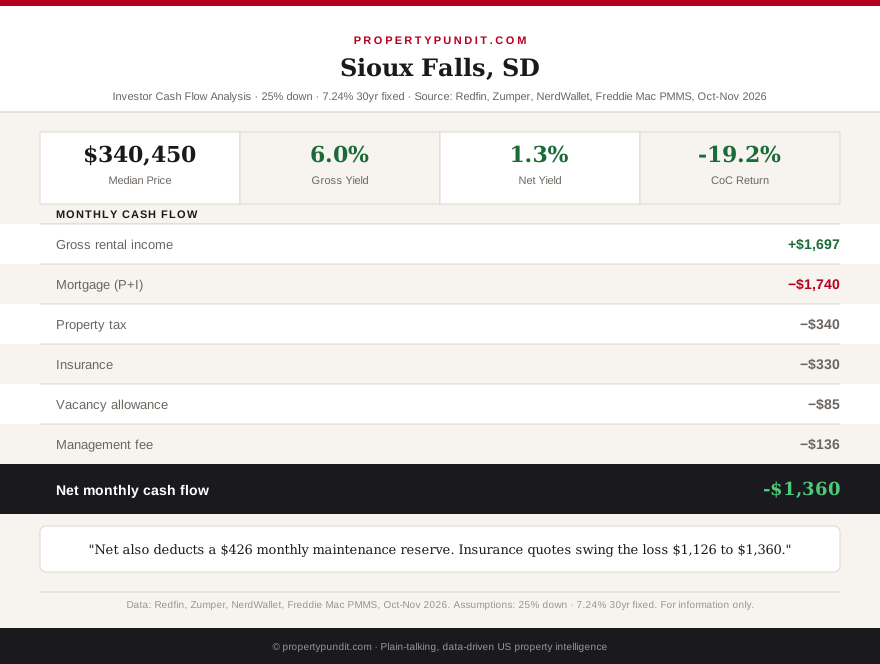
The table uses the statewide $330 insurance figure, the same one we used in August, so the comparison to that pass is clean. Rent is Zumper's November 3, 2026 average for houses in Sioux Falls, $1,697 a month, up 4% from a year ago. Property tax is the 1.20% non-homestead rate for Minnehaha County, carried from the earlier passes. Everything else follows the percentage method used for South Dakota in August.
| Item | Monthly |
|---|---|
| Purchase price (Redfin, 3 months to July 2026) | $340,450 |
| Loan (75% of price) | $255,338 |
| Principal and interest (7.24%, 30-year) | $1,740 |
| Property tax (1.20%, Minnehaha County) | $340 |
| Insurance (statewide average, $3,965 a year) | $330 |
| PITI total | $2,411 |
| Rent (house average, Zumper, Nov. 3) | $1,697 |
| Rent covers PITI (DSCR) | 0.70 |
| Vacancy (5%) | -$85 |
| Management (8%) | -$136 |
| Maintenance reserve (1.5% of price a year) | -$426 |
| Monthly cash flow | -$1,360 |
At 6.65%, the same house would have lost $1,259 with today's rent, so the rate move alone costs $101 a month in principal and interest. Rent growth has not come close to covering that. Here is how the insurance choice changes the picture:
| Insurance used (monthly) | PITI | DSCR | Cash flow |
|---|---|---|---|
| $96 ($1,150 a year, InsuranceQuotes.com) | $2,177 | 0.78 | -$1,126 |
| $244 ($2,929 a year, Insurify, Sioux Falls) | $2,325 | 0.73 | -$1,274 |
| $330 ($3,965 a year, NerdWallet, statewide) | $2,411 | 0.70 | -$1,360 |
Even the most optimistic quote leaves rent covering only 78% of the mortgage, tax and insurance, and lenders writing DSCR loans generally want to see 1.0 or better. If you're hoping Sioux Falls is the Plains market that finally pencils out at 25% down, the lender's own test says no on every version of the insurance number.
Two price sources, two stories
The $340,450 price is Redfin's median sale price for the three months ending July 2026, up 1.6% from a year earlier. Redfin's Sioux Falls page for September 2026 shows the all-home median down 0.81% year over year, so the direction of the trend flipped between the two readings. Resideline's six-month median sold price, updated in October 2026 across 1,966 closings, is $332,000. Those figures differ because they cover different windows: a three-month Redfin average, a single-month Redfin year-over-year reading and a six-month closed-sales median will never agree to the dollar.
It doesn't change the answer. At $332,000, with tax and reserve scaled down, the loss is $1,298 a month instead of $1,360, a $62 improvement that leaves the DSCR at 0.72. If you're negotiating in Sioux Falls, softer prices help your offer, but a price cut of that size doesn't rescue a rental that is $1,300 a month underwater.
What it takes to break even
We ran each lever one at a time on the $340,450 house, using the $330 insurance figure.
| Scenario ($340,450 house, $1,697 rent) | P&I | Cash flow |
|---|---|---|
| 25% down (base case) | $1,740 | -$1,360 |
| 50% down | $1,160 | -$780 |
| 75% down | $580 | -$200 |
| 84% down | $371 | +$9 |
| 25% down, 3.00% rate | $1,077 | -$696 |
| 25% down, 0.01% rate | $710 | -$330 |
Three other levers get to zero on their own. The purchase price would have to fall to about $155,500, a 54% drop. Monthly rent would have to reach about $3,260, which is 92% above today's $1,697. And no mortgage rate does it with 25% down: even at 0.01%, the house still loses $330 a month because tax, insurance and the maintenance reserve alone cost $1,096 against $1,476 of rent after vacancy and management.
The takeaway is blunt. If you want to own Sioux Falls rental property for cash flow, you're buying it with roughly 84% of the price in cash, so the real question is whether that equity could earn more somewhere else.
The new tax relief still skips landlords
Nothing has changed since August on the regulatory front. The two March 2026 laws that raise the state sales tax from 4.2% to 4.5% in July 2027 and allow an optional county sales tax of up to 0.5% direct the proceeds toward property tax relief for owner-occupied dwellings only (South Dakota Searchlight, April 28, 2026). A rental can't file the owner-occupied certification, so the relief your sales tax dollars help fund doesn't reach your tax bill.
Budget the 1.20% rate with no relief, and treat any future decrease as upside you probably won't see.
What a South Dakota investor should do now
The math points toward not buying Sioux Falls as a financed rental at today's rates. Frankly, if you're set on South Dakota, the only version that holds together is a large-equity, long-hold purchase where you're paid mostly by appreciation, and Redfin's September reading of a 0.81% annual decline doesn't support counting on that. Most investors who run these numbers end up shifting to markets where rent is a bigger share of price, which the SFR yield county map ranks by county.
Before you commit to any financing, read the DSCR loan guide to see why a 0.70 coverage ratio shuts the door on most investor loan products. If you're comparing Plains states, our North Dakota spotlight shows the same tax-relief exclusion with a different price tag.
Frequently asked questions
Is Sioux Falls a good place to buy a rental property in 2026? Not for cash flow with a mortgage. At Freddie Mac's 7.24% (October 29, 2026), a $340,450 house with 25% down loses between $1,126 and $1,360 a month depending on the insurance quote, and rent covers only 70% to 78% of the payment.
How much down payment does a Sioux Falls rental need to break even? About 84%, or roughly $286,000 on a $340,450 house at 7.24%, using $1,697 in monthly rent and $330 a month in insurance. At 50% down it still loses about $780 a month.
How much is homeowners insurance in Sioux Falls? Published 2026 estimates run from $1,150 to $3,965 a year. Insurify puts Sioux Falls at $2,929 for a $300,000 dwelling, and NerdWallet puts the statewide average at $3,965. Get a written quote for the actual address.
Does South Dakota's property tax relief apply to rental property? No. The 2026 laws direct new sales tax revenue to owner-occupied homes and require an owner-occupied certification that a rental can't file (South Dakota Searchlight, April 28, 2026).