 Property
South Dakota just cut property taxes. If you own a rental in Sioux Falls or Rapid City, that sentence doesn't apply to you. Two laws signed in March 2026 route a sales tax increase specifically toward owner-occupied homes, and an investment property, no matter how long you've held it or how thin the margin already runs, doesn't qualify. You'll pay the higher sales tax funding the relief. You just won't receive it.
That's the regulatory headline in this second-pass update to our June 2026 South Dakota spotlight. The second, more consequential finding is ours to own: the insurance figure we used in that first pass was wrong, understated by more than half, and correcting it pushes Sioux Falls from a bad cash-flow market to a meaningfully worse one.
The tax cut that skips every landlord in the state
In March 2026, South Dakota's legislature approved two laws that direct new sales tax revenue toward reducing property taxes, but only on owner-occupied dwellings. One law restores the state sales tax rate from 4.2% back to 4.5% starting July 2027 and earmarks that increase for owner-occupied relief; the other authorizes an optional county-level sales tax of up to 0.5% for the same purpose (South Dakota Searchlight, April 28, 2026). To actually receive either benefit, a homeowner has to file a Certification of Owner-Occupied Dwelling with their county Director of Equalization by March 15 each year. A rental property, by definition, can't file that certification.
This sits on top of an existing structural gap: South Dakota's owner-occupied assessment freeze already caps how fast a primary residence's taxable value can climb year to year. Investment property gets no such cap, so a landlord's taxable value can compound upward at the market's full pace while a neighboring owner-occupant's is held back, and now that same owner-occupant is also getting a sales-tax-funded rate cut the landlord helped pay for at the register.
None of this is unique to South Dakota; North Dakota's $1,600 homeowner tax credit carries an identical exclusion for rental property, and it's a pattern worth watching in every low-tax Plains state marketing itself to investors. The so-what here is specific: if you're underwriting a South Dakota rental on the assumption that "the state just cut property taxes" applies to your bottom line, rerun the numbers. It doesn't.
Get this in your inbox every Friday.
One email. The number that matters and what it means for you.
We had Sioux Falls' insurance wrong. Here's the corrected math.
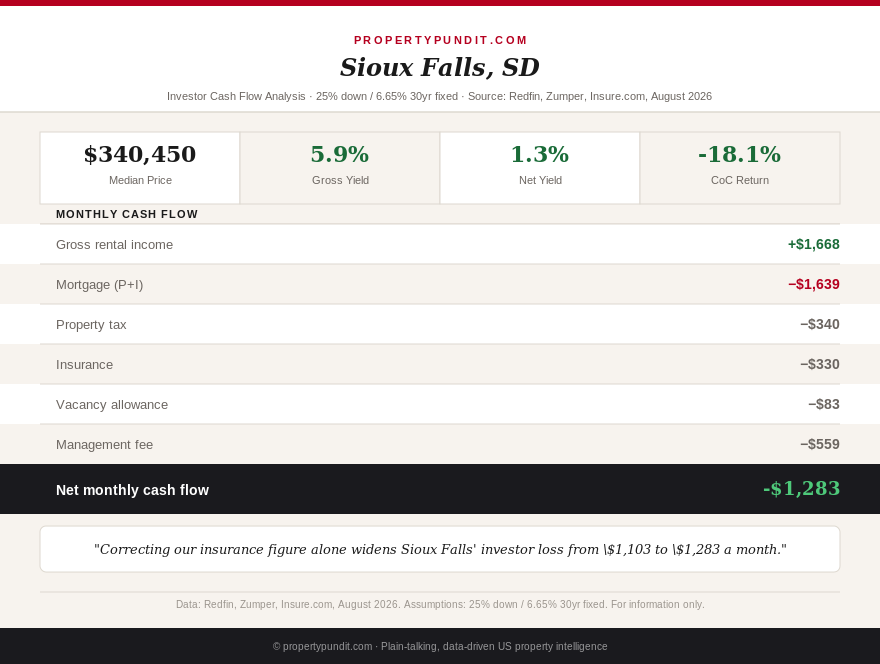
Our June 28, 2026 first pass on Sioux Falls used a $150-a-month insurance estimate in the cash-flow table. The actual 2026 statewide average for South Dakota homeowners insurance is $3,965 a year, or about $330 a month (Insure.com, 2026), more than double what we modeled, and in line with a pattern we've now caught in several other second-pass states: insurance is the line item most likely to be understated on a first look, and it's rarely a small miss.
Sioux Falls' median sale price has also moved since June, to $340,450 over the three months ending July 2026, up 1.6% year over year (Redfin). Zillow's smoothed home value index shows $313,960 for the same period, also up 1.6% year over year; the two diverge because Redfin reflects actual closed transactions and Zillow smooths across the full housing stock, including homes that haven't sold recently. Rents have moved too: Zumper puts the average 3-bedroom house at $1,668 a month as of August 1, 2026, toward the upper end of a $1,552-to-$1,778 range across rental data providers.
Here's the recalculated investor math at the Sioux Falls median, 25% down, at the current 6.65% rate:
| Item | Monthly |
|---|---|
| Purchase price | $340,450 |
| Down payment (25%) | $85,113 |
| Loan amount | $255,338 |
| P&I (6.65%, 30yr) | $1,639 |
| Property tax (1.20%, Minnehaha Co., non-homestead) | $340 |
| Insurance (corrected) | $330 |
| PITI total | $2,309 |
| Gross rent (3BR SFR) | $1,668 |
| DSCR (gross rent / PITI) | 0.72: FAILS |
| Vacancy allowance (5%) | -$83 |
| Property management (8%) | -$133 |
| Maintenance reserve (1.5%/yr) | -$426 |
| Monthly cash flow | -$1,283 |
Rerun that same table with everything updated except the insurance line held at our old, wrong $150 figure, and cash flow comes out to about negative $1,103, actually a touch better than June's negative $1,129, since rent growth has slightly outpaced the higher purchase price. Swap in the corrected $330 insurance figure and the number drops to negative $1,283. That $180-a-month swing is the insurance correction alone, isolated from every other change in the market this year.
The sub-$200,000 entry tier, the segment we flagged in June as the closest thing to breakeven, still exists, but it's worse too. At $200,000 with 30% down and a scaled insurance estimate near $200 a month, PITI runs about $1,299 against roughly $1,550 in rent for an older 2-to-3 bedroom SFR, for a DSCR of 1.19 and cash flow near negative $201, down from the negative $106 we first reported. If you need monthly cash flow today, that entry tier is still the only part of Sioux Falls worth underwriting, but budget for the worse number, not the old one.
Rapid City moved from "nearly identical" to notably worse
Our first pass called Rapid City's math "nearly identical" to Sioux Falls. That's no longer true. Rapid City's median has climbed to somewhere between $356,706 (Redfin, June 2026, up 1.9% year over year) and $365,969 (Zillow, up 1.9% over the same period), a meaningful move from the $315,000-to-$325,000 range we cited two months ago. At 25% down and 6.65% rates, PITI runs close to $2,430 a month once insurance is scaled up for the higher price and corrected the same way as Sioux Falls.
Rapid City's investor case still runs on Ellsworth Air Force Base, home to the 28th Bomb Wing and roughly 5,000 active-duty personnel and contractors. 2026 Basic Allowance for Housing at Ellsworth ranges from about $1,800 to $2,889 a month depending on rank and dependent status, comfortably covering a 3-bedroom home near the base priced under $220,000. But at the city median, with a BAH-anchored rent near $1,600 a month, DSCR comes out to about 0.66 and cash flow to roughly negative $1,484, worse than Sioux Falls' corrected negative $1,283.
The Black Hills tourism layer, Mount Rushmore, Crazy Horse, and the Badlands draw 4 to 5 million visitors a year, still supports a seasonal short-term rental play in the $2,500-to-$4,000-a-month range during peak season, but that requires active management most passive investors don't want. If you're comparing the two cities on a spreadsheet rather than a lifestyle basis, Sioux Falls is now the smaller loss of the two, not the tied one we described in June.
What this means for a South Dakota investor in 2026
South Dakota's real case was never monthly cash flow at the median, and correcting our own numbers hasn't changed that; it's changed how big the gap is. Zero state income tax on rental income is still genuine, still worth roughly $1,780 a year for an investor in the 22% federal bracket collecting $18,000 in rental income who'd otherwise be paying Oregon- or Minnesota-level state tax on it. Population growth in Sioux Falls, still running around 3.2% a year, is still a real appreciation driver. None of that changes because a state law now hands the property tax break to homeowners instead of landlords, and none of it changes because our insurance number was too low.
What does change is the size of the check you write to hold the asset. The math points toward South Dakota as a market for investors who already have cash-flow-positive holdings elsewhere and are buying the income tax efficiency and appreciation with money they can afford to have tied up at a loss for years, not as a first rental purchase for someone who needs the property to pay for itself starting month one. For a first purchase with a real cash-flow requirement, check your numbers against a DSCR lender's minimum before you assume a Plains state's low headline taxes will carry the deal, and compare South Dakota against county-level yield data elsewhere in the Midwest where the entry price is lower and the math has more room to work. If you're weighing how much cash you'd need to bring to a deal like this, the 20%-down assumption is itself often wrong and worth checking before you rule a market out on price alone.
Frankly, if you're deciding between South Dakota and another Plains state purely on which one just cut taxes, that's the wrong question for a landlord to be asking; check who the law actually pays, not just what the headline says, the way we should have priced the insurance line the first time.