 Property
You came to North Dakota for the reasons every out-of-state investor does: low property tax in the right county, a 2.5% top income tax rate, and a housing market that never had the Sun Belt's boom to give back. Then you priced a Fargo rental at today's mortgage rate and the spreadsheet turned red. The rate that made this state look quietly profitable in August is gone: Freddie Mac's 30-year average now sits at 7.32%, up from 6.67% on August 13 (Freddie Mac PMMS, October 22, 2026), and every North Dakota market we run lost another $100 or so a month.
This is the third time we've underwritten the state, and the bottom line is a harder version of the first two. Grand Forks, the best of the four cities, loses $497 a month on a 25%-down purchase. Fargo, the biggest, loses $938. Below you'll find the new numbers, what it would take for Grand Forks to break even, and how much the answer depends on which price source you trust.
Prices here are carried forward from our August pass (Zillow ZHVI and Redfin figures, dated below) because no fresher city-level medians are published for Grand Forks and Williston; the financing cost and the insurance and tax assumptions are the same, so the change you see is the rate. Where a newer reading exists, we flag it.
What 7.32% does to four North Dakota markets
Same method as August: 25% down, a 30-year fixed at 7.32%, county effective property tax rates, landlord insurance at 0.55% of value (North Dakota sits in hail alley), an 8% management fee and one month of vacancy a year. Rents are three-bedroom averages from the August pass.
| Item | Fargo | Bismarck | Grand Forks | Williston |
|---|---|---|---|---|
| Price | $315,000 | $381,727 | $303,687 | $324,361 |
| Principal and interest | $1,623 | $1,967 | $1,565 | $1,671 |
| Property tax | $305 | $286 | $311 | $189 |
| Insurance | $144 | $175 | $139 | $149 |
| Total PITI | $2,072 | $2,428 | $2,015 | $2,009 |
| 3BR rent | $1,355 | $1,810 | $1,815 | $1,792 |
| Effective rent | $1,134 | $1,514 | $1,519 | $1,499 |
| Monthly cash flow | -$938 | -$914 | -$497 | -$510 |
| Coverage (effective rent / PITI) | 0.55 | 0.62 | 0.75 | 0.75 |
| Change since August | -$103 | -$125 | -$101 | -$106 |
Prices from Redfin (Fargo, three-month average through June 2026) and Zillow ZHVI (Bismarck, Grand Forks, Williston); rents from RentCafe, Rentometer and 2026 market data as cited in our August North Dakota analysis. The ranking hasn't changed: Grand Forks and Williston are least bad, and Fargo and Bismarck are worst. What changed is the size of the hole. A lender running a DSCR test (see our DSCR loan guide) wants coverage near 1.0 and would likely decline all four at these ratios. So if you were holding a Fargo or Bismarck contract on the strength of August's numbers, the rate move alone added more than $100 a month to your shortfall, and a deal that was marginal then doesn't survive now.
Grand Forks: what it would take to break even
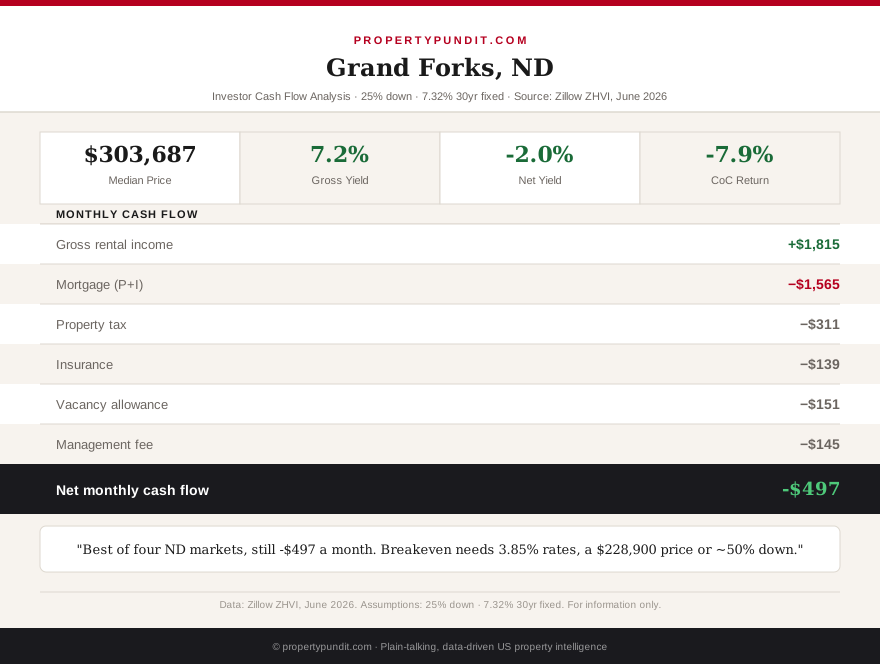
Grand Forks has the best rent in the state, $1,815 a month for a three-bedroom house, a lift that likely reflects steady demand from the University of North Dakota and Grand Forks Air Force Base. Its home values are up 7.6% over the year to $303,687 (Zillow ZHVI, June 2026), and its 1.23% effective property tax rate is the highest of the four. At 7.32% it loses $497 a month. We ran six levers against that number.
| Lever | Monthly cash flow |
|---|---|
| Today: 25% down, 7.32%, $303,687, $1,815 rent | -$497 |
| Rate back at August's 6.67% | -$397 |
| 30% down | -$392 |
| Rent of $2,100 | -$258 |
| 40% down | -$184 |
| 50% down | +$25 |
| Break-even price | about $228,900 |
| Break-even rate | about 3.85% |
| Break-even rent | about $2,408 |
Only one realistic lever gets this property to the black: putting half down, which leaves you with $25 a month on $152,000 of your own cash, a 0.2% annual cash return before appreciation. The rest are out of reach. Rents would have to rise 33% to $2,408, the price would have to fall about 25%, and the rate would have to drop to roughly 3.85%. Even a return to August's rate leaves a $397 loss. So if you're buying in Grand Forks for appreciation, which has been real at 7.6% a year, treat the monthly loss as a carrying cost you're paying for that bet, and size it against your reserves before you sign.
Fargo and Bismarck: the two names investors guess first
Fargo is the state's biggest city and its deepest job base, and at $315,000 it posts the worst coverage at 0.55 and the largest loss at $938. The issue is rent: $1,355 for a three-bedroom (RentCafe/Apartments.com, 2026) against a $2,072 payment. To break even at this price and rate, Fargo rent would need to reach about $2,477, which is 83% above today's. Bismarck is the capital, with a 0.90% effective tax rate, the lowest of the big three counties, and the highest price at $381,727. Its price has climbed faster than its rent, and its coverage is 0.62 with a $914 monthly loss.
Both cities also depend on which price you trust. Fargo's $315,000 is a Redfin three-month average through June 2026. A Redfin figure republished in May 2026 put Fargo's median sale price at $304,054, down 5.7% from a year earlier (Stacker/Redfin analysis, May 2026), and an automated valuation estimate dated September 14, 2026 reads $322,840, up 4.48% (Foreclosure.com). Those three prices imply monthly losses of $866, $938 and $990 at today's rate. The sources disagree because one tracks closed sales, one tracks a model, and Fargo's sale prices have moved in both directions since spring, but the conclusion holds across all of them: no price in that range comes close to covering the payment. Likewise, Bismarck's August Zillow reading of $377,821 (up 5.5% year over year) moves the loss to $889, not far from the $914 above. For you, that means the price source can shift a Fargo or Bismarck loss by about $125 a month but can't turn it positive, so don't let a seller's comp or a model number talk you into a better-looking spreadsheet.
Williston and the tax edge that doesn't pay the bills
Williston posts the lowest property tax, 0.70% in Williams County, which keeps the tax line at $189 a month against $305 in Fargo, and a loss of $510 on a $324,361 purchase. Zillow's index and Redfin's closed-sales median disagree here by $54,539 (we used the lower, broader figure in August), a thin-market gap that would raise the loss if you used the Redfin number. Oil context matters as well: in August we found the state's active rig count fell during a geopolitical oil-price spike, so there's no new drilling cycle behind Williston rents.
North Dakota's tax picture is also easier to misread than to find. It isn't a zero-income-tax state: the 2026 brackets run 0%, 1.95% and 2.5%, and they apply to rental income. The $1,600 Primary Residence Credit goes to owner-occupants only and specifically excludes rentals (North Dakota Office of State Tax Commissioner, tax.nd.gov). A landlord here pays low-ish rates but receives none of the relief homeowners get. Williston's $122-a-month property tax advantage over Grand Forks is nearly all absorbed by its higher purchase price and lower rent, leaving it $13 a month worse. So if you're comparing the two, decide on rent and price, because the tax rate is not what separates these deals.
The call on North Dakota rentals right now
Frankly, if your plan is a cash-flowing North Dakota rental financed at today's rate with 25% down, the math says no in all four cities. The most defensible position is Grand Forks, either with roughly half down (about $152,000 of cash for +$25 a month) or as an appreciation play where you've budgeted $400 to $500 a month of carrying cost. Williston is a similar deal at a thinner, more volatile market. Fargo and Bismarck should wait for either a meaningful price correction, which Fargo's spring figures suggest is possible, or a materially lower rate.
Most investors who run these numbers end up in one of two places: they move to a market with higher rent relative to price, like the ones in our single-family yield county map, or they stay in North Dakota with a much larger down payment and a long hold. If you're staying, set a hard rule: don't close on anything with coverage below 0.75 unless you can name the reserve account that pays the shortfall, and re-run the numbers the week the next Freddie Mac rate posts.
Frequently asked questions
Are North Dakota rental properties profitable in 2026?
Not at today's rates. At 7.32% with 25% down, Grand Forks loses about $497 a month, Williston $510, Bismarck $914 and Fargo $938 on three-bedroom rents.
What is the best city in North Dakota for a rental property?
Grand Forks has the best coverage at 0.75 and the highest three-bedroom rent at $1,815, but it still loses $497 a month. Putting half down brings it to about breakeven.
What rent would a Fargo rental need to break even?
About $2,477 a month at a $315,000 price, 25% down and a 7.32% rate, 83% above the $1,355 three-bedroom average (RentCafe, 2026).
Does North Dakota have a state income tax on rental income?
Yes. The 2026 brackets are 0%, 1.95% and 2.5%, and they apply to rental income. North Dakota is not a zero-income-tax state.
Can landlords claim North Dakota's $1,600 property tax credit?
No. The Primary Residence Credit is limited to owner-occupied homes and excludes rental and investment properties (tax.nd.gov).
What was the Freddie Mac 30-year rate on October 22, 2026?
7.32%, down from 7.40% the week before and up from 6.19% a year earlier (Freddie Mac PMMS).