 Property
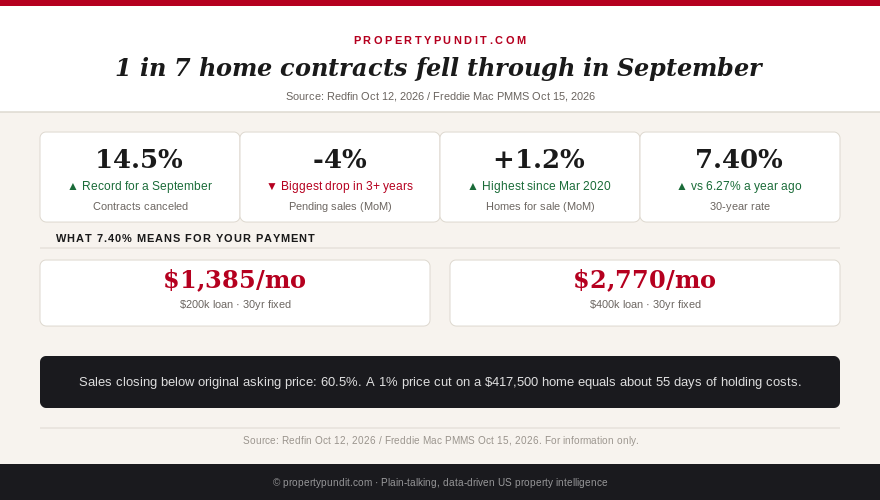
If you own a home at 3.8% and you're weighing a sale, the number to watch this week isn't the 7.40% mortgage rate. It's 14.5%. That's the share of homes that went under contract in September and then fell apart, the highest for any September in Redfin's records (Redfin, October 12, 2026). About 1 in 7 deals that looked finished weren't.
The cancellations arrived with the weakest demand in more than a decade. Redfin's seasonally adjusted pending sales fell 4% from August, the largest monthly drop in over three years, to the lowest level since spring 2014 outside April 2020 (Redfin, October 12, 2026). Before 2020, the cancellation rate never exceeded 12% in 2017 through 2019, and only March and April 2020 have run higher than September 2026 (Benzinga, October 14, 2026).
Below I put dollar figures on a failed contract, show why it should change how you price a listing, and update what your 3.8% lock-in is worth against today's rates. It's a data drop, so the table comes first.
Get this in your inbox every Friday.
One email. The number that matters and what it means for you.
The September numbers, in one table
| Measure (September 2026) | Figure | What it says |
|---|---|---|
| Contracts canceled | 14.5% | Highest September in Redfin's records |
| Pending sales, month over month | -4% | Biggest monthly drop in over three years |
| Closed sales, month over month | -1.6% | Lowest since late 2023 |
| Homes for sale, month over month | +1.2% | Highest level since March 2020 |
| Median sale price | $393,895 | +1.3% year over year, slowest gain since February |
| Sales closing below original asking price | 60.5% | Most buyers got a discount |
| Active sellers cutting their price | 19.8% | About 1 in 5 listings |
All figures are Redfin's, reported October 12, 2026; price is not seasonally adjusted. The cancellation rate is not spread evenly. Jacksonville ran 19.9%, Tampa 18.8%, Las Vegas 18.6%, San Antonio 18.5% and Phoenix 18.4%. Pending sales fell year over year in all 50 of the largest metros, with Seattle down 24.4% and Los Angeles down 16%.
So what for you: if you list in Jacksonville, Tampa, Las Vegas, San Antonio or Phoenix, plan for roughly a 1-in-5 chance that your first contract dies. Ask your agent for your own metro's number before you set a timeline.
Why contracts are dying
Redfin's explanation is bargaining power. With more sellers than buyers, a buyer who finds a problem at inspection, or a better house, can walk. The company also points to financial anxiety: housing costs near historic highs, worry about layoffs and tariffs, and first-time buyers who spent most of their savings on the down payment (Redfin, February 2026 release on cancellations). The Redfin release I read does not cite mortgage denials as a driver.
The rate backdrop matters at the margin. Freddie Mac's 30-year average was 7.40% in the October 15 survey, up from 6.27% a year ago, and the 15-year was 6.71% (Freddie Mac PMMS, October 15, 2026). Daily trackers read lower this week: Optimal Blue's index was 7.32% on October 20, below its 52-week high of 7.46% on October 5 (MortgageDaily, October 20, 2026).
So what for you: if you're a seller, assume the buyer's inspection is a negotiation, not a formality, and price the house so a $3,000 to $5,000 repair credit doesn't sink the deal.
What a failed deal costs a seller
Here's a worked example. Say you own at 3.8% with a $300,000 balance. Your principal and interest is $1,398 a month. Add $900 for property tax, insurance, utilities and upkeep (my assumption; use your own number) and holding the house costs about $2,300 a month. You list at the national existing-home median of $417,500 (NAR, September 2026).
| Scenario | Math | Cost |
|---|---|---|
| Contract dies, relist takes 45 days | 1.5 months x $2,300 | $3,450 |
| Contract dies, relist takes 90 days | 3 months x $2,300 | $6,900 |
| Cut the price 1% | 1% x $417,500 | $4,175 |
| Cut the price 3% | 3% x $417,500 | $12,525 |
| Expected cost of fall-through risk | 14.5% x $3,450 | about $500 |
The comparison that matters is the 1% cut. At $2,300 a month, a $4,175 price cut equals about 55 days of carrying cost. If a cut shortens your time on market by more than 55 days, it pays for itself; if it saves 20 days, you've given away money. The 14.5% fall-through risk adds only about $500 in expected cost per listing at a 45-day relist, so it shouldn't drive a panic cut by itself.
The bigger signal is the 60.5% of sales that closed below the original asking price, because that's the market telling you where houses actually clear. Price near the clearing level from day one and the cancellation risk shrinks, since a buyer who feels they got a fair price has less reason to walk.
So what for you: cut the price only when you expect it to save more than about 55 days at your carrying cost, and do your own version of this table with your real monthly number.
What your 3.8% is worth against today's rates
Move up from that $417,500 median with 20% down and you borrow $334,000. At 7.40% the principal and interest is $2,313 a month. At 6.27%, last year's rate, it would have been $2,061, so the year's rate rise costs a new buyer $252 a month. Against your 3.8% rate, the same $334,000 would cost $1,556, a gap of $757 a month, or $9,084 a year.
| Rate on a $334,000 loan | Monthly principal and interest | Versus 3.8% |
|---|---|---|
| 3.8% (your current rate) | $1,556 | - |
| 6.27% (October 2025 PMMS) | $2,061 | +$505 |
| 7.32% (Optimal Blue, October 20) | $2,294 | +$738 |
| 7.40% (PMMS, October 15) | $2,313 | +$757 |
Those figures cover principal and interest only; taxes and insurance come on top. The cancellation record doesn't change that gap, but it does change what you can ask for. Redfin's Chen Zhao says slower competition gives buyers more room to negotiate price, repairs and closing costs (Benzinga, October 14, 2026). On a $334,000 loan, a seller credit that buys the rate down a quarter point saves about $57 a month.
So what for you: if you must move, the lock-in cost is fixed at roughly $757 a month on this example, so the negotiable piece is the purchase price and credits, not the rate.
If you're the buyer on the other side
A 14.5% cancellation rate also means listings reappear. A house that went pending can return to the market a few weeks later, usually after an inspection or financing problem, and the seller who just lost a buyer is often more flexible. Ask the listing agent to put you on a backup offer list, and keep an eye on pending listings you liked.
NAR's September report points the same way: existing-home sales rose 1.5% from August to a 3.99 million annual pace but were 2.2% below a year earlier, with 1.60 million homes for sale, up 1.9% (NAR, October 13, 2026). NAR's Lawrence Yun said August and September were the year's slowest sales months and that further rate rises could leave fewer buyers able to qualify. The next catalyst is the Federal Reserve's meeting on October 28, followed by the PCE inflation report on October 29 (MortgageDaily, October 20, 2026).
So what for you: as a buyer, get preapproved with a lender who'll hold a rate lock, and keep your inspection contingency; both are cheaper than losing a deposit.
What this means for you
The cancellation record is a symptom of a market with plenty of sellers and too few confident buyers. If you're selling, set your price by the 60.5% rule, not by last spring's comps, and compare any price cut to your monthly carrying cost before you make it. If you're buying, use the leftover bargaining power on price, repairs and credits, because that's the only lever a 7.40% market gives you. And if you own at 3.8%, the data says there's no hurry: your gap to today's rates is worth about $757 a month, and nothing in this report closes it.
What I couldn't verify
Freddie Mac's October 22 survey hadn't posted when I wrote this, so 7.40% is the October 15 reading. The Kobeissi Letter figure that sellers outnumber buyers by 63% appears in coverage without a clear definition, so I left it out of the analysis. The $900 monthly holding cost and the 45-day relist time are my assumptions, not Redfin data. I used a national price from NAR ($417,500) for the example; your local median may differ.
Frequently asked questions
What share of home contracts fell through in September 2026?
Redfin reported that 14.5% of homes that went under contract in September were canceled, the highest September rate in its records (Redfin, October 12, 2026). Before 2020, the monthly rate never exceeded 12% from 2017 through 2019.
Which metros have the highest contract cancellation rates?
Redfin listed Jacksonville at 19.9%, Tampa at 18.8%, Las Vegas at 18.6%, San Antonio at 18.5% and Phoenix at 18.4% in September 2026 (Redfin, October 12, 2026).
Should I cut my price if my buyer backs out?
Compare the cut to your monthly carrying cost. With carrying costs of $2,300 a month, a 1% cut on a $417,500 house ($4,175) equals about 55 days of holding the property, so cut only if it should save you more than that.
How much more does a new mortgage cost than a 3.8% rate?
On a $334,000 loan, principal and interest is $1,556 at 3.8% and $2,313 at 7.40%, a gap of $757 a month (Freddie Mac PMMS, October 15, 2026, and PropertyPundit calculations).