 Property
You've run the payment at 7.24% and the number on a $400,000 house is ugly: $2,453 a month in principal and interest on a 10%-down loan, before taxes and insurance. Somewhere in the back of your mind is the comfort that the mortgage interest deduction will take a big bite out of that. It will take a bite. It just isn't the bite you're picturing.
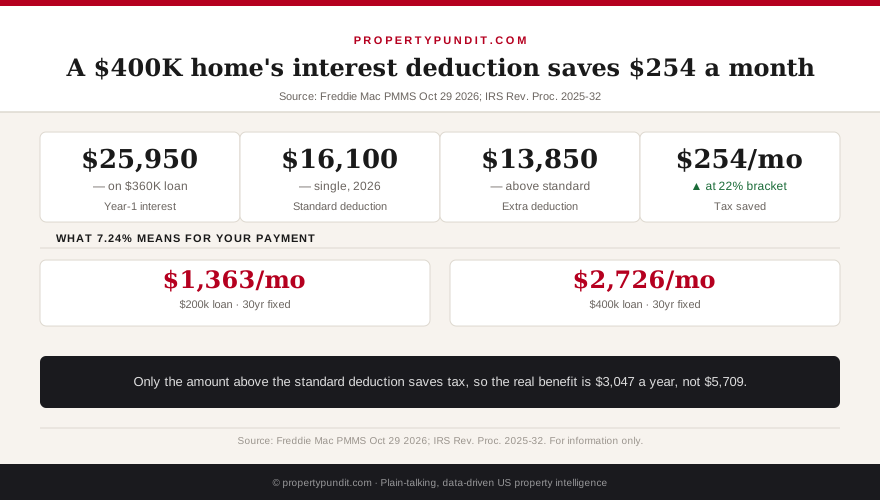
Freddie Mac's 30-year average is 7.24% (Freddie Mac PMMS, October 29, 2026), so first-year interest on a $360,000 loan is $25,950. Multiply that by a 22% bracket and you get $5,709 a year, or $476 a month, which is the number most people carry around. The real figure is $3,047 a year, or $254 a month. The difference is one rule: you only benefit from what you deduct above the standard deduction you'd have claimed anyway.
Get this in your inbox every Friday.
One email. The number that matters and what it means for you.
The $25,950 you'll hear about isn't the number that matters
Here's the worked example. A single filer earns $112,000 in wages and has no other itemized deductions. The 2026 standard deduction for a single filer is $16,100 (IRS Rev. Proc. 2025-32), which leaves $95,900 of taxable income, inside the 22% bracket that runs from $50,400 to $105,700 for singles in 2026. The home costs $400,000, with $40,000 down and a $360,000 loan at 7.24%.
- First-year mortgage interest: $25,950
- Property tax at an assumed 1% of price: $4,000
- Total itemized deductions: $29,950
- Standard deduction you give up: $16,100
- Extra deduction from owning: $13,850
- Tax saved at 22%: $3,047 a year, or $254 a month
That $254 offsets about 10% of the $2,453 principal and interest payment. It's real money, and it's a long way from the $476 you get by multiplying the interest line by your bracket. The first $16,100 of deductions was already yours.
So if you're budgeting a $400,000 purchase, count about $254 a month of tax relief at most, and count it as a bonus rather than a reason to stretch.
A bigger house raises the savings and the bill
The same math at four prices shows how little of each extra dollar of interest comes back. All rows use 10% down, 7.24%, a 1% property tax assumption and the same single filer in the 22% bracket.
| Price | Year-1 interest | Itemized total | Above standard | Saved per year | Saved per month |
|---|---|---|---|---|---|
| $250,000 | $16,219 | $18,719 | $2,619 | $576 | $48 |
| $300,000 | $19,462 | $22,462 | $6,362 | $1,400 | $117 |
| $400,000 | $25,950 | $29,950 | $13,850 | $3,047 | $254 |
| $500,000 | $32,437 | $37,437 | $21,337 | $4,694 | $391 |
Going from $300,000 to $500,000 raises the monthly principal and interest payment by $1,227 ($1,840 to $3,067) and raises your tax saving by $274. In other words, the government returns about 22 cents of each extra interest dollar and you keep paying the other 78.
For you, that means the deduction should never be the reason a higher price feels affordable.
Who gets nothing: cheaper homes and married couples
Run the same loan structure on cheaper homes and the standard deduction wins. With 10% down at 7.24% and a 1% property tax, itemizing doesn't beat the $16,100 standard deduction until the price reaches about $215,000. Below that, the deduction saves you nothing, however large the mortgage feels.
Couples face a higher bar. The 2026 standard deduction for married couples filing jointly is $32,200 (IRS Rev. Proc. 2025-32). The $400,000 house above produces $29,950 of itemized deductions, which is $2,250 short, so a couple with that mortgage and no other deductions saves $0 by itemizing. You'd need roughly a $450,000 home on the same terms before the deduction starts to matter.
If you're a first-time buyer in the $250,000 to $350,000 range, treat the interest deduction as worth $0 to $185 a month and decide on the payment alone.
The saving shrinks every year
Interest is front-loaded, so the deduction is largest in year one and drifts down as the balance falls. Holding property tax at $4,000 and the standard deduction at $16,100 (it normally rises with inflation, which makes this a generous estimate), the $400,000 example looks like this:
- Year 1: $25,950 of interest, $254 a month saved
- Year 5: $24,781 of interest, $232 a month saved
- Year 10: $22,756 of interest, $195 a month saved
By year 10 the relief has fallen by about 23%, and a rising standard deduction would trim it further. So if you're comparing owning with renting over a decade, use a declining number rather than $254 forever, and see the Nashville rent-vs-buy break-even for the rent side of that comparison.
A lower rate saves you more on the payment than on the deduction
It's tempting to think a falling rate will cost you tax relief, so here's what happens to the same $360,000 loan. At 6.5% the payment drops $178 a month to $2,275 and the deduction falls $49 a month to $205. At 6.0% the payment is $2,158 and the tax saving is $172. At 5.0% the payment is $1,933 and the saving is $106.
Every rate drop leaves you better off overall: the payment falls roughly $3.50 for every $1 of tax relief you lose. So if you're waiting for a lower rate and worrying about the deduction, stop worrying about the deduction.
What to do with this
The math points toward ignoring the deduction when you decide how much house you can afford. Lenders don't count it when they calculate your debt-to-income ratio, as the debt-to-income explainer lays out, and it only shows up months later as a lower tax bill or a bigger refund.
Frankly, if your plan only works with the tax savings in it, the plan is too tight. Most people who run these numbers end up treating $250 a month as a cushion for repairs, not as income. Two more things to check before you buy: whether paying points changes your first-year deduction (the mortgage points myth-buster covers the break-even), and how your property tax will be set after you close (the property tax reset article explains why your bill may differ from the seller's). Then ask a tax preparer to run your actual return, because state income tax, other deductions and your real bracket will move every number here.
Frequently asked questions
How much does the mortgage interest deduction save on a $400,000 home? For a single filer in the 22% bracket with 10% down at 7.24%, about $3,047 in the first year ($254 a month), because only the $13,850 above the $16,100 standard deduction reduces taxable income.
Is it worth itemizing with a mortgage in 2026? Only if your interest, property tax and other itemized deductions exceed the standard deduction: $16,100 for single filers and $32,200 for married couples filing jointly (IRS, 2026). At 7.24% with 10% down and a 1% property tax, a single filer passes that threshold near a $215,000 price.
Do mortgage lenders count the tax savings when I apply? No. Lenders qualify you on gross income and your monthly debts, so the interest deduction doesn't raise the loan you can get.
Does the deduction shrink as I pay down the loan? Yes. On the $360,000 example, interest falls from $25,950 in year one to $22,756 in year ten, and the monthly tax saving falls from $254 to about $195 if the standard deduction and property tax stay constant.