 Property
You're 34, you pay about $2,050 a month to rent in Nashville, and every headline says renting is dead money. Then you price a mortgage at Freddie Mac's 7.40% (October 15, 2026) and the payment on a $347,000 home comes to $2,690 before a dollar of repairs. The question that matters is how many years you'd have to stay before owning comes out ahead.
I ran it. With 10% down, a 7.40% rate and 2% annual appreciation, buying beats renting in year 14. At 3.5% appreciation it's year 8. At 0% it doesn't happen inside 15 years. The median U.S. homeowner stays 12 years (Redfin, 2026), so at today's rate a typical buyer sells before the math turns.
Some readers will take that as "never buy." The conclusion is narrower. The break-even year moves a long way with a few inputs you control, and the table below shows which ones. The decision comes down to matching your time horizon to the break-even year, and today's rate pushes that year out.
Get this in your inbox every Friday.
One email. The number that matters and what it means for you.
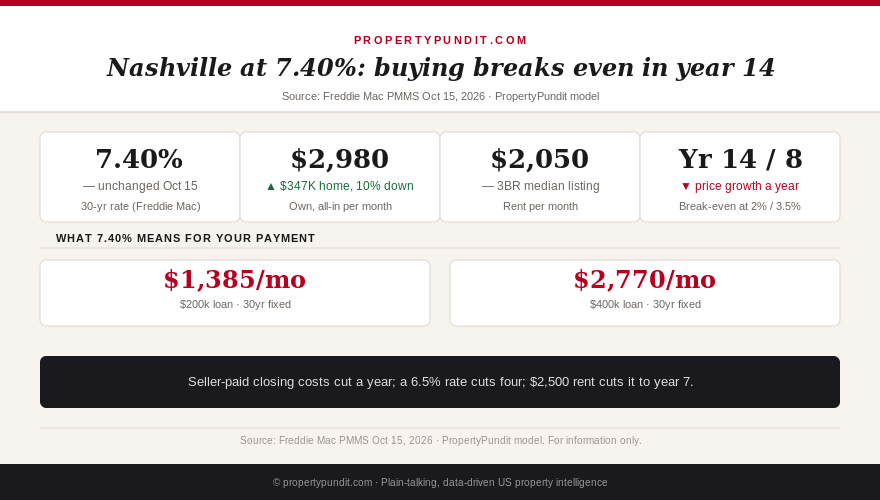
The monthly gap: $2,980 to own, $2,050 to rent
The price is $347,000, about what a $112,000 income supports under the 28% guideline: the payment below is 28.8% of gross monthly income. That is 25% under Nashville's September median sale price of $464,779 (Redfin, down 1.1% year over year), so in Nashville this budget buys a condo, a townhome or a smaller house outside the core.
| Monthly cost | Amount | Basis |
|---|---|---|
| Principal and interest | $2,162 | $312,300 loan (10% down), 30-year fixed at 7.40% |
| Property tax | $237 | 0.82% in-city Davidson County rate |
| Homeowners insurance | $135 | Estimate scaled from a Nashville quote |
| Mortgage insurance | $156 | 0.6% of the loan a year, until 80% of purchase price |
| Maintenance | $289 | 1% of price a year |
| Owning, all-in | $2,980 | Year-one total |
| Renting | $2,050 | Three-bedroom median listing, RentHop, October 2026 |
The $930 difference is what a renter can save or invest each month. You also need $45,110 up front to buy: $34,700 down plus 3% for closing costs. In the model the renter invests that $45,110 on day one, so both paths start with the same money.
Some online calculators leave out maintenance and mortgage insurance, which makes owning look cheaper than it is. With both included, the table shows the payment you'd really carry. If $2,980 plus savings for a roof doesn't fit your budget, skip to the section on what moves the break-even.
When buying catches up: the scoreboard
Each cell shows how much richer the buyer is (positive) or poorer (negative) than the renter at that year, after 6% selling costs. The renter earns 4% on savings and pays rent that rises 3% a year.
| Year | Prices flat (0%) | Prices +2% a year | Prices +3.5% a year |
|---|---|---|---|
| 1 | -$41,496 | -$34,972 | -$30,080 |
| 5 | -$77,672 | -$43,723 | -$16,453 |
| 7 | -$92,065 | -$43,567 | -$3,253 |
| 10 | -$105,034 | -$33,602 | +$28,895 |
| 12 | -$106,351 | -$18,856 | +$60,349 |
| 15 | -$98,500 | +$14,315 | +$121,785 |
The 2% column crosses zero in year 14. The 3.5% column crosses in year 8. The flat-price column is still $98,500 behind in year 15. Nashville's median sale price is down 1.1% over the past year, and the national median is up just 1.3% ($417,500, NAR, September 2026), so 2% is a reasonable middle case, not a pessimistic one.
Notice that the buyer's loss is largest in years 5 to 7, the stretch when many buyers change jobs, marry or have children and decide to sell. If you might move inside seven years, the model says renting leaves you about $44,000 ahead at 2% appreciation.
What moves the break-even year
Rent is the largest lever and rate is the most visible one. Each row changes one input from the base case (2% appreciation) unless noted.
| Change from base | Break-even year |
|---|---|
| Base: $347,000, 7.40%, $2,050 rent, 10% down | 14 |
| Seller pays your closing costs (about $10,410) | 13 |
| Price negotiated 5% lower ($329,650) | 12 |
| Price 5% lower and seller pays closing costs | 11 |
| Mortgage rate 7.0% / 6.5% / 6.0% from day one | 12 / 10 / 9 |
| 20% down instead of 10% (no mortgage insurance) | 10 |
| Comparable rent $2,300 / $2,500 instead of $2,050 | 10 / 7 |
| Rent grows 5% a year instead of 3% | 11 |
| Rent grows 1% a year | Past 15 |
| Renter earns 5% instead of 4% on savings | Past 15 |
That last row matters now. The 10-year Treasury yield fell to about 5.1% on Thursday (Yahoo Finance, October 15, 2026), so a renter parking the $930 monthly difference in Treasuries can earn more than the 4% I used. Interest is taxable, which narrows the gap, but the point stands: high rates reward savers as well as punishing borrowers.
Rent is where your own numbers beat mine. RentHop's October data shows a three-bedroom median of $2,050, up 7.3% from a year earlier, yet its two-bedroom median fell 12.1%, so the figures conflict across bedroom counts. Look up what a home like the one you'd buy actually rents for. If it's $2,500, the break-even drops to year 7 and the answer changes to buy.
What the market is telling a Nashville buyer right now
Freddie Mac's 30-year rate held at 7.40% this week, 1.13 points above last year's 6.27%, and the 15-year edged down to 6.71%. Zillow's daily purchase average on Thursday was 7.36%. September CPI came in hot at 3.7%, and the consensus in Yahoo Finance's October 15 report is a Fed hold this month and a hike in December. That doesn't point to a rate that falls soon.
The sales data looks soft but not collapsing. NAR reported September existing-home sales up 1.5% from August and down 2.2% from a year earlier, with 4.8 months of supply, and Lawrence Yun said buyers have more negotiating power with higher inventory and longer days on market. Analyst Ali Wolf called it the last clean read before rates rose above 7%, so expect October to show the rate effect.
Nashville gives you bargaining power on paper. Redfin shows homes taking a median 66 days to sell, a 97.4% sale-to-list ratio and 38.3% of listings with price drops (September 2026). Redfin counted seller concessions on 75.5% of Nashville sales in spring 2026, the highest of 28 metros it tracked. Use that: the table shows a seller who covers closing costs saves you a year, and a 5% price cut saves two.
The rule I'd use
Buy when the break-even year, run with your own rent and your own price, is at least three years shorter than the number of years you expect to stay. At today's base case, that means committing to roughly 17 years, which almost nobody can promise. With a 5% price cut and a seller-paid closing, the break-even is 11 years and the commitment drops to 14.
If you can't make that commitment, keep renting and save the $930 a month. Over 12 months that is $11,160, about a third of the extra $34,700 that 20% down requires. A full 20% down cuts the break-even from 14 to 10 years and removes the $156 mortgage insurance. Set a trigger to re-run the numbers: a 30-year rate near 6.5% (year 10), comparable rent near $2,300 (year 10) or a seller willing to pay closing costs on a price you've already negotiated down.
If you already have 20% saved and plan to stay a decade, the answer flips: the model says buy. For the payment math behind these figures, see the payment-per-$100,000 rule, and for the timing question, the fall discount versus spring rate comparison.
What the model leaves out
It ignores the tax benefit of owning, which is small at this price because most buyers take the standard deduction. It ignores the forced-saving benefit beyond the equity counted: principal paid is included, but the discipline of a mortgage isn't. It gives the renter perfect discipline in investing $930 a month, which many renters never achieve, so if you wouldn't save the difference, owning looks better than the table shows. It also ignores the value of stability, the risk of a rent spike and the cost of a move.
What I couldn't verify
The $347,000 price is a budget, not a listing. The 0.82% tax rate is the in-city Davidson County figure from our August Tennessee pass, not a parcel bill, and insurance ($135) is scaled from a Nashville estimate, not a quote. Mortgage insurance at 0.6% is an assumption; actual pricing depends on credit score. The $2,050 rent is a RentHop listing median whose bedroom-level data conflict, and a home at this price may rent for more or less. The 4% return, 3% rent growth and 6% selling costs are my assumptions. The Redfin tenure figure of 12 years comes from its 2026 homeowner report as cited in our research file, and I didn't re-open the report today.
Frequently asked questions
Is it better to rent or buy in Nashville in 2026?
At Freddie Mac's 7.40% rate, renting wins for most of the first decade. Owning a $347,000 Nashville home costs about $2,980 a month all-in against $2,050 for a comparable rental, and buying overtakes renting in year 14 at 2% annual appreciation. At 3.5% appreciation, the break-even is year 8.
How long do you have to stay in a home to break even at a 7.40% mortgage rate?
In this model, 14 years at 2% appreciation, 8 years at 3.5% and longer than 15 years at 0%. The assumptions are 10% down, 3% closing costs, 6% selling costs, rent rising 3% a year and a renter who invests the monthly difference at 4%.
How much does a lower mortgage rate shorten the break-even?
Each half-point helps by roughly two years at first: 7.0% gives year 12, 6.5% gives year 10 and 6.0% gives year 9, all at 2% appreciation. A seller who pays your 3% closing costs saves about one year.
Should I wait for mortgage rates to fall before buying a house?
Wait only if you can't stay about 14 years at today's terms. Waiting costs the rent you pay meanwhile, but a house bought at 7.40% and refinanced later also carries refinance costs of about 2% of the loan. Re-run the break-even whenever the rate, the price or comparable rent moves.