 Property
You've been refreshing listings for months, and the single-family houses you can afford keep sliding out of range, so the condos start to look like the only door left open. They're $59,000 cheaper on average, which feels like the answer. Before you tour one, run the monthly number with the dues included, because the sticker gap and the payment gap are two very different sizes.
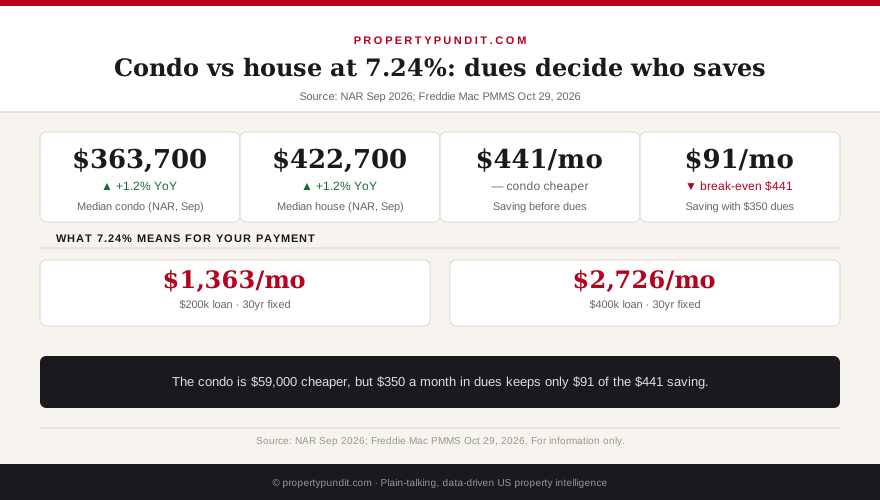
NAR's September 2026 existing-home sales report put the median single-family price at $422,700 and the median condo or co-op price at $363,700, both up 1.2% from a year earlier (NAR, October 13, 2026). Freddie Mac's 30-year fixed rate averaged 7.24% for the week ending October 29, 2026 (Freddie Mac PMMS), down from 7.32% the week before. Here's what those two prices cost you each month, and the dues level where the condo stops being the cheaper choice.
Get this in your inbox every Friday.
One email. The number that matters and what it means for you.
The payment before dues: the condo wins by $441
For the math, assume 10% down, a 30-year fixed loan at 7.24%, no mortgage insurance, and property tax plus homeowner's insurance at 1.6% of the price per year in both columns. Those inputs are illustrative; your county and insurer will differ, and a condo owner's insurance policy usually costs less than a house's, which would tilt the result slightly toward the condo.
| Single-family | Condo or co-op | |
|---|---|---|
| Median price | $422,700 | $363,700 |
| Down payment (10%) | $42,270 | $36,370 |
| Principal and interest | $2,593 | $2,231 |
| Property tax and insurance (1.6%) | $564 | $485 |
| Payment before dues | $3,156 | $2,716 |
On paper the condo is $441 a month cheaper, and you need $5,900 less cash up front. A 14% lower price produces a 14% lower payment, nothing more. The catch is that the condo's monthly bill isn't finished yet.
So if you're comparing the two on payment alone, you're looking at the wrong half of the bill.
Add the dues and the gap shrinks fast
HOA dues sit on top of the mortgage every month for as long as you own the unit. The Census Bureau puts the national median monthly condo or HOA fee at $135 among households that pay one (U.S. Census Bureau, 2024 data), but that median blends small townhome associations with full-service condo buildings. Condo fees run higher: published estimates for typical condos range from $300 to $600 a month, and coastal and high-rise buildings go well beyond that. The $350 row below is an assumption, not a national average, so replace it with the listing you're actually considering.
| Monthly HOA dues | Condo total | Saving vs. house | Income needed at 28% |
|---|---|---|---|
| $0 | $2,716 | $441 | $116,400 |
| $135 (Census median) | $2,851 | $306 | $122,200 |
| $350 | $3,066 | $91 | $131,400 |
| $441 (break-even) | $3,157 | $0 | $135,300 |
| $500 | $3,216 | -$59 | $137,800 |
At $350 a month in dues, three-quarters of the condo's $441 advantage is gone and you're saving $91. At about $441 the two payments are the same, and above that the cheaper condo is the more expensive monthly choice. A house usually has no building association to raise your bill, while the condo's saving shrinks the moment the board raises dues.
That means the dues number, not the price, decides whether the condo is cheaper, so get it before you fall for the unit.
What your budget buys: $350,000 house or $303,000 condo
Work backward from a payment you can carry. On a $112,000 household income, the standard 28% front-end rule gives a ceiling of $2,613 a month for principal, interest, tax, insurance and dues (the same budget used in our buying-power breakdown). At 7.24% and 10% down, that buys about $350,000 of single-family house. The same $2,613 buys about $331,900 of condo if dues are $135, about $303,100 at $350, and about $283,000 at $500.
The condo market's lower sticker price is real, but your budget is the payment, and dues take a slice of it before the mortgage gets any. Each $100 of monthly dues removes about $13,400 of condo you can afford. A HOA fee buying-power explainer on this site shows the same effect across more rates.
If your target is $350,000, you're looking at a house, or a condo that costs well under $300,000 once dues are counted.
Where the condo does have the edge: bargaining power
Condo sales fell 5.4% from a year earlier to a seasonally adjusted 350,000 annual rate in September, a sharper drop than the 1.9% decline in single-family sales (NAR, October 13, 2026). Fewer buyers means more room to negotiate on price, repairs and closing costs, and you can ask the seller to cover some of the closing costs. A seller concession of a few thousand dollars won't change the monthly math much, but a price cut of 3% on a $363,700 unit lowers your payment by about $80 a month before dues.
Low demand also hides a risk. Associations with weak reserves raise dues or levy special assessments, and a buyer who skips the budget review inherits both. The reserve funding check and our condo review guide explain what to request before you make an offer.
So if you're buying a condo, spend part of your negotiating advantage on a clean budget and reserve study, not just on price.
The call: when each one wins
The math points toward the condo only when the dues are low and the building is healthy. Frankly, if dues are above about $250 a month, the cushion that pays for a special assessment, a rate-driven dues hike or a vacant month of your own income is already thin, and most people who run these numbers end up preferring the house or a smaller, lower-dues condo. Under $250 in dues you keep at least $190 a month of the condo's advantage, which is a meaningful saving. Above $441, the house is simply cheaper to own.
Before you tour any unit, ask for the monthly dues, the latest annual budget, and the reserve study, then rerun the table with the real numbers.
Frequently asked questions
Is a condo cheaper than a house in 2026? The median condo or co-op price was $363,700 against $422,700 for single-family homes in September 2026 (NAR). At 7.24% with 10% down, that's about $441 a month cheaper before HOA dues, and $91 cheaper if dues are $350.
How much are HOA fees on a condo? The Census Bureau's national median condo or HOA fee is $135 a month among households that pay one, but typical condo fees are often $300 to $600 and higher in coastal and high-rise buildings.
Do lenders count HOA dues in my debt-to-income ratio? Yes. Dues are included in your monthly housing expense, so higher dues reduce the loan you qualify for. At $350 in dues the income needed at the 28% rule rises from about $116,400 to about $131,400.
At what HOA fee does a condo stop saving money? At 7.24% with 10% down, a median condo and a median house cost the same each month at roughly $441 in dues. Above that level, the house is cheaper.