 Property
You've found two listings in Nashville that look like the same decision on paper: a townhome at $340,000 with a $220-a-month HOA fee, and a detached house three streets over for $365,000 with no association at all. The townhome's asking price is lower, so your gut says it's the better deal, the one that stretches your $112,000 income further. Run the actual numbers a lender uses to qualify you, and that gut call is often backward. The HOA fee doesn't just cost you $220 a month. It quietly shrinks the size of the mortgage you can get approved for in the first place, and almost no one shows you that math before you fall in love with a listing.
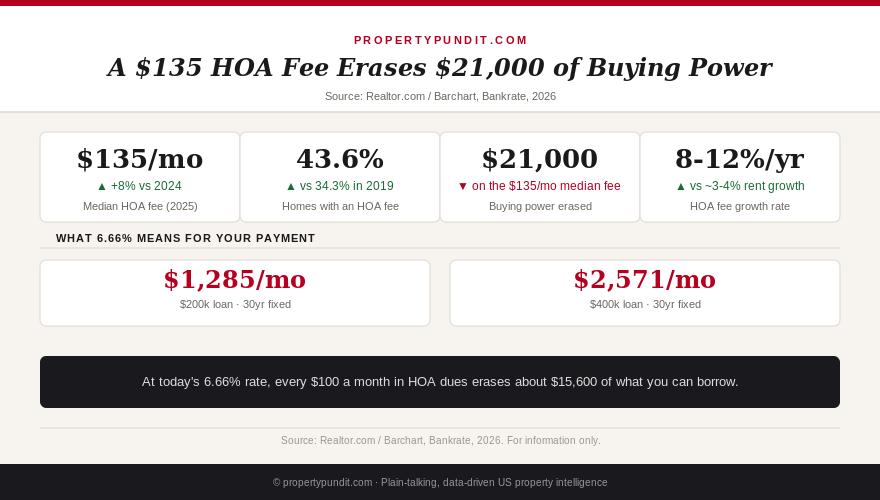
What the median HOA fee actually costs now
The median HOA fee reached $135 a month in 2025, up from $125 in 2024 and $108 in 2019, a 25% increase over six years, according to Realtor.com and Barchart's 2026 analysis of active listings. It isn't a niche cost either: 43.6% of homes for sale now carry a monthly HOA fee, up from 34.3% in 2019, as more new construction gets built inside community associations. The number hides a wide split by property type. Condo owners pay a median $420 a month, up 29% since 2019, largely because condo dues typically fund building insurance, the roof, and shared structural elements. Single-family homes inside an HOA community average a much lower $63 a month, up 26% over the same stretch, usually covering little more than a shared entrance, common landscaping, or a private road.
So what for you: before you compare a condo's price to a house's price, you need to compare the property type each fee actually buys, because a $420 condo fee and a $63 single-family fee are answering completely different questions about what the association is responsible for.
Why dues are outrunning your raise
HOA fees have been climbing 8% to 12% a year in recent Barchart and Realtor.com data, a pace that outruns rent growth of roughly 3% to 4% a year in most markets, and comfortably outruns a typical annual raise. Three forces are driving it: rising insurance costs on the buildings and common areas the association is responsible for, stricter building-safety and reserve-funding standards that spread nationally after the 2021 Surfside condo collapse, and higher labor and material costs for the maintenance every association eventually has to do. None of these pressures are temporary. Insurance costs are still rising across most of the country, reserve requirements are tightening rather than loosening, and labor costs rarely fall once they've climbed.
The Foundation for Community Association Research estimates the number of community associations nationally will grow from roughly 373,000 in 2025 to as many as 377,000 in 2026, meaning more of the housing stock, not less, will carry this kind of fee going forward. About two-thirds of new housing construction is now built inside a community association, so if you're shopping new construction specifically, assume a fee is coming even if the model home doesn't mention one yet.
So what for you: an HOA fee that looks manageable today is not the number you should budget against for the next 10 years, because the underlying cost pressures pushing it up aren't going away, and a fee that grows 10% a year roughly doubles in seven years.
The buying-power math no listing shows you
Here's the part that actually changes your decision. Lenders count your HOA fee as a fixed monthly obligation inside your debt-to-income ratio, exactly like property tax or homeowners insurance, even though the fee is billed by the association, not your mortgage servicer. Every dollar you commit to dues is a dollar you can't put toward principal and interest, which means it directly shrinks the loan size you qualify for, not just your monthly budget.
Bankrate calculated in March 2026, using that month's average 6.27% rate, that every $100 a month in HOA dues erases about $16,200 of purchasing power. Rates have moved since then. At today's 6.66% Freddie Mac PMMS average (August 27, 2026), the same $100 a month in fixed dues erases closer to $15,600 of qualifying loan amount, using standard 30-year amortization math. On the 2025 median $135 fee, that's about $21,000 of borrowing power gone, before a single dollar of the fee has bought you anything you can resell.
| Monthly HOA fee | Buying power erased at 6.66% |
|---|---|
| $63 (median single-family HOA) | ~$9,800 |
| $135 (national median, all HOAs) | ~$21,000 |
| $220 (typical townhome example above) | ~$34,200 |
| $420 (median condo) | ~$65,400 |
Notice the asymmetry: the $340,000 townhome from the opening example, with its $220 HOA fee, has effectively priced out about $34,200 of your qualifying power compared to a fee-free property. Its $25,000 lower list price than the house next door doesn't come close to offsetting that. The house is very likely the better move on pure lending math, even though the townhome's price tag looked like the win.
Run it against a concrete income. At $112,000 a year and a lender's standard 43% back-end debt-to-income ceiling, roughly $4,013 a month is available for every housing-related and other debt payment combined. Commit $220 of that to an HOA fee before you've even chosen a mortgage, and you've spent about 5.5% of your entire monthly debt ceiling on a payment that builds no equity and isn't reflected in the $34,200 buying-power figure above, which only measures the loan side. Add a car payment and a student loan on top, and the HOA fee is frequently the one recurring obligation on the list you could have chosen to avoid entirely.
So what for you: run this math on every HOA-attached listing before you get attached to it, because the sticker price difference between two homes is frequently smaller than the buying-power gap their monthly fees create.
The "shadow mortgage" you can't refinance away
Bankrate and other 2026 coverage have started calling rising HOA dues a "shadow mortgage," and the comparison holds up uncomfortably well. Like a mortgage payment, an HOA fee is a fixed monthly obligation you must pay to keep your home. Unlike a mortgage payment, it isn't fixed for 30 years, it doesn't build you any equity, it generally isn't tax-deductible, and you can't refinance it to a lower rate when your budget gets tight. An HOA board or a majority vote of homeowners can raise it whenever the association's finances require it, and if the reserve fund is underfunded, as many are, the fee increase can arrive alongside a special assessment, a one-time bill that can run into the thousands of dollars per unit.
An August 2026 report from 24/7 Wall Street, building on the same shadow-mortgage framing, documented owners whose monthly HOA payment jumped from roughly $600 to $1,300 in a single reassessment, a shift severe enough to push some households toward foreclosure even though their actual mortgage payment never changed. That's the real risk profile of an HOA fee: it behaves like debt you took on without underwriting it the way your mortgage was underwritten.
So what for you: treat your HOA fee as a second, less predictable housing payment when you stress-test your budget, not as a minor add-on line item next to your actual mortgage.
How to budget for it before you make an offer
The math points toward pulling three things before you write an offer on any HOA property: the association's fee history for the last three to five years, its most recent reserve study, and its meeting minutes for any discussion of a pending special assessment. A flat fee history with a fully funded reserve is a genuinely different risk than a fee that's jumped every year with a reserve study showing a shortfall, even if today's monthly number looks identical on both listings. If you're financing a condo specifically, your lender will require an HOA questionnaire or certification anyway, covering owner-occupancy ratios, litigation history, and reserve funding, so ask your agent to request it during your due-diligence period rather than waiting for underwriting to surface a problem after you're already under contract and paying for an appraisal.
Frankly, if you're comparing two otherwise similar properties and one carries an HOA fee, discount its advertised price by that fee's trailing growth rate projected out five to seven years, not just today's number, before you decide which one actually fits your down payment and budget. Add that projected figure to your closing costs worksheet alongside the other hidden costs that sit above your mortgage payment, since HOA dues are one of the few costs on that list that can legally increase without your consent. If you're weighing whether a rental property's HOA math tells a different story than a primary home's, the investor-side breakdown of the same fee walks through how it hits cap rate instead of qualifying power. Either way, the $135 median fee isn't the number to budget against. The number five years from now is.