 Property
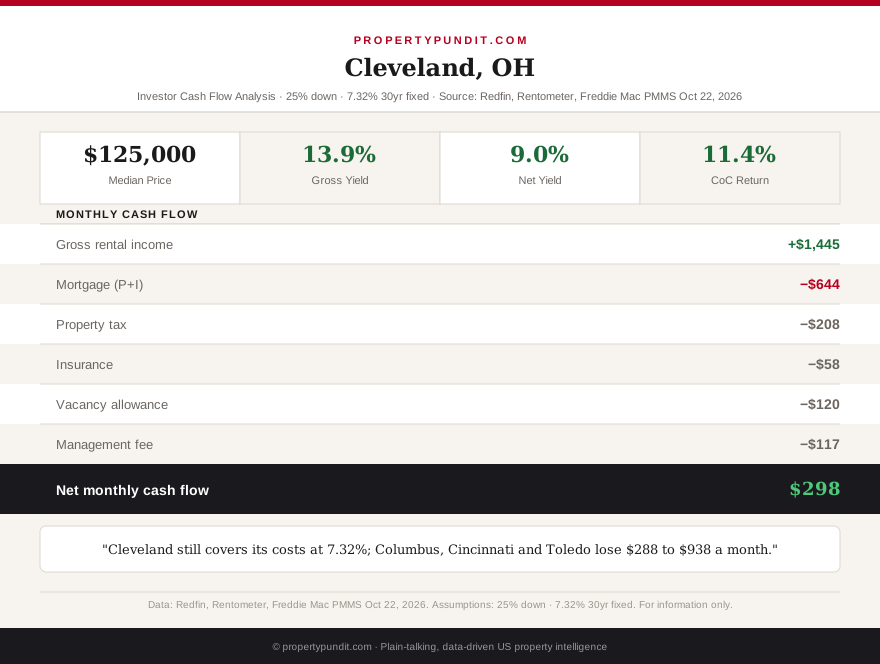
You ran Cleveland's numbers in August, saw a 1.39 coverage ratio, and told yourself you'd move once the rate settled. It didn't settle. The 30-year fixed went from 6.67% to 7.32% (Freddie Mac PMMS, October 22, 2026), and the question sitting in your head now is whether the one Ohio deal that worked just died on you.
It didn't, but it shrank. This is a third-pass re-underwrite of Ohio at the new rate, building on this site's August Ohio spotlight, and it comes with a clear split: Cleveland still pays you, and the other three big Ohio metros got worse.
Get this in your inbox every Friday.
One email. The number that matters and what it means for you.
Cleveland at 7.32%: the same deal, $40 a month thinner
Cleveland's median sale price is about $125,000 (Redfin, January 2026 reading, the latest city-level figure this site has verified), and Cuyahoga County's effective property tax rate is roughly 2.00%. On a 25%-down purchase, the $93,750 loan costs about $644 a month in principal and interest at 7.32%, up from $603 at August's 6.67%. Add $208 a month in property tax and $58 in landlord insurance and total payment lands at $910 against $870 in August.
Rent held up. A single-family 3-bedroom rents for about $1,445 (Rentometer, 2026 mid-year single-family report), which becomes $1,208 after a one-month annual vacancy allowance and an 8% management fee. That leaves roughly $298 a month in cash flow and a coverage ratio of 1.33, down from $338 and 1.39. The cash-on-cash return on your $31,250 down payment drops from about 13.0% to about 11.4%.
One caution on price: Zillow's home value index puts a typical Cleveland home lower, at $104,666. If you can buy near that number, cash flow at 7.32% rises to roughly $446 a month. So if you've been waiting for Cleveland to "get cheaper" before you commit, the rate move cost you $40 a month, and the right house at the right price is worth more than that.
Columbus, Cincinnati, and Toledo slid further negative
The three pricier metros took bigger hits because they carry bigger loans. Here's every Ohio market re-run at 7.32% with the same 25% down and the same price, tax, insurance, and rent inputs as August.
| Metro | Price | Total payment | Effective rent | Monthly cash flow | Coverage | Change since August |
|---|---|---|---|---|---|---|
| Cleveland | $125,000 | $910 | $1,208 | +$298 | 1.33 | -$40 |
| Columbus | $304,000 | $2,080 | $1,142 | -$938 | 0.55 | -$99 |
| Cincinnati | $296,000 | $2,144 | $1,563 | -$581 | 0.73 | -$97 |
| Toledo | $130,101 | $953 | $665 | -$288 | 0.70 | -$42 |
Columbus prices come from Redfin's three-month average through June 2026, Cincinnati the same, and Toledo from Zillow's home value index; rents are RentCafe 2026 figures for Columbus and Cincinnati. Cincinnati's reported 17% rent jump likely reflects new apartment supply in the average, so its real gap may be wider than $581. Columbus would need rent near $2,490 a month to cover its payment at today's price, against a reported $1,366.
If you were holding Columbus on the strength of Intel's New Albany campus, the appreciation story is still there, but the cash flow story is a $938 monthly bill at 7.32%. That means Columbus only makes sense if you're buying it for growth and can carry the loss, not for income.
How much would have to break before Cleveland stops working
The useful question for a cash-flow investor isn't whether the rate hurt. It's how much cushion remains. These are the levers on the same $125,000 Cleveland rental at 7.32%.
| Lever | Monthly cash flow |
|---|---|
| Today: 25% down, 7.32%, $125,000, $1,445 rent | +$298 |
| Rate back at August's 6.67% | +$339 |
| 20% down instead of 25% | +$255 |
| Buy at Zillow's $104,666 instead | +$446 |
| HB 186 fully phased in (2029 tax line) | +$277 |
The deal flips negative only if the price climbs to about $166,000, or rent drops to about $1,089, or the rate reaches roughly 11.7%. None of those is close. Cleveland's margin is wide enough that this rate move trimmed the return without threatening the deal.
Put plainly, if you're a cash-flow buyer, Cleveland is the one Ohio market where a further half-point rate increase still leaves you above break-even, and that's a position almost no other state this site has covered this month can claim.
Ohio's landlord tax credit cut is still on the calendar
House Bill 186 ended Ohio's 10% non-business tax credit for rental property in December 2025 while enlarging the rollback credit for owner-occupied homes. The cut phases in through 2029 at roughly 2.5 percentage points a year, which adds about $21 a month to a Cleveland rental's property tax line once complete. That trims cash flow from $298 to about $277 and the coverage ratio from 1.33 to 1.30.
That doesn't change the verdict, but it does change the number you should underwrite. If you're pricing a Cleveland purchase this year, use the 2029 tax line, not today's, so the return you expect in year four is the return you actually get.
What an Ohio investor should do now
The math points toward Cleveland and away from the other three. At 7.32%, a 25%-down Cleveland rental still returns about $298 a month and 11.4% on your cash, and the three bigger metros lose between $288 and $938 a month before a single repair. Frankly, if you've been waiting for rates to fall before acting on Cleveland, you're paying a delay cost for a deal with a lot of cushion, and most investors who run these numbers end up deciding the property matters more than the rate. You can always refinance if rates drop; you can't recover a deal you passed on.
Before you make an offer, run the address through the DSCR loan investor guide to see what a lender will count as rent, and check how Cuyahoga County stacks up against other counties in the SFR yield county map. If you want the buyer's side of the same city, the Pittsburgh vs. Cleveland comparison covers what living there costs.
Frequently asked questions
Is Ohio still a good state for rental property at 7.32% mortgage rates? Only in one city. Cleveland still covers its costs at 7.32% (Freddie Mac PMMS, October 22, 2026), with about $298 a month in cash flow and a 1.33 coverage ratio on a 25%-down purchase. Columbus, Cincinnati, and Toledo all run negative cash flow, so treating Ohio as one market is the fastest way to underwrite the wrong city.
How much did Ohio rental cash flow fall when rates rose from 6.67% to 7.32%? Cleveland's monthly cash flow fell about $40, from roughly $338 to $298. Columbus slid about $99 deeper into the red to a $938 monthly loss, Cincinnati about $97 to a $581 loss, and Toledo about $42 to a $288 loss.
What interest rate would make a Cleveland rental stop covering its costs? On the same 25%-down, $125,000 purchase with $1,445 rent, Cleveland's cash flow would not reach zero until the rate climbed to roughly 11.7%. The price would need to reach about $166,000 at 7.32%, or monthly rent would need to fall to about $1,089.
What is Ohio HB 186 and how does it affect landlords? HB 186 removes the 10% non-business property tax credit for non-owner-occupied residential property while raising the rollback credit for owner-occupied homes. It phases in through 2029 and adds about $21 a month to a typical Cleveland rental's tax line, which trims today's $298 cash flow to roughly $277.