 Property
If you've been watching the housing headlines this week wondering whether you're priced out of every fast-growing city in the country, Pittsburgh's name probably caught your eye for the wrong reason: it just posted the fastest home price growth of any major US metro, up 9.1% year over year. If you're earning around $112,000 and trying to figure out where that kind of number actually gets you a house, the instinct is to assume Pittsburgh is now out of reach and to look somewhere quieter instead. Two hours west, Cleveland has been posting almost as much appreciation with a fraction of the price tag, and the two cities get compared to each other constantly as "affordable Rust Belt" alternatives. Run the actual numbers at your income level, though, and the gap between them is bigger than either city's headline suggests.
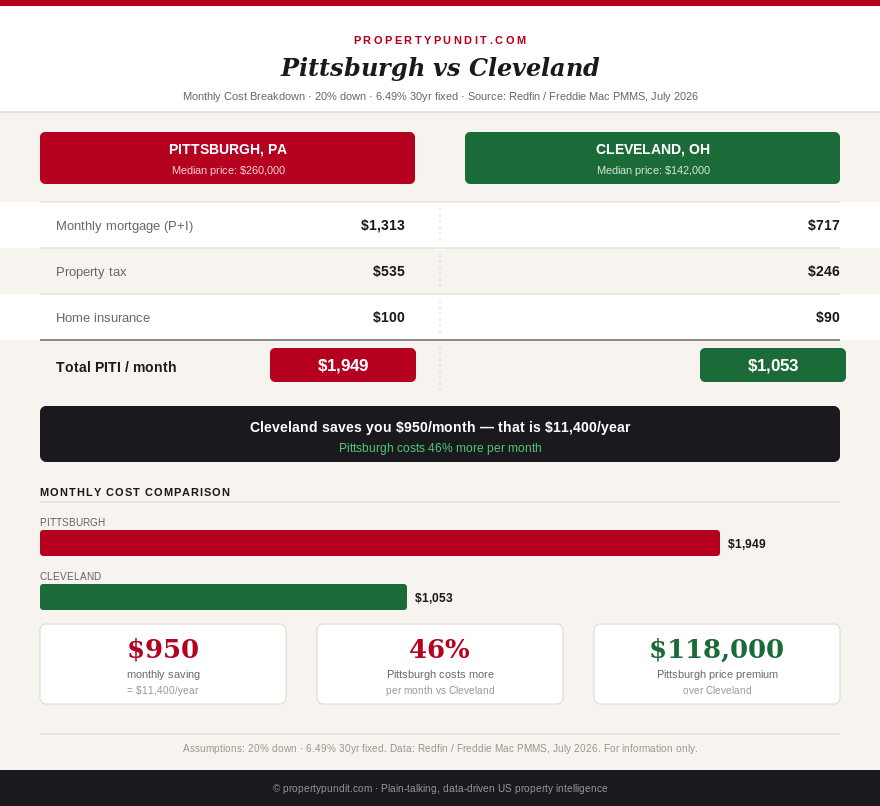
The side-by-side monthly cost table
All figures below use 20% down payment and a 6.49% 30-year fixed rate (Freddie Mac PMMS, July 9, 2026). Income tax uses 2026 state rates at $112,000 gross income.
| Item | Pittsburgh, PA | Cleveland, OH |
|---|---|---|
| Median home price | $260,000 | $142,000 |
| 20% down payment | $52,000 | $28,400 |
| Loan amount | $208,000 | $113,600 |
| Monthly P&I at 6.49% | $1,313 | $717 |
| Property tax/month | $535 (2.47%, city median) | $246 (2.08%, Cuyahoga Co.) |
| Homeowner's insurance | $100 | $90 |
| PITI total | $1,948 | $1,053 |
| PITI as % of $112k income | 20.9% | 11.3% |
| State income tax/month | $287 (3.07% flat, PA) | $232 (graduated, OH) |
| All-in monthly cost | $2,235 | $1,285 |
| Cleveland monthly advantage | $950/month |
Sources: Redfin median home prices (Pittsburgh, Cleveland; three months ending May 2026), Allegheny County property tax records (Pittsburgh city median effective rate, 2026), Cuyahoga County Fiscal Officer (2026), Ohio and Pennsylvania Departments of Revenue (2026), Freddie Mac PMMS (July 9, 2026).
The so-what for you: if you're comparing these two cities purely on monthly financial impact, Cleveland saves you $950 a month from day one, which is $11,400 a year. That's a bigger swing than most of the city comparisons we've run this year, and it holds even though both cities clear the 28% housing rule with room to spare.
Get this in your inbox every Friday.
One email. The number that matters and what it means for you.
Why Pittsburgh's 9.1% headline doesn't change the verdict
Pittsburgh posted the fastest year-over-year price growth of any major US metro this June, alongside San Francisco and West Palm Beach (Redfin, June 2026). It's a genuinely notable number, and it's tempting to read it as "Pittsburgh is about to get expensive, buy now." Look at what's actually driving it, though: Redfin's own reporting on this same wave of price gains attributed a large share of it to a roughly 23% year-over-year jump in luxury closed sales in the cities posting the biggest increases, not broad-based appreciation across every price tier. A $260,000 entry-level Pittsburgh home sitting well below the luxury segment is not guaranteed to be riding that same 9.1% curve. Cleveland's more modest 5.9% three-month appreciation (Redfin, May 2026) is a steadier, more broadly distributed number across a market with far less luxury inventory to skew it. If you're buying at Pittsburgh's entry-level price rather than its luxury segment, don't underwrite that 9.1% headline into your own appreciation assumptions.
The property tax gap that's smaller than it looks
Both cities carry unusually high effective property tax rates for their price points, a pattern common across the Rust Belt: fixed local budgets divided by comparatively low home values push the percentage rate up even when the dollar bill stays modest. Pittsburgh's city median effective rate runs 2.47%, among the highest of any major metro on this site, translating to $535 a month on the $260,000 median. Cuyahoga County's 2.08% rate, the highest of Ohio's 88 counties, adds $246 a month to Cleveland's lower $142,000 median. In dollar terms, Cleveland's tax bill is $289 a month lower even though its rate is only slightly lower in percentage terms, a reminder that the rate alone tells you less than the rate applied to the actual price. Neither city rewards buyers who only check the percentage and skip the math on their specific purchase price.
Rent, yield, and the investor angle
For anyone eyeing either city as a rental rather than a primary residence, Cleveland's price-to-rent picture is the stronger one on paper: a $142,000 median against roughly $1,150 in average rent (Zillow Rental Manager, July 2026) beats Pittsburgh's $260,000 median against roughly $1,545 in average rent on a pure ratio basis. Both cities' elevated property tax rates eat into that advantage more than a quick yield calculation would suggest, so treat this as a starting point rather than a green light. Anyone underwriting either city as a cash-flowing rental should run full PITIA and DSCR math rather than relying on the price-to-rent shortcut alone, the same way our Ohio market spotlight and Pennsylvania market spotlight do for each state's other metros.
The case for Pittsburgh the spreadsheet doesn't capture
Pittsburgh has real structural advantages Cleveland doesn't match as clearly right now: a stronger tech and healthcare employment base anchored by Carnegie Mellon, the University of Pittsburgh Medical Center, and a growing robotics and AI sector, plus a more walkable, amenity-dense downtown and South Side that consistently rank higher on lifestyle surveys. If your income growth and career opportunities specifically favor Pittsburgh, the $950 monthly gap could be smaller than the income premium the city offers you. Cleveland has its own momentum too, a rebuilding downtown, a lower cost base that makes entrepreneurship more forgiving, and a Great Lakes location some buyers genuinely prefer to Pittsburgh's river valleys. Neither city's non-financial case should be dismissed, but neither one is large enough on its own to erase an $11,400-a-year cost gap without a specific personal reason behind it.
The verdict at $112k income in July 2026
The math points toward Cleveland for anyone weighing these two cities on financial terms alone. A lower purchase price, a lower monthly payment, a lower all-in cost including state income tax, and $23,600 less required at closing all favor Cleveland, and its price-to-rent ratio holds up better for anyone considering renting the property out later. Pittsburgh's appreciation headline is real, but it's concentrated in a luxury segment that a $260,000 entry-level buyer isn't necessarily participating in, which means betting on that number to justify the higher monthly cost is a weaker case than it looks at first glance. If your career specifically needs Pittsburgh, or the tech and healthcare job market there is worth more to your household than $950 a month, that's a legitimate reason to choose it anyway. Absent that, most buyers running these numbers end up choosing the city that leaves them $950 a month of breathing room rather than the one betting on a luxury-driven headline holding up at their price point. Review our closing costs breakdown and down payment guide before you commit to either city's numbers.