 Property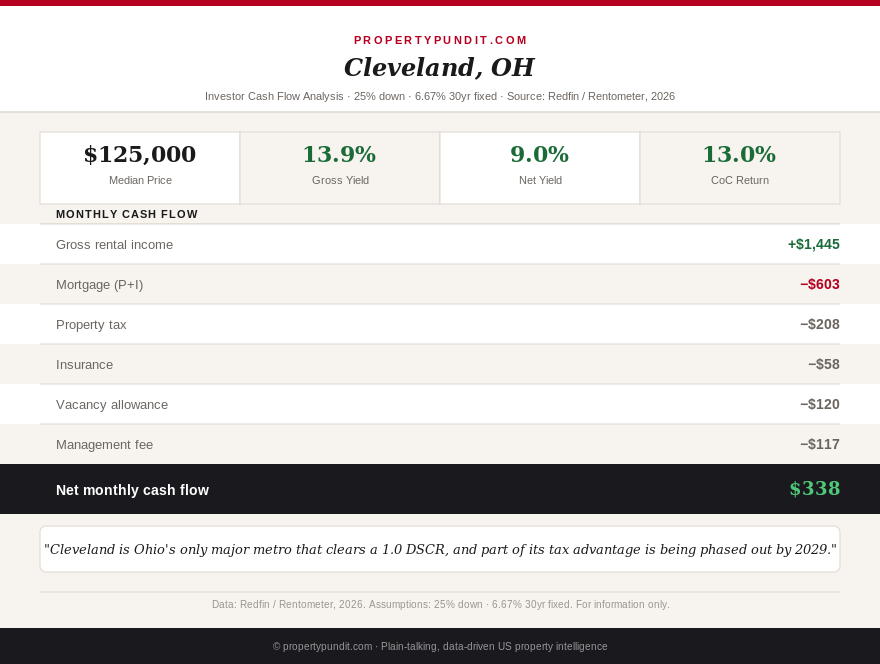
You've spent the past few weeks scrolling out-of-state listings looking for a market where the math still works at today's rates, and if you've been reading this site's spotlights in order, every one of the last several has ended the same way: nobody clears DSCR. Ohio breaks that streak, in exactly one city, and that city is about to start losing part of the tax break that helps make the number work.
This is a second-pass, full re-underwrite of Ohio, following up on this site's original April-data Ohio spotlight from June. The numbers moved more than you'd expect in four months: Columbus, which cleared a breakeven 1.02 DSCR back then, has slipped to 0.58 today. Here's the full underwriting across Cleveland, Columbus, Cincinnati, and Toledo, and the regulatory change that quietly reshapes the math for every landlord in the state.
Ohio's $218,865 statewide figure hides Cleveland's outlier math
Ohio's statewide home value index sits at $218,865, up 3.5% year over year (Zillow ZHVI, August 2026), among the more affordable statewide figures this site has covered. That number is a reasonable planning benchmark, but it collapses the moment you look at the state's four largest metros, which range from a $125,000 median in Cleveland to $304,000 in Columbus, at a Freddie Mac 30-year fixed rate of 6.67% (Freddie Mac PMMS, August 13, 2026, the most recent reading, with the next release due Thursday, August 20).
Treating Ohio as one market is the fastest way to underwrite the wrong city. The state's cheapest major metro is also its only one that clears positive cash flow, and that's not a coincidence you'd catch from the statewide number alone.
Get this in your inbox every Friday.
One email. The number that matters and what it means for you.
Cleveland: the cheapest market on this list is the only one that clears DSCR
Cleveland's median sale price sits around $125,000, up 5% year over year (Redfin, January 2026 reading), while Zillow's home value index puts the typical home lower still, at $104,666. Both are legitimate: Redfin measures actual closed transactions, and Zillow's index averages the full housing stock, including a large share of already-rehabbed, lower-value homes concentrated across Cleveland's east side. Using the higher, more conservative Redfin figure, a 25%-down purchase finances a $93,750 loan that runs about $603 a month in principal and interest at 6.67%. Cuyahoga County's effective property tax rate of roughly 2.00%, the highest of the four metros in this comparison, adds about $208 a month, and estimated landlord insurance of $58 brings total PITI to $870.
Against a single-family 3-bedroom asking rent of $1,445 (Rentometer's 2026 mid-year single-family rental report), and after a one-month vacancy allowance and a roughly 8% management fee, effective rent lands at about $1,208. That's a DSCR of 1.39 and a net monthly cash flow of about +$338, before financing costs even factor in Zillow's lower $104,666 price, which would push cash flow closer to +$480 and DSCR to 1.66. Either way, Cleveland is the strongest number this site has recorded in weeks: a 13.9% gross rental yield and a cash-on-cash return near 13.0% on the down payment alone. If you've been passing over Cleveland because the price tag looks too low to be real, this is the market on this site's list right now where that instinct is working against you.
Columbus, Cincinnati, and Toledo: higher prices, weaker math
Columbus sits at a $304,000 median sale price, up 6.2% year over year (Redfin, three months ending June 2026), even as Zillow's average home value reads $251,236, down 0.7% over the same period, another case of two legitimate sources measuring different slices of the market. At 25% down, a $228,000 loan runs about $1,467 a month in principal and interest, and Franklin County's 1.47% effective tax rate, the lowest of the four metros, adds $373 more. Against an average asking rent of $1,366 (RentCafe, 2026), Columbus posts a DSCR of just 0.58 and a monthly loss of roughly $839, the tax advantage no match for a purchase price more than double Cleveland's. That's a real reversal from this site's April-data pass, when Columbus priced around $292,000 and cleared a breakeven 1.02 DSCR at roughly -$210 a month; a 4% price gain on top of an already-thin margin was enough to push it firmly negative. If you underwrote Columbus off that earlier number, it's worth rerunning before you commit capital.
Cincinnati's $296,000 median, up 5.7% year over year (Redfin, three months ending June 2026), pairs with Hamilton County's 1.95% effective tax rate and a reported average rent of $1,869, up a striking 17% year over year (RentCafe, 2026). That jump is steep enough to treat with caution: a rent figure moving that fast in a single year likely reflects new, higher-priced apartment supply entering a citywide average more than what a comparable single-family rental actually commands, so the DSCR of 0.76 and monthly loss of about $485 calculated here may understate Cincinnati's real gap. Toledo, the cheapest of the four at roughly $130,101 (Zillow ZHVI, up 5.1% year over year, versus Redfin readings ranging from $132,000 to $154,400 depending on the window measured), still misses DSCR at 0.73 and a $246 monthly loss, dragged down by Lucas County's 2.05% effective rate, the highest in this comparison, on a rent base of just $795 a month.
None of these three cities are disasters on the scale this site has flagged elsewhere this month, but none of them work at today's rates either. If you're underwriting Ohio on a budget, Cleveland's entry-level single-family stock, not the state capital and not the two cities with university and hospital-anchored demand, is where the actual math clears.
Ohio just took landlords' 10% tax credit away. Homeowners keep theirs.
House Bill 186, effective December 2025, eliminates Ohio's 10% non-business tax credit specifically for non-owner-occupied residential property, meaning every rental home, apartment, and investment condo in the state. In the same bill, the legislature increased the rollback credit for owner-occupied homes instead, explicitly shifting relief toward homeowners who vote on local levies and away from landlords and investors. The removal phases in over four years, adding roughly 2.5 percentage points to a landlord's effective tax rate each year through 2029, a cumulative 10% increase that the homeowner next door, in an identical house, will never pay.
On Cleveland's own numbers, that phase-out adds about $21 a month to the property tax line by 2029, split into four annual steps of roughly $5 each, trimming today's $338 monthly cash flow to closer to $317 once fully phased in. That's not enough to flip Cleveland's DSCR below 1.0, but it is a real, scheduled reduction in the return you'd underwrite a 2026 purchase against, and it's easy to miss if you're only checking today's tax bill rather than the four-year trajectory. If you're running the numbers on an Ohio rental this year, model the 2029 tax line, not the 2026 one, or you'll overstate your own return by a few hundred dollars a year without realizing why.
So what should an Ohio investor actually do
At today's 6.67% rate, Cleveland's entry-level single-family stock is the only realistic cash-flow target in Ohio, and it's cheap enough that the coming HB 186 phase-out doesn't change that conclusion, only the size of the return. Columbus, Cincinnati, and Toledo are manageable losses rather than the outright disasters this site has flagged in some other states this month, worth watching if prices soften or rents keep climbing, but not underwriteable at today's numbers. Frankly, if cash flow is the goal, the math points toward Cleveland's cheaper east-side inventory over the state capital's higher price tag. It's also the same city that already won on pure affordability grounds in this site's Pittsburgh vs. Cleveland comparison, so the case for Cleveland now holds up from both a buyer's and an investor's side of the ledger.
Before underwriting a specific Cleveland address, run it through the DSCR loan investor guide and cross-check the county against the SFR yield county map rather than assuming Ohio's low statewide reputation applies evenly across a state where three of its four largest cities miss DSCR entirely.
Frequently asked questions
Is Ohio a good state for rental property investment in 2026? It depends entirely on the city. Cleveland is the only major Ohio metro in this comparison that clears a 1.0 DSCR at 6.67% rates, producing roughly $338 a month in positive cash flow on a 25%-down purchase. Columbus, Cincinnati, and Toledo all run negative cash flow despite Ohio's low $218,865 statewide median value, so treating Ohio as one investor market rather than four very different ones is the fastest way to underwrite the wrong city.
Why is Cleveland's home price so much lower than the rest of Ohio? Cleveland's median sale price sits around $125,000 (Redfin), while Zillow's home value index puts the typical home closer to $104,666, a gap that reflects Cleveland's aging, heavily rehabbed housing stock and decades of population decline that left prices well below replacement cost. That low entry price, paired with single-family rents near $1,445 a month, is exactly what produces the city's unusually strong rent-to-price ratio compared with Columbus or Cincinnati.
What is Ohio's HB 186 property tax law? HB 186 eliminates the 10% non-business tax credit on non-owner-occupied residential property, meaning rental homes, while increasing the rollback credit for owner-occupied homes instead. The change took effect in December 2025 and phases in over four years, adding roughly 2.5 percentage points to a landlord's effective tax rate each year through 2029, a cumulative 10% increase that homeowners next door won't pay.
How much extra property tax will Ohio landlords pay by 2029? On a typical Cleveland rental with a roughly $208 monthly property tax line today, the full phase-out of HB 186's non-business credit adds about $21 a month by 2029, split into four annual steps of roughly $5 each. That would trim Cleveland's current $338 monthly cash flow to closer to $317, not enough to flip the market's DSCR below 1.0, but enough that investors underwriting a 2026 purchase on today's tax bill alone are underestimating the real cost.