 Property
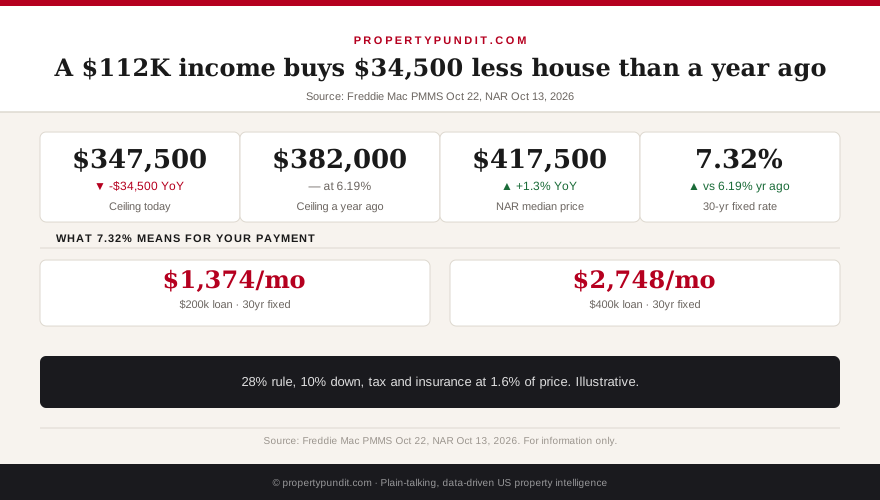
You haven't had a raise that matters, you've been saving for three years, and every time you re-run the numbers the answer gets a little worse. You assume it's because prices keep climbing. It mostly isn't. The price of the median home rose about $5,400 in a year; your buying power fell about $34,500.
That gap between the sticker price and what you can actually afford is the most misunderstood number in housing right now. Here's how to calculate it yourself, and which lever is doing the damage.
Get this in your inbox every Friday.
One email. The number that matters and what it means for you.
Your ceiling is set by a payment, not a price
Lenders and the standard 28% front-end rule start from what you can pay each month, not from what the house costs. On a $112,000 household income, 28% works out to $2,613 a month for principal, interest, property tax, and insurance. Everything else flows from that fixed number.
For the math here, assume 10% down, no mortgage insurance (which would lower the ceiling further), and property tax plus insurance together at 1.6% of the price per year. Those inputs are illustrative; your county and insurer will differ. What matters is that they stay the same in both columns, so the only thing that changes is the rate and the price.
So if you're trying to find your own ceiling, start with your income divided by twelve, multiply by 0.28, and work backward. The price is the output, not the input.
A year ago, that budget bought $382,000. Today it buys $347,500
Freddie Mac's 30-year fixed rate was 7.32% in the week ending October 22, 2026, against 6.19% a year earlier (Freddie Mac PMMS). At 6.19%, principal and interest cost about $612 per $100,000 borrowed; at 7.32% it's about $687. Hold the $2,613 budget constant and the ceiling falls from about $382,000 to about $347,500, a drop of roughly $34,500.
| Scenario (10% down, $2,613 budget) | Rate | Price you can afford |
|---|---|---|
| A year ago | 6.19% | $382,000 |
| Today | 7.32% | $347,500 |
| Today with a half-point drop | 6.82% | $362,000 |
| Today with 20% down | 7.32% | $382,500 |
| Today with only 5% down | 7.32% | $332,500 |
The rate rise erased about $34,500 of purchasing power, and you didn't lose a dollar of income to do it. If you set your search range last spring, your number is stale, so reset your price filter to the lower figure before you fall for a house you can't carry.
Prices barely moved. That's the surprise.
NAR's September median existing-home price was $417,500, up 1.3% from a year earlier, the 39th straight month of year-over-year gains (NAR, October 13, 2026). Working backward, the median was about $412,100 a year ago, so prices rose roughly $5,400. Sales fell 2.2% over the same stretch, and months of supply reached 4.8 against 4.5 a year earlier.
Put those side by side. The median home now sits about $70,000 above your ceiling; a year ago the gap was about $30,000. Roughly $34,500 of that widening came from the rate and about $5,400 from price. So the thing worth watching isn't headlines about home values; it's the 30-year rate. If you're checking Zillow every morning, you're tracking the smaller of the two forces.
Why a lender may approve you for more than you should borrow
The 28% rule is a budgeting guideline, not a lending cap. Lenders usually look at a back-end ratio that counts all your monthly debts, and many conventional loans allow 36% to 45% of gross income. On a $112,000 income with no other debts, 33% of gross income is $3,080 a month and supports a price near $409,500 at 7.32%; 36% is $3,360 and supports about $447,000.
That's the trap. A pre-approval letter will often show a number $60,000 to $100,000 above the 28% ceiling, and it reflects what a bank will risk, not what leaves you room for repairs, a car payment, and savings. A buyer stretched to 36% on housing alone has little cushion if rates, taxes, or insurance climb after closing. So if you're comparing your pre-approval to the ceiling in this article, treat the 28% number as your comfortable limit and the bank's number as an outer edge you shouldn't walk to.
Where the wiggle room is
You can't set the rate, but you can move three other levers. A bigger down payment helps most: going from 10% to 20% down lifts the ceiling to about $382,500, which wipes out the entire rate shock, though it means finding roughly $35,000 more in cash on a $350,000 home. A half-point rate drop adds about $14,500 of ceiling; this site's math on that shows a half-point cut saves about $105 a month on a $312,300 loan, which is real but smaller than people expect.
The lever buyers underuse is price. Redfin reported that 60.5% of September home sales closed below the original asking price and 19.8% of active sellers had cut their price (Redfin, October 12, 2026). Our own buyers' market breakdown shows where 4.8 months of supply sits against the 6-month benchmark. Pushing a $350,000 listing down 3% saves $10,500 in price, which is worth about the same as a 0.4-point rate cut. So if you're trying to close the gap between your ceiling and the median, you can start negotiating this month instead of waiting for a rate that may not come.
What to do with this
The math points toward working from your payment ceiling and shopping the price, rather than waiting for rates to fall. Most people who run this calculation discover they're looking at homes $30,000 to $70,000 above what they can carry, and the productive response is to search below the median and negotiate hard, not to stretch the budget. Frankly, if your ceiling is $347,500 and you keep touring $420,000 listings, you're going to keep losing the same argument with your spreadsheet.
Before you shop, check what the closing costs bill adds on top, and read the down payment myth before assuming you need 20% down. If you want to see how the same trade-off plays out against renting in a specific city, this site's Nashville rent-versus-buy break-even runs it year by year.
Frequently asked questions
How much house can I afford on a $112,000 income at 7.32%? Using the standard 28% front-end rule, a $112,000 household can carry about $2,613 a month in housing costs. With 10% down, a 7.32% rate (Freddie Mac PMMS, October 22, 2026), and about 1.6% of the price a year for property tax and insurance, that supports a purchase price near $347,500, before private mortgage insurance.
Why does a small rate increase cut buying power so much? Your monthly budget is fixed, and a higher rate means more of each payment goes to interest. From 6.19% to 7.32%, the principal and interest on each $100,000 borrowed rose from about $612 to about $687, so the same $2,613 budget buys a smaller loan.
Are home prices falling, making up for higher rates? No. NAR's September median was $417,500, up 1.3% from a year earlier and the 39th straight yearly gain (NAR, October 13, 2026). Prices rose about $5,400 while the rate move cost a 10%-down buyer on this budget about $34,500 of purchase price.
Is it better to wait for lower rates or negotiate the price now? Rates do the heavy lifting, but you can't control them. A half-point drop adds about $14,500 of buying power on this budget, while Redfin reported 60.5% of September sales closed below the original asking price, so negotiating is available to you today.