 Property
You've been hearing that fall is the time to buy, and you've been saving for it. Then Thursday's headline lands: the 30-year mortgage rate is 7.28%, the highest in almost three years, and you're staring at your spreadsheet wondering whether the seasonal discount just evaporated and whether you'd be smarter to sit out until spring and hope rates come down. The short answer is that the fall discount is worth about $86 a month, one week of rate increases took $63 of it back, and waiting for spring needs a 6.95% mortgage rate just to break even.
Here's the setup. Freddie Mac's 30-year fixed rate rose 25 basis points to 7.28% on October 1, 2026, up from 7.03% the week before, with the 15-year at 6.60%; a year ago the 30-year averaged 6.34% (Freddie Mac PMMS, October 1, 2026). It's the highest reading since November 22, 2023 (Freddie Mac via Fox Business, October 1, 2026). Meanwhile Realtor.com's seasonal analysis names September 27 through October 3 as the best week of 2026 to buy, with listing prices about 3.5% below seasonal highs (Realtor.com, September 2026).
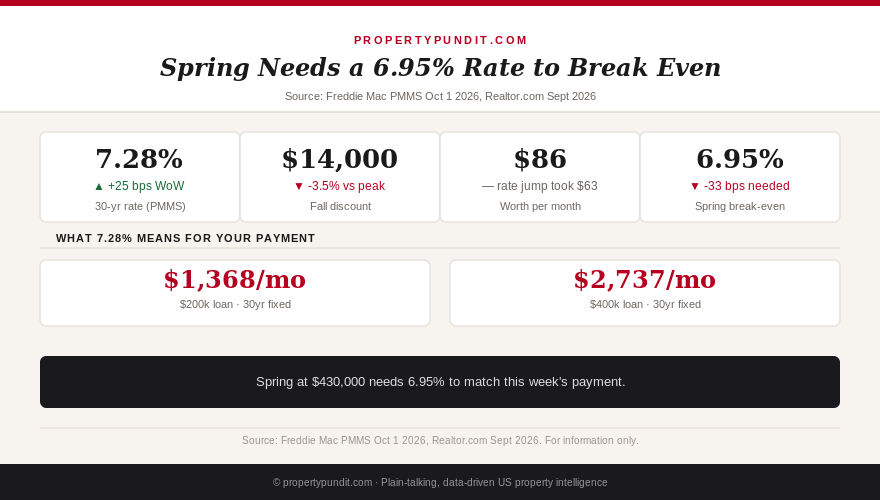
The fall discount is worth $86 a month, and one week of rates took $63
Realtor.com estimates a buyer this week could save about $14,000 against the summer peak on a median-priced home of roughly $416,000, with 31.9% more active listings than at the start of the year, buyer demand 30.1% below its annual peak, and homes sitting about 64 days, roughly 13 days longer than at peak speed (Realtor.com, September 2026). The report draws on 2018 through 2025 data across the 50 largest metros and excludes 2020, so it describes a seasonal pattern, not a forecast.
Now put it in monthly dollars. Say you put 10% down on $416,000. The loan is $374,400, and at 7.28% the principal and interest payment is $2,562. If you had instead bought at a $430,000 peak price, the loan would be $387,000 and the payment $2,648. The seasonal discount saves you $86 a month, or about $1,035 a year. This week's rate move from 7.03% to 7.28% added $63 a month to the same $374,400 loan ($2,498 to $2,562). One Thursday's rate move erased 73% of the discount. Realtor.com's economist made the year-over-year version of the same point: the nearly one-point rise in rates over the past year has added more than $200 a month in principal and interest on a median-priced home (Realtor.com via Fox Business, October 1, 2026). On this loan, the move from 6.34% to 7.28% is worth $234 a month. What it means for you: the $14,000 discount is real, but it's worth less than the rate swings you can't control, so don't let a seasonal headline set your timeline.
What spring would cost you: the 6.95% break-even
The honest comparison is between buying now and buying in spring, so I ran both. Assume the price climbs back to a $430,000 summer-peak level, which is the most the seasonal pattern implies. At an unchanged 7.28%, you'd pay $86 more a month. To pay the same $2,562 you'd pay today, the rate would have to fall to 6.95%, a drop of 33 basis points.
| If you wait until spring and... | Price | Monthly P&I (10% down) | vs. buying this week |
|---|---|---|---|
| Buy this week at 7.28% | $416,000 | $2,562 | baseline |
| Price returns to the summer peak, rate stays 7.28% | $430,000 | $2,648 | +$86 |
| Price returns to peak, rate falls to 6.95% | $430,000 | $2,562 | $0 (break-even) |
| Price returns to peak, rate falls to 6.28% | $430,000 | $2,390 | -$172 |
| Price returns to peak, rate rises to 7.53% | $430,000 | $2,714 | +$152 |
The table shows what you're betting on. A one-point drop to 6.28% would save $172 a month relative to buying this week. A 25-point rise to 7.53%, which is exactly what happened this week, would cost you $152 a month more. Rates moved 62 basis points in the last month, according to Freddie Mac's survey history (via Mortgage News Daily), so a 33-point reversal isn't impossible. It's a bet against the direction of the market, though, and it only pays off if the move is large. What it means for you: waiting for spring isn't a free option, it's a bet that rates fall by at least a third of a point while prices drift back up.
Why a drop by spring is a long shot
Mortgage rates follow the 10-year Treasury yield, not the Fed's overnight rate, and the 10-year stood near 5.24% on October 1 (Mortgage News Daily, October 1, 2026), close to the highest levels since 2007. The Fed raised its target range by 25 basis points to 3.75% to 4.00% on September 16, its first hike since 2023 (FOMC, September 16, 2026), and Minneapolis Fed President Kashkari said this week that one more increase this year looks likely, with another possible in 2027 (Mortgage News Daily, October 1, 2026). Mortgage News Daily's own daily index read 7.54% on October 1, which is above the official 7.28% because Freddie Mac's survey lags the market by a few days.
There are forecasts that rates ease. In mid-September, Fannie Mae projected the 30-year near 6.3% by the end of 2026 and the Mortgage Bankers Association about 6.5% through 2027 (Fannie Mae and MBA, September 2026). Those were published before this week's jump, and I'd treat them as stale until they're updated. For more on why yields can overshoot, see our look at the 10-year yield and the 8% mortgage scenario. What it means for you: nobody knows where rates land in April, but the people setting policy are leaning toward higher, so your plan shouldn't depend on lower.
Get this in your inbox every Friday.
One email. The number that matters and what it means for you.
The question that matters more: does the payment fit?
The seasonal-versus-spring debate assumes you can afford the house either way. Test that first. A buyer earning $112,000 a year has $9,333 a month of gross income, and the standard 28% front-end guideline allows $2,613 a month for housing. Property tax averages $4,427 and insurance $3,057 a year for homeowners with escrow (LERETA and Ownwell, March 2026), about $624 a month together. On a $416,000 home with 10% down at 7.28%, principal and interest of $2,562 plus $624 of tax and insurance totals $3,185 a month, or 34.1% of gross income, before any mortgage insurance. That's about 6 points above the 28% guideline. The same buyer would need an income of about $136,500 for the median-priced home to clear 28%.
Run it the other way. At 7.28% with 10% down, a $112,000 income supports a home of about $323,000 at the 28% limit, which is $93,000 below the median. To afford $416,000 on that income, the rate would have to fall to about 4.9%. A 3.5% seasonal discount can't close a gap that size, and neither can a 33-basis-point rate drop. What it means for you: if the payment fails the 28% test today, the decision isn't fall versus spring, it's which price band you can actually afford.
Three levers that beat waiting for spring
First, use the bargaining power the data already shows. Sellers offered concessions on 44.7% of August 2026 home sales, up from 42.6% a year earlier, and 15.8% of sales carried both a price cut and a concession, both records for August (Redfin, September 2026). NAR reports 4.9 months of supply, the most in more than a decade (NAR, August 2026), and Realtor.com counted a record 20.8% of September listings with a price cut. A 3% concession on a $416,000 home is $12,480, and as we showed in our buydown versus price cut comparison, putting a seller credit toward points can beat a headline price cut when rates are this high.
Second, shop the rate itself. Our September 29 explainer found credit-band spreads of roughly 25 to 66 basis points in a myFICO sample, and the headline 7.28% assumes a 20% down payment and a strong credit profile. A single credit tier or three competing loan estimates can be worth the entire 33-point spring gamble, and you get the savings now. Third, plan for a refinance. If rates fall one point, from 7.28% to 6.28%, the payment on $374,400 drops by about $249 a month. Divide your refinance closing costs by that figure to see the break-even; at 2% of the loan, which is my assumption ($7,488), it's about 30 months, and our closing costs guide shows what to expect. With median homeowner tenure at 12 years (Redfin, 2026), you'd have time to collect.
What this means for you
If the payment passes the 28% test with taxes and insurance included, and you plan to stay at least five years, the math points toward buying this fall, negotiating a seller concession, and treating 7.28% as a rate you can refinance later. Waiting for spring costs you $86 a month unless rates fall at least 33 basis points, and the Fed is moving the other way. Frankly, if you're pre-approved and the house fits, the discount week is the week to negotiate, because you'll have the most inventory and the least competition of the year.
If the payment doesn't pass the test, don't wait for spring either. Lower your price target toward the $323,000 range, increase your down payment, or spend the next 60 to 90 days improving your credit score and collecting loan estimates, because a better rate tier beats a seasonal discount. Before you do anything, check your own numbers with our down payment guide and get at least three written loan estimates on the same day. The September jobs report lands today, October 2 (BLS), so expect another rate move before you've finished reading this.