 Property
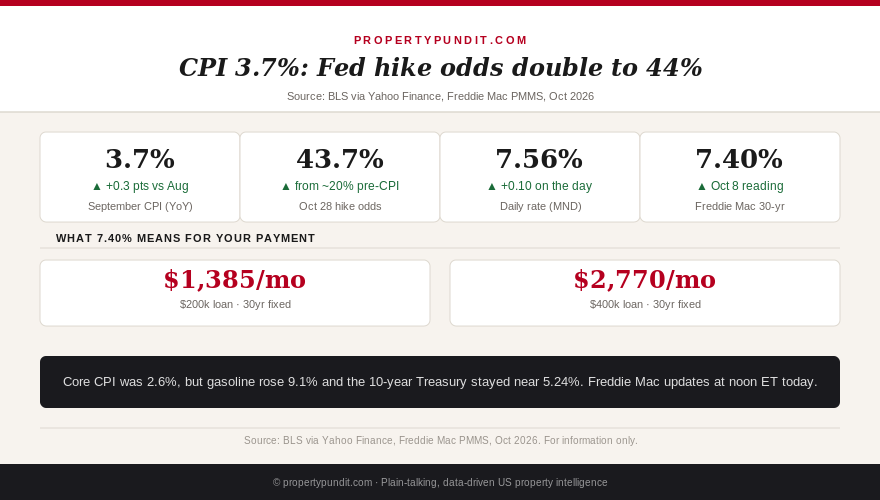
You locked a 3.8% mortgage years ago, and you're watching for the day a move makes sense. Wednesday's inflation report was not that day. September's consumer price index rose 3.7% from a year earlier, one-tenth above the 3.6% forecast, and the odds of a Fed rate hike at the October 28 meeting jumped from about 20% to 43.7% (CME Group data via Yahoo Finance, October 14, 2026).
Mortgage News Daily's index rose 10 basis points that day to 7.56%. Freddie Mac's official 30-year average was 7.40% last Thursday, and the new reading is due at noon Eastern today, after this was written. On a $320,000 loan, the gap between your 3.8% and 7.56% is $760 a month.
Here is what the report contained, why a gasoline-led number moved mortgage prices, and what each plausible rate costs you.
Get this in your inbox every Friday.
One email. The number that matters and what it means for you.
What September CPI printed against the forecast
| Measure | September | August | Forecast |
|---|---|---|---|
| Headline CPI, year over year | 3.7% | 3.4% | 3.6% |
| Headline CPI, month over month | 0.6% | 0.4% | Not published |
| Core CPI, year over year | 2.6% | 2.4% | 2.5% |
| Core CPI, month over month | 0.3% | 0.3% | 0.2% |
| Gasoline, month over month | +9.1% | n/a | n/a |
Sources: the Bureau of Labor Statistics report as covered by Yahoo Finance and CNBC on October 14, 2026, and the 3.6% and 2.5% forecasts logged in our October 14 preview. Gasoline rose 9.1% in the month and the average pump price hit a record $4.33 a gallon (AAA). The shelter component, the biggest piece of the index for housing, wasn't in the coverage I could read.
Both headline and core beat the forecast by a tenth. That sounds small, and the quarter-point math below shows why the market didn't treat it that way. The takeaway for you is that a one-tenth miss in an inflation report is enough to swing a rate that sets a $2,000-plus payment.
Why a gas-price report moves a mortgage rate
Core inflation, which strips out food and energy, was only 2.6%. If the Fed looked at core alone, this report might have been a shrug. Mortgage rates don't track the Fed's meeting or core inflation directly. They follow the 10-year Treasury yield, plus a spread. The 10-year jumped above 5.30% in Wednesday's early trading and eased to about 5.24% by the afternoon (Yahoo Finance, October 14), still near its recent highs.
The spread matters as much as the yield. Per MortgageDaily's October 11 outlook, the 30-year rate sits about 220 basis points above the 10-year, 20 wider than its one-year average of roughly 200. At a normal spread, a 5.24% 10-year implies about 7.24%, not 7.44%. That 20 basis points costs $44 a month on a $320,000 loan, and it comes from lender and bond-market risk pricing rather than from the Fed.
For you, that is a split. Roughly $44 of today's payment can shrink without any Fed action if markets calm, and it can widen further if they don't. Track the 10-year, not the headline number.
The odds: from 20% to 44% in one morning
| Fed event | Before the report | After the report |
|---|---|---|
| Quarter-point hike on October 28 | About 20% | 43.7% |
| A second hike by December | Not stated | Better than 50% |
The Fed raised its target to 3.75% to 4.00% on September 16, its first hike since 2023, by a 12-0 vote. A second hike would take it to 4.00% to 4.25%. Our October 14 preview reported roughly 80% odds of a hold on the 28th, so the report shifted the odds by about 24 points.
Remember the September precedent. When the Fed hiked, mortgage rates barely moved the next morning because bond traders had already priced it in, which we explained in the pre-vote piece. With odds at 44%, neither a hold nor a hike on October 28 would be a shock. The larger moves come from the data that arrive first: producer prices and retail sales today, industrial production on October 16, and the PCE inflation report on October 29, the day after the meeting. Your takeaway: watch those releases, not the meeting itself.
What the rate costs on a $320,000 mortgage
Take your situation: a $400,000 home with 20% down, so a $320,000 loan. Principal and interest on a 30-year fixed:
| Rate | What it represents | Monthly P&I | vs 3.8% |
|---|---|---|---|
| 3.80% | Your current rate | $1,491 | n/a |
| 6.65% | Freddie Mac, August 20 | $2,054 | +$563 |
| 7.40% | Freddie Mac, October 8 | $2,216 | +$725 |
| 7.56% | Mortgage News Daily, October 14 | $2,251 | +$760 |
| 7.75% | Scenario | $2,293 | +$802 |
| 8.00% | Scenario | $2,348 | +$857 |
Two rules of thumb fall out of it. Every 10 basis points costs about $22 a month on this loan, so Wednesday's 10-point move was worth $262 a year. And the climb from 6.65% on August 20 to 7.40% on October 8 added $162 a month, or $1,936 a year, on top of what you already faced. Principal and interest only; taxes, insurance and any mortgage insurance would add to every row, and the 7.56% row is a daily tracker rather than the Freddie Mac survey.
The bigger number is the lock-in. Keeping the 3.8% loan instead of replacing it at 7.40% saves $725 a month, or $8,695 a year, on a loan this size. Unless life forces a move, that's what staying put is worth, and it explains why so few owners list their homes.
What the application data shows about buyers
The Mortgage Bankers Association reported that applications fell 2.7% in the week ending October 9, that the average 30-year fixed contract rate reached its highest point since November 2023, and that adjustable-rate mortgages rose to 10.5% of applications (MBA, as quoted by Fortune on October 15). ARM share was 8.0% in the week ending August 28 and 8.5% in the week ending September 11 (MBA), so the move up is steady rather than a one-week blip.
Buyers are rationing payments, and an ARM is one way to do it. The trade is that you take on rate risk after the fixed period ends, so an ARM only makes sense if you're confident you will sell or refinance before it adjusts. For you, as someone with a 3.8% fixed loan, the lesson is the opposite: the thing you hold is scarce, and it's worth more every time the rate backs up.
What to do this week
My call, by situation:
- You hold a 3.8% loan and don't have to move: do nothing. The lock-in is worth about $8,695 a year per $320,000.
- You're closing on a purchase within 45 to 60 days: lean toward locking before the October 29 PCE report. Another quarter-point to 7.65% adds $55 a month ($658 a year) on a $320,000 loan. Ask for the lock fee and any float-down terms in writing first.
- You're waiting for a better rate: the market is leaning the other way. Set a payment you can carry at 7.75%, which is $2,293 on this loan, and decide from there.
Today's Freddie Mac number will tell you more than any forecast. The daily trackers don't agree on direction for the week: Mortgage Research Center's 30-year conventional average rose to 7.449% on October 14 from 7.388% a day earlier but was down about 7 basis points on the week (Fortune, October 15). Compare lenders on the same day: Fortune puts the savings from comparison shopping at $600 to $1,200 a year.
What I couldn't verify
Freddie Mac's October 15 survey hadn't posted when I wrote this, so 7.40% is the latest official reading. The Fed odds come from one live-blog report of CME data; I didn't pull the CME tool directly. The 7.56% figure is Mortgage News Daily's index as reported by Yahoo Finance. I couldn't retrieve the shelter component of CPI or MBA's exact contract rate for the week ending October 9. The $320,000 loan is an illustration, and the payments exclude taxes and insurance.
Frequently asked questions
What was the September 2026 CPI?
Consumer prices rose 3.7% from a year earlier and 0.6% on the month, above the 3.6% forecast. Core CPI, which excludes food and energy, rose 2.6% on the year and 0.3% on the month. Gasoline jumped 9.1% in the month, according to the Bureau of Labor Statistics report released October 14, 2026.
Will the Fed raise rates on October 28?
CME Group data showed a 43.7% chance of a quarter-point hike after the CPI report, up from about 20% before it, as reported by Yahoo Finance on October 14. Markets also priced better than 50% odds of a second hike by December. The Fed's current target is 3.75% to 4.00%.
What is the 30-year mortgage rate today?
Freddie Mac's latest official average is 7.40%, from October 8, 2026, and a new reading is due at noon Eastern on October 15. Daily trackers were higher on October 14: Mortgage News Daily's index was 7.56% and Mortgage Research Center's conventional average was 7.449%.
How much does a 0.10 point rise in mortgage rates cost?
About $22 a month on a $320,000 30-year loan, or $262 a year. A quarter-point costs about $55 a month. Moving from 7.40% to 7.75% adds $77 a month. These figures are principal and interest only and exclude taxes and insurance.