 Property
If you own rentals anywhere else in the country, you've learned to assume the tax assessor treats you as a second-class owner. Non-homestead rates, lost exemptions, reassessment on transfer. You budget for the penalty because the penalty is universal. Montana just stopped charging it.
Under House Bill 231, effective for the 2026 tax year, a long-term rental in Montana qualifies for the same reduced homestead classification rate as an owner-occupied home: 0.76% on value up to $378,000. The old residential classification rate was 1.35%. For a landlord holding a house under that threshold, that's a 43% cut in the number the mill levy gets applied to (Montana Department of Revenue, 2026 property tax information).
Then you run the cash flow at 6.69% and discover the gift isn't big enough. Of Montana's three largest markets, exactly one produces positive monthly cash flow, and only at the bottom of its price range.
Get this in your inbox every Friday.
One email. The number that matters and what it means for you.
How the homestead rate actually works, and the two-step math nobody does
Montana doesn't apply a percentage directly to your sale price the way Texas or Florida effectively do. The classification rate converts market value into taxable value, and then the combined mill levy for your county, city, and school district is applied to that taxable value. Skip the first step and you'll overstate a Montana tax bill by a factor of two or more.
The 2026 homestead tiers run 0.76% up to $378,000, 0.90% from $378,001 to $756,000, 1.10% from $756,001 to $1,511,999, and 1.90% above that. Everything that doesn't qualify, meaning second homes, cabins, and short-term rentals, is assessed at a flat 1.9% regardless of value (Montana Department of Revenue, HB 231, 2026).
Worked example on a $400,000 Billings house. Taxable value as a qualifying long-term rental: $378,000 at 0.76% plus $22,000 at 0.90%, giving $3,071. Apply a combined levy of roughly 550 mills and the annual bill is about $1,689, or $141 a month. As a short-term rental, taxable value is $400,000 at 1.9%, or $7,600, and the annual bill is about $4,180, or $348 a month.
That's a $2,491 annual gap on the same building, decided entirely by lease length. If you've been running a Montana property on 14-day and 21-day bookings, the switch to 28-day-minimum leases is now worth more than most of the operational decisions you will make this year.
The qualifying rules are strict, and the deadline is real
The property must be occupied as a primary residence for at least seven months of the year. For a rental, that means your tenant's primary residence, under leases of 28 days or longer. Weekly vacation bookings don't count no matter how many of them you string together.
Enrollment isn't automatic for investors. Owner-occupants who received the 2024 property tax rebate were rolled forward automatically; landlords weren't. Applications for the 2026 reduced rate had to be filed with the Montana Department of Revenue by March 1, 2026, with the portal opening the previous December (Montana Governor's Office, 2026).
If you bought a Montana rental after that deadline or inherited a property whose prior owner never filed, you're paying the 1.9% rate this year whether or not the tenancy qualifies. Check the classification on the actual tax bill before you underwrite a Montana deal, because a listing agent quoting last year's taxes is quoting a number from a system that no longer exists.
Statewide prices: two sources, two different stories
Montana's headline median depends entirely on who you ask. Redfin puts the statewide median sale price at roughly $505,000, up about 1% year over year. Zillow's home value index for the state runs closer to $523,000 with growth near 4.1%.
The gap is methodological rather than a contradiction. Redfin's figure reflects what actually closed, which is weighted toward whatever mix of properties transacted in a thin, seasonal market. Zillow's index estimates the value of the whole housing stock, including the resort-adjacent property in Flathead and Gallatin counties that rarely trades. In a state where a handful of high-value counties can swing a monthly median, the two will keep diverging.
For underwriting, neither statewide number is usable. Montana isn't one market, it's three or four disconnected ones, and a half-million-dollar state median tells you nothing about what a rental in Great Falls costs.
Billings: the biggest market, and the worst arithmetic
Billings is Montana's largest city and its most liquid market. Zillow puts the typical home value at $402,554, up 2.1% over the past year, with homes going to pending in roughly 15 days. Average rent for a three-bedroom house runs around $1,850 a month (RentCafe, 2026).
Run it at 25% down. On a $402,554 purchase, the loan is $301,916 at 6.69%, giving $1,946 in principal and interest. Add $142 a month in property tax at the homestead rate and $185 for a landlord policy at 0.55% of value, and PITI lands at $2,272. Effective rent after a 12.5% vacancy and maintenance haircut is $1,619.
That is negative $654 a month and a debt service coverage ratio of 0.71. Drop to an entry-level $265,000 property renting at $1,600 and it improves to negative $95 with a DSCR of 0.94, still short of the 1.0 that most lenders treat as the floor.
Billings sells the appreciation story well: 15 days to pending is genuine demand, and the local median effective property tax rate of 0.97% reported by Ownwell reflects bills issued under the old system rather than the new homestead rate. But nothing in Billings clears cash flow at current rates, so treat it as a hold-and-appreciate market and finance it accordingly.
Missoula: the most expensive way to lose money in Montana
Missoula's median price sits near $525,000, the highest of the three cities, and three-bedroom rents run about $2,143, which sounds like it should compensate. It doesn't.
At 25% down, the loan is $393,750 at 6.69% for $2,538 in principal and interest. Property tax at the homestead tiers runs $220 a month, insurance $241, giving PITI of $2,999 against $1,875 in effective rent. That is negative $1,124 a month and a DSCR of 0.63.
Missoula County also approved an 8% property tax increase for its 2026 budget to raise an additional $4.6 million, largely for wage increases and detention center costs (Montana Free Press, September 2025). The state's rate reform partially offsets that for qualifying properties, which is why most Missoula homeowners still saw bills fall, but the county levy is moving in the wrong direction underneath the state relief.
A university town with capped supply and a $525,000 median is an appreciation bet with a $13,000 annual carrying cost. If your thesis is cash flow, Missoula isn't where the numbers are.
Great Falls: the only Montana market that clears
Great Falls is the state's third-largest city and the only one where the arithmetic works. It also carries the same two-source divergence as the state: Zillow's home value index puts the typical home at $305,137, up 5.4% over the past year, while the median sale price reported for early 2026 runs closer to $357,500. Zillow indexes the whole stock; the sale-price median reflects the subset that actually sold, skewed by a thin market in a city with limited transaction volume. Underwrite against the Zillow figure and verify the specific property.
Three-bedroom rents run about $1,917 (RentCafe, 2026), which is only slightly below Billings on a property that costs roughly $95,000 less. That ratio is the entire investment case.
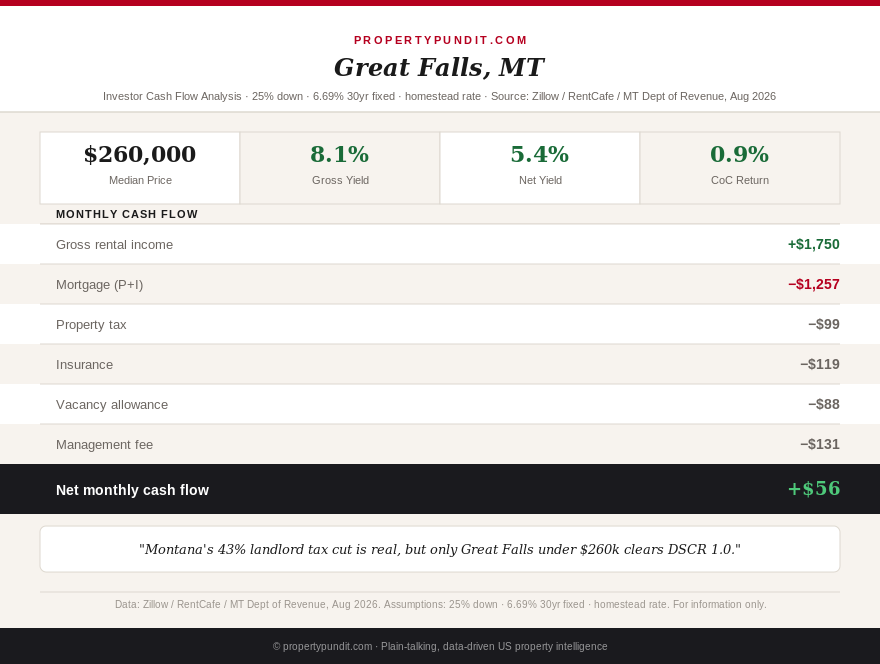
At the $305,137 index value with 25% down, PITI comes to $1,731 against effective rent of $1,677: negative $54 a month, DSCR 0.97. Buy at $260,000 with rent at $1,750 and it flips positive at $56 a month with a DSCR of 1.04. At $240,000 renting at $1,700, cash flow reaches $126 a month, a DSCR of 1.09, and a cash-on-cash return of 2.2% on roughly $67,800 all in.
| Market | Price | PITI | Effective rent | Monthly cash flow | DSCR |
|---|---|---|---|---|---|
| Missoula | $525,000 | $2,999 | $1,875 | -$1,124 | 0.63 |
| Billings (index value) | $402,554 | $2,272 | $1,619 | -$654 | 0.71 |
| Billings (entry) | $265,000 | $1,495 | $1,400 | -$95 | 0.94 |
| Great Falls (index value) | $305,137 | $1,731 | $1,677 | -$54 | 0.97 |
| Great Falls (entry) | $260,000 | $1,475 | $1,531 | +$56 | 1.04 |
| Great Falls (sub-entry) | $240,000 | $1,362 | $1,488 | +$126 | 1.09 |
Note what the table is telling you: nothing in Montana clears the 1.25 DSCR that gets you the better pricing tier on a DSCR loan. Great Falls under $260,000 clears the 1.0 minimum and nothing more, which means you'll qualify but you won't be rewarded for it.
Income tax, capital gains, and the exit
Montana isn't a no-income-tax state, and anyone telling you otherwise is confusing it with Wyoming next door. For 2026, House Bill 337 set two ordinary-income brackets: 4.7% up to $47,500 for single filers or $95,000 for joint filers, then 5.65% above that. Rental income is taxed as ordinary income at those rates.
Long-term capital gains get a preferential schedule at 3.0% or 4.1% depending on bracket, which is a genuine advantage over states that tax gains as ordinary income. The trap is depreciation recapture: the depreciation you claimed against rental income comes back at the full 4.7% or 5.65% ordinary rate on the state side, not the reduced capital gains schedule, on top of federal unrecaptured Section 1250 treatment at up to 25%.
Montana also has no statewide sales tax, which lowers the cost of every renovation you undertake in a way that quietly improves a value-add return. If your Montana thesis is appreciation followed by an exit rather than monthly income, that combination of a 3.0% to 4.1% gains rate and no sales tax on materials is worth more to you than the property tax reform is.
The call
Montana handed long-term landlords a real tax break and it isn't enough to fix a market where a median house costs half a million dollars and rents for $2,100.
The math points toward one specific position: Great Falls, single-family, under $260,000, financed at 25% down, held on a 28-day-minimum lease with the homestead application filed. That's the only combination in the state that produces a positive number, and it produces a small one, roughly $56 to $126 a month with a cash-on-cash return around 2.2%. If that return doesn't beat what you can get elsewhere on the risk-adjusted basis you use, then Montana is an appreciation market for you and should be underwritten as one, with reserves sized for the negative carry rather than pro formas that assume it away.
Frankly, if you were drawn to Montana by the tax headline rather than by a specific property, the honest read is that the reform makes a bad cash-flow state slightly less bad. Investors comparing this against genuinely cash-flowing geographies should start with our county-level single-family yield map rather than a state that just made the news.
One practical step before anything else: pull the classification code on the actual tax bill for any Montana property you're considering. If it reads as non-qualifying, you're looking at 1.9% until at least the next March 1 filing window, and every cash flow figure above gets roughly $200 a month worse.