 Property
You've found a house you can almost picture yourself in. The listing says property taxes are $4,108 a year, so you drop $342 a month into your budget spreadsheet, see that the total fits under your limit, and start thinking about an offer. Nobody tells you that $342 is the previous owner's number, and that your first real bill could land at $686 to $766 a month instead.
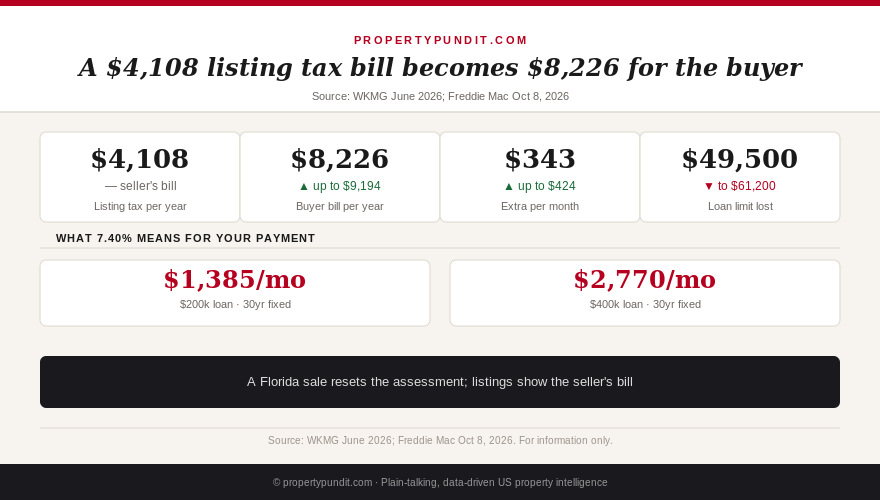
That's a real case from Orange County, Florida, reported by WKMG on June 2, 2026. A home that sold in 2025 for $535,000 showed 2024 taxes of $4,108 on Zillow, which reflected the prior owner's homestead exemption and capped assessment. The county's own tax estimator put a new owner's bill at $8,225.96 to $9,194.46 (Orange County Property Appraiser estimator, as quoted by WKMG). The listing number was roughly half of reality.
Three things decide whether this hits you: whether your state resets the assessment when a home sells, how far the seller's assessed value sits below the price, and whether your lender builds your escrow on the right figure. We'll walk through each with numbers.
Get this in your inbox every Friday.
One email. The number that matters and what it means for you.
Why the number on the listing belongs to the seller
Listing sites pull the last tax bill on record. That bill reflects the previous owner's assessed value, exemptions and any cap on increases, none of which transfer to you. In Florida, the Save Our Homes cap limits annual assessment increases for a homesteaded owner to 3% or the change in inflation, whichever is less. When the home sells, the cap resets, and the new owner's first bill is based on current market value (WKMG, June 2, 2026).
Orange County Property Appraiser Amy Mercado put it plainly: "When they receive their first tax bill after the sale, with their reset rate, it's at the current market value." Her illustration was a home bought for $100,000 that's worth $300,000 ten years later. The seller may be paying about $1,000 a year, while the next buyer pays on the full $300,000. At the same effective rate that would be roughly $3,000, which is our arithmetic, not hers.
The gap matters most in the places where homes have appreciated the most. The typical Florida single-family home runs about $400,000, up 66% in ten years after adjusting for inflation (Shimberg Center for Housing Studies, University of Florida, as cited by WKMG). A long-time owner's capped assessment can trail that by a wide margin.
What it means for you: treat any listing tax figure as a floor, and the longer the seller has owned the home, the further below the real bill it is likely to sit.
The Orange County example, line by line
| Item | Listing (seller) | Buyer estimate (low) | Buyer estimate (high) |
|---|---|---|---|
| Annual property tax | $4,108 | $8,226 | $9,194 |
| Monthly equivalent | $342 | $686 | $766 |
| Increase vs listing, per year | - | +$4,118 | +$5,086 |
| Increase vs listing, per month | - | +$343 | +$424 |
| Multiple of the listing figure | 1.0x | 2.0x | 2.2x |
Sale price $535,000; listing figure is 2024 tax per Zillow; buyer estimates are the county estimator range for a buyer who files a new homestead exemption (Orange County Property Appraiser estimator, as quoted by WKMG, June 2, 2026). Monthly figures divide the annual bill by 12.
A bill that doubles at closing can decide whether a house fits your budget.
What it means for you: before you fall for a listing, ask what the assessed value is relative to the price, because a big gap predicts a big jump.
What an extra $343 to $424 does to a $78,000 income
Take a buyer earning $78,000 a year, or $6,500 a month gross. The common 28% front-end guideline caps housing at $1,820 a month for principal, interest, taxes and insurance. An unexpected $343 to $424 of tax is 18.8% to 23.3% of that entire limit.
The loan size that disappears is easy to calculate. At Freddie Mac's 7.40% 30-year rate (October 8, 2026), each $100,000 borrowed costs about $692 a month in principal and interest. So a $343 monthly tax surprise removes about $49,500 of borrowing power, and $424 removes about $61,200. That much loan no longer fits under your $1,820 limit once the real tax lands in escrow.
This connects to something we've covered before. Our pre-approval budget piece explains why a lender's approved amount isn't a safe amount, and a mis-estimated tax line makes the same problem worse. If the lender builds your escrow on the seller's bill, your payment is lower on paper at closing and higher after your first escrow analysis, which is the pattern behind the escrow shortage letters that show up a year later.
What it means for you: price the home against your limit using a tax figure built on the sale price, and if the answer breaks your budget, lower your offer ceiling now instead of discovering it in escrow.
California: the bill arrives after closing
California resets the assessment too, but the shock comes in a different form. A sale is a reassessable change in ownership, and the property's new base value becomes its market value at transfer. The tax is a 1% base levy plus local bonds and special assessments; the Orange County Assessor (California) uses a 1.15% example, which on a $250,000 taxable value produces $2,875 a year (Orange County Assessor, accessed October 2026).
Illustration, using that 1.15% rate: if the seller's assessed value was $100,000, their bill is about $1,150. Yours on a $250,000 purchase is $2,875, or $1,725 more a year ($144 a month).
The extra cost can also show up as a separate bill. If market value at transfer is higher than the old taxable value, you receive a supplemental tax bill for the difference, prorated from the transfer date to June 30. Supplemental taxes are usually not collected in escrow, which is based on the previous owner's taxable value, and the notice arrives several months after closing, with a bill about two weeks after that. A transfer between January 1 and May 31 triggers two supplemental assessments (Orange County Assessor). On the same illustration, a September 1 closing would carry about 10 months of the $1,725 gap, roughly $1,438, as a bill you have to pay on top of the escrow payment. If market value is lower than the old value, you get a refund instead. The buyer must also file a Change in Ownership Statement within 45 days (Kassouni Law, July 21, 2026).
We've written about the investor side of the same rule in our California market spotlight. For a buyer, the point is simpler: the sticker shock is real, and it's due in cash.
What it means for you: if you buy in California, set aside roughly a year's worth of the assessment gap in cash before closing, and ask your lender whether any of it is being escrowed.
How to check your real number in ten minutes
You don't have to guess. The same steps work in any state that reassesses on sale:
- Find the county tax estimator. Many appraisers and assessors publish one. Enter the expected purchase price and the exemptions you'll claim. Orange County, Florida, has one, and the $8,226 to $9,194 range above came from it.
- Compare assessed value to price. If the county's assessed value is far below the listing price, expect a reset. The wider the gap, the bigger the jump.
- Ask your loan officer to build escrow on the purchase price. Get the tax figure in writing on your Loan Estimate and ask what value and millage rate they used.
- Know your exemption deadline. A homestead exemption isn't automatic, as we showed in our homestead exemption piece. Miss the filing date and you can pay a full year at the higher rate.
- Add taxes to your cash-to-close. Along with the items in our closing costs guide, include any prorated tax and possible supplemental bill.
A Florida bill, SB 856, would have required listing sites to estimate taxes without using the current owner's tax information. It passed the Florida Senate and did not pass the House (WKMG, June 2, 2026), so listing figures remain the seller's. Other states appraise on different schedules, so check yours: we priced Florida and California here, and we haven't priced the others.
What it means for you: ten minutes with a county calculator before you make an offer is worth more than any other bit of homework in the process.
The call
Frankly, if the listing's tax bill looks low compared with the price, assume it is. Rebuild your budget using a sale-price estimate, cut your offer ceiling by the difference in loan capacity, and walk away from any house that only works on the seller's tax number. Most people who run this check find the home that fit at $342 a month of tax simply doesn't at $686. If you've already appealed or plan to challenge a valuation after purchase, read our property tax appeal piece first, since an appeal helps only when the assessed value is wrong, and a value that is simply higher than the seller's usually is not wrong.
Frequently asked questions
Does the property tax on a Zillow listing show what I will pay?
Often not. The figure is the seller's last bill, with the seller's assessed value and exemptions. In Florida and California a sale resets the assessment to market value, so the buyer's bill can be double or more.
How much will my Florida property taxes go up after I buy?
In the Orange County example, taxes went from $4,108 on the listing to an estimated $8,226 to $9,194 for the buyer, an increase of $4,118 to $5,086 a year. Your result depends on how far the seller's assessed value sits below the price.
Will my escrow cover a California supplemental tax bill?
Usually not. Escrow is based on the previous owner's taxable value, so the supplemental bill arrives separately, several months after closing.
How can I estimate my real property tax before making an offer?
Use your county's tax estimator with the expected purchase price and exemptions, then ask your loan officer to build escrow on that number rather than the seller's bill.