 Property
If Fresno and Bakersfield are on your shortlist because a DSCR lender's marketing page called them California's best cash-flow metros, here is the number that pitch leaves out: a full underwrite of a median-priced Fresno rental loses $1,396 a month. Bakersfield, pitched just as hard, loses $1,313. These aren't the state's most expensive markets. They're the two cities everyone points to as the affordable alternative to the coast.
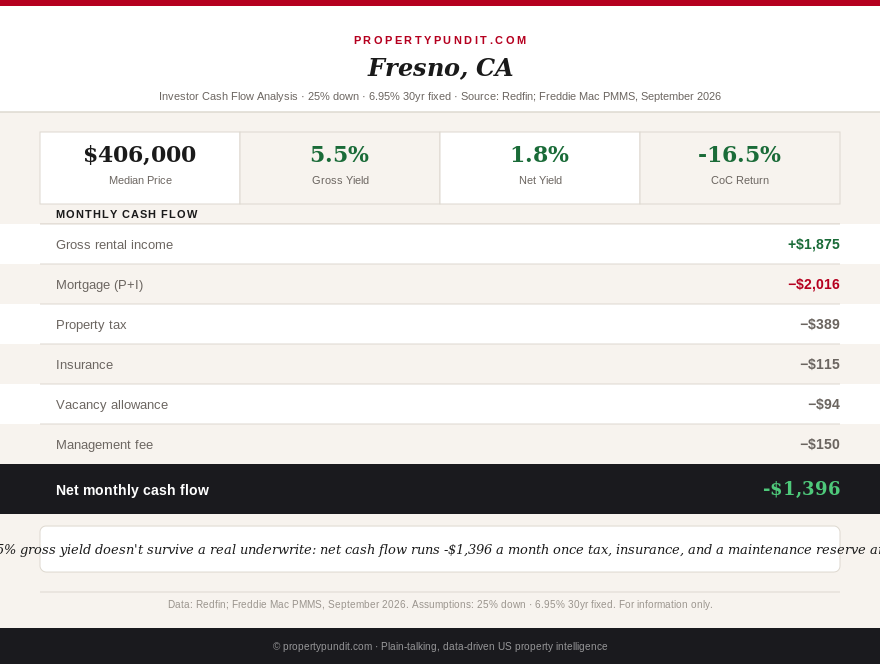
The gross yield numbers those pitches cite aren't fabricated. Fresno and Bakersfield both post gross rental yields above 5.5%, genuinely among the highest in the state, because home prices there run a third of what a comparable house costs in Los Angeles or the Bay Area. The problem is that gross yield ignores everything a lender's underwriting actually charges you for: the mortgage at today's rate, California's property tax, landlord insurance, and the ongoing cost of owning a thirty- or forty-year-old house at a distance. Run those numbers in full, including a maintenance reserve most first-pass pitches skip entirely, and both cities fail a 1.0 debt service coverage ratio by a wide margin.
This is California's third look in our state rotation, following underwrites in May and July 2026. The July pass on these same two cities found smaller losses, Fresno at roughly $429 a month and Bakersfield at $714, because it priced the mortgage, tax, and insurance but left out the 1% to 1.5% of a property's value that a long-hold rental needs budgeted every year for repairs. Add that reserve back in, along with a rate that has climbed since July, and the picture gets meaningfully worse.
Get this in your inbox every Friday.
One email. The number that matters and what it means for you.
California's median price depends on which California you mean
Redfin's statewide data put California's median sale price at $746,890 in August 2026, essentially flat year over year, while Zillow's smoothed statewide home value index runs higher at $775,549, down 0.4% over the past year (Redfin; Zillow, August 2026). Both numbers are dominated by the coastal metros, Los Angeles, the Bay Area, San Diego, where the bulk of the state's transaction volume and value sits. Neither figure tells you anything useful about Fresno or Bakersfield, where prices run closer to $400,000, a third of the state's blended average. Treat any single "California home price" headline as a coastal number unless the source specifically names an inland metro.
For you, the practical takeaway is that this state punishes lazy generalizations more than most. A market explorer or a national headline citing "California prices" is almost always describing a coastal reality that has nothing to do with the Central Valley numbers below.
Fresno: advertised as one of the state's best yields, still loses $1,396
Fresno's median sale price ran $406,000 over the three months ending August 2026, down 2.3% year over year (Redfin, 2026). At 25% down and today's 6.95% rate (Freddie Mac PMMS, September 17, 2026), the $304,500 loan carries a $2,016 principal and interest payment. Add California's roughly 1.15% effective property tax under Proposition 13 ($389 a month) and an estimated $115 a month in landlord insurance, well below coastal wildfire-zone rates since Fresno sits outside the state's highest-risk fire zones, and the PITI payment reaches $2,520. A three-bedroom single-family rental in Fresno runs an estimated $1,875 a month, above the blended $1,495 average Zillow Rental Manager reports across all property types but below the $2,057 all-apartment-type figure RentCafe cites for September 2026, a gap that mostly reflects RentCafe's sample skewing toward newer, amenity-heavy complexes rather than standalone houses. That $1,875 rent puts the debt service coverage ratio at 0.74. Add an 8% management fee ($150), a 5% vacancy allowance ($94), and a 1.5% annual maintenance reserve ($508 a month), and the full monthly cost stack reaches $3,271 against $1,875 in rent, a loss of $1,396.
The lesson for you is that a 5.5% gross yield headline and a cash-flowing property are not the same claim, and the gap between them in Fresno is more than a thousand dollars a month once every real carrying cost is on the page.
Bakersfield: pitched as "not a punchline," still comes up $1,313 short
Bakersfield's average home value runs $392,105, down 0.4% over the past year (Zillow, 2026). The same 25% down and 6.95% rate produce a $294,079 loan and a $1,947 principal and interest payment. Add roughly $376 a month in property tax and an estimated $110 in landlord insurance, and the PITI payment reaches $2,432. A three-bedroom rental in Bakersfield runs close to $1,850 a month, consistent with active listings in the market (Zillow; local listing data, 2026), producing a 0.76 DSCR, marginally better than Fresno's. After an 8% management fee ($148), a 5% vacancy allowance ($93), and a $490 monthly maintenance reserve, the full cost stack reaches $3,163 against $1,850 in rent, a $1,313 monthly loss, the smaller of the two shortfalls but still a clear DSCR fail.
Gross yield in Bakersfield runs about 5.7%, arguably the more defensible of the two cities' marketing claims. Net cash flow tells a different story, and net is the number that actually determines whether the property services its own debt.
Proposition 13 doesn't play favorites, and that's rare
Most states we cover in this rotation give homeowners a property tax break that a rental in the same neighborhood doesn't get, a homestead exemption, a credit, or an assessment growth cap reserved for owner-occupants, a pattern now confirmed in states from North Dakota to Arkansas. California works differently. Proposition 13's 1% base rate plus local bonds and its 2%-per-year cap on assessment growth after purchase apply identically whether the owner lives in the house or rents it out. An investor buying a Fresno rental today is taxed the same way, at the same rate, as a first-time buyer purchasing next door.
That's a genuine structural advantage relative to most of the country, and it's worth knowing if you already own here. It just isn't large enough, on its own, to fix a debt service coverage ratio that's short by thirteen to fourteen hundred dollars a month before the tax bill is even the biggest line item.
The wildfire insurance story isn't this story
California's FAIR Plan, the state's insurer of last resort for wildfire-exposed properties, is raising rates by an average of 29.1% effective October 15, 2026, with the highest-risk zip codes seeing premiums run from $5,000 to more than $12,000 a year (California FAIR Plan, 2026). That's a real and worsening cost for coastal foothill and wine country properties. Fresno and Bakersfield sit in the Central Valley, largely outside the state's highest wildfire-risk tiers, which is why the insurance estimates used in this underwrite, $110 to $115 a month, land close to a national-average landlord policy rather than a FAIR Plan quote. If you're underwriting a California property in a higher-risk foothill or wine country zip code instead of the flat Central Valley, price your insurance from an actual quote, not the numbers in this article; the gap between a Central Valley policy and a wildfire-zone policy can run into thousands of dollars a year on its own.
What this means for you
At today's rate and prices, the math points toward passing on both Fresno and Bakersfield as pure cash-flow plays, at least until rents close a meaningful share of the thirteen-hundred-dollar gap or rates fall by a full point or more. If you're underwriting California as a long-hold appreciation and tax-parity bet rather than a monthly-income bet, Proposition 13's even-handed treatment of owners and investors remains a genuine reason to stay in the state. Most people who run this exact underwrite end up looking outside California entirely for a property that services its own debt, and treating any Central Valley "best cash flow in California" pitch as a claim to verify against your own numbers, not a number to trust on the page. For the underwriting mechanics behind these DSCR and yield figures, see our DSCR loan investor guide and the county-level SFR yield map; our July underwrite of this same state shows how much the picture has worsened now that a maintenance reserve and a higher rate are both priced in.