 Property
You've been saving, watching listings and telling yourself the smart move is to wait until things get back to normal. On October 8 the 30-year rate hit 7.40%, its seventh straight weekly rise (Freddie Mac PMMS via Fox Business, October 8, 2026), and Redfin just put a date on "normal": for 24 of 46 large metros, it's at least a decade away at any mortgage rate from 6% to 8%.
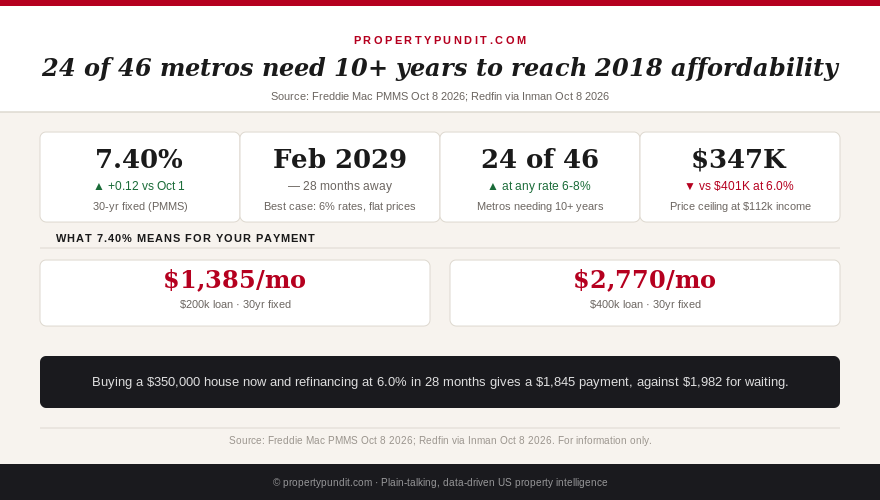
Redfin's analysis, reported by Inman on October 8, 2026, defines normal as each metro's August 2018 level, when a mortgage payment took 30% of the median household income nationally. The scenarios assume a 20% down payment, current local price growth and income growth based on 2015 to 2019 Census data, and Redfin says the scenarios are hypothetical and not predictions. They're still the best available answer to the question you're really asking: how long does waiting take?
The answer changes the decision. If the best case is years away and needs prices to stall, your real choice is between buying now with a plan to refinance and paying rent while you wait for a date that may not arrive. I priced both below on a $350,000 house.
Get this in your inbox every Friday.
One email. The number that matters and what it means for you.
The best case is February 2029, and it needs prices to stand still
Redfin's national scenarios are blunt. With rates at 6% and home prices flat, affordability returns to the 2018 benchmark in February 2029. At 7.5% and flat prices it takes until about 2032. If prices keep growing at 2.1% a year, any rate from 7% to 8% takes 10 years or more (Redfin via Inman, October 8, 2026). Nobody sells at flat prices to help your timeline. Case-Shiller's national index rose 1.9% year over year in July 2026 (S&P Cotality Case-Shiller, September 2026), close to Redfin's 2.1% growth assumption.
Your local market sets the clock, and the spread is wide:
| Metro (at about 7.5% rates) | Returns to 2018 affordability |
|---|---|
| San Jose | October 2027 |
| Austin | February 2028 |
| Oakland | April 2028 |
| Seattle | June 2029 |
| Portland | February 2030 |
| San Antonio | January 2031 |
| Denver and Los Angeles | June 2032 |
| Fort Worth | February 2033 |
| New York, Chicago, Philadelphia and 21 other metros | At least 10 years, at any rate from 6% to 8% |
San Francisco already got there in late September 2026, when rates were about 7.25%, but its prices are up 9.7% year over year, and at 7.5% or 8% it would need at least a decade to return. Chicago prices rose 5.5% against projected income growth of 3.9%, which is why it sits in the slow group (Redfin via Inman, October 8, 2026).
What it means for you: if your metro is in the slow group, "wait until it's normal" is a hope without a date, so price the alternatives below before you commit to it.
What waiting costs on a $350,000 house
Take the date Redfin gives for the national best case, February 2029, which is 28 months away. A buyer who waits and finds a 6.0% rate then also finds a higher price, because 2.1% annual growth turns $350,000 into $367,391. With 10% down, that buyer finances $330,652 at 6.0% and pays $1,982 a month in principal and interest.
A buyer who purchases the $350,000 house today finances $315,000 at 7.40% and pays $2,181. If rates reach 6.0% in 28 months and this buyer refinances the $307,735 balance into a new 30-year loan, the payment drops to $1,845, and the $6,155 refinance cost (2% of the balance, my assumption) pays back in about 18 months.
| $350,000 house, 10% down | Buy now, keep 7.40% | Buy now, refinance at 6.0% | Wait 28 months, buy at 6.0% |
|---|---|---|---|
| Price | $350,000 | $350,000 | $367,391 |
| Down payment (10%) | $35,000 | $35,000 | $36,739 |
| Loan amount | $315,000 | $315,000 | $330,652 |
| Principal and interest, months 1 to 28 | $2,181 | $2,181 | Your rent |
| Principal and interest, month 29 onward | $2,181 | $1,845 | $1,982 |
| Loan balance at month 28 | $307,735 | $307,735 | None yet |
| One-time refinance cost (2% of balance) | $0 | $6,155 | $0 |
The refinance path ends with a payment $137 a month lower than the waiter's, and the buyer owns a house for the whole stretch. The waiter owns nothing: 28 months of rent are gone, and the entry price rose by $17,391 under Redfin's growth assumption. The buyer pays for that with 28 months at 7.40%, which comes to $61,068 of principal and interest, of which $53,803 is interest. Set that against 28 months of your own rent: at $2,000 a month it's $56,000 with nothing coming back. The buyer's figure excludes property tax, insurance and repairs, but it also builds $7,265 of principal and keeps any price appreciation. Note that this uses a new 30-year loan, which restarts your payoff clock.
What it means for you: waiting beats buying only if rates fall faster than prices rise and you can live with renting meanwhile; in the base case above it doesn't.
The risk is the refinance that never comes
The refinance column assumes rates fall to 6.0%, and nobody can promise that. The 10-year Treasury yield averaged 5.28% this week, and Realtor.com economist Joel Berner said high rates have unsettled the housing market (Fox Business, October 8, 2026). A year ago the 30-year was 6.3%, so the climb has been 110 basis points in twelve months. If rates stay near 7.40% for years, the buyer keeps paying $2,181 and the waiter keeps renting.
That's why the first test is whether you'd be comfortable at the current rate permanently. If you can't carry 7.40% without a refinance, the purchase depends on a bet about rates.
What it means for you: treat any future refinance as a bonus and underwrite the purchase at today's 7.40%, using our payment-per-$100,000 rule to check it in your head.
What 7.40% does to your price ceiling
Take a buyer earning $112,000 and the common 28% housing cap, which allows $2,613 a month. Subtract $450 for property tax and insurance, and $2,163 is left for principal and interest. At 7.40%, that supports a $312,449 loan, or a $347,165 purchase with 10% down. At 6.0% the same budget supports a $400,918 purchase. The 140 basis points cost $53,753 of buying power.
Waiting doesn't win the full gap back, because a house like this one rises about $17,000 over the same 28 months at 2.1% growth. Check the ceiling before you shop, and see how a smaller down payment than you expect changes it.
What it means for you: if the houses you want cost more than about $347,000 on that income, the constraint is your budget at 7.40%, and you should save or wait for a better price in your metro, not for the national rate.
When waiting is the right call
Three situations favor waiting. First, you might move within three years: a refinance and the cost of selling take a bite that short ownership can't absorb. Second, the payment fits only if the rate falls. Third, you're in a market where sellers are already cutting. Redfin found roughly 21% of sellers with active listings cut their asking price in the four weeks before September 20, 2026, the highest share for this time of year since the company began tracking in 2022. Denver led with 30.9% of listings carrying a price cut, ahead of Indianapolis at 29.9% and San Antonio at 26.8%, and Boston's share jumped 7.6 points in a year (Redfin via Business Insider, October 6, 2026). In those metros a lower price can do the work a lower rate would. Our fall discount versus spring rate decision walks through how much.
What it means for you: waiting makes sense for a price cut you can see in your metro, not for a rate drop you can't see anywhere.
What this means for you
The math points toward buying now if three things are true: the house payment at 7.40% fits inside 28% of your income with room to spare, you expect to stay at least five years, and you have cash left after closing. In that case the refinance is optional upside. Frankly, if you're in one of the 24 metros Redfin puts a decade away, the date you're waiting for sits past your next lease renewal, and every month of rent during that time buys nothing. If the payment only works at 6.0%, keep saving and let the market come to you through price cuts.
Frequently asked questions
How long until housing is affordable again?
Redfin's scenarios put a return to 2018 affordability at February 2029 in the best national case, with 6% rates and flat prices. At about 7.5% it takes until roughly 2032, and 24 of 46 large metros need 10 years or more at any rate from 6% to 8%.
Should I wait for mortgage rates to fall before buying?
Only if the payment at today's 7.40% doesn't fit your budget or you may move within three years. Otherwise, buying now and refinancing later beats waiting in the $350,000 example: a $1,845 payment against $1,982, with equity building the whole time.
How much does a refinance cost?
This article assumes 2% of the loan balance, about $6,155 on $307,735. At a $336 monthly saving from a 7.40% to a 6.0% rate, that pays back in about 18 months. Actual refinance costs vary by lender and state.
Which metros will recover affordability first?
At about 7.5% rates, Redfin projects San Jose in October 2027, Austin in February 2028, Oakland in April 2028, Seattle in June 2029 and Portland in February 2030. New York, Chicago and Philadelphia are in the group that needs at least a decade.