 Property
You have about $25,750 to put down on a Detroit house and a lender that wants 25% on an investment loan. In August this looked like the one Michigan deal that paid you $185 a month. At 7.40% it pays you nothing: the $103,000 median house now loses $27 a month after management, vacancy and a maintenance reserve, while Grand Rapids loses $1,153 and Ann Arbor $2,563.
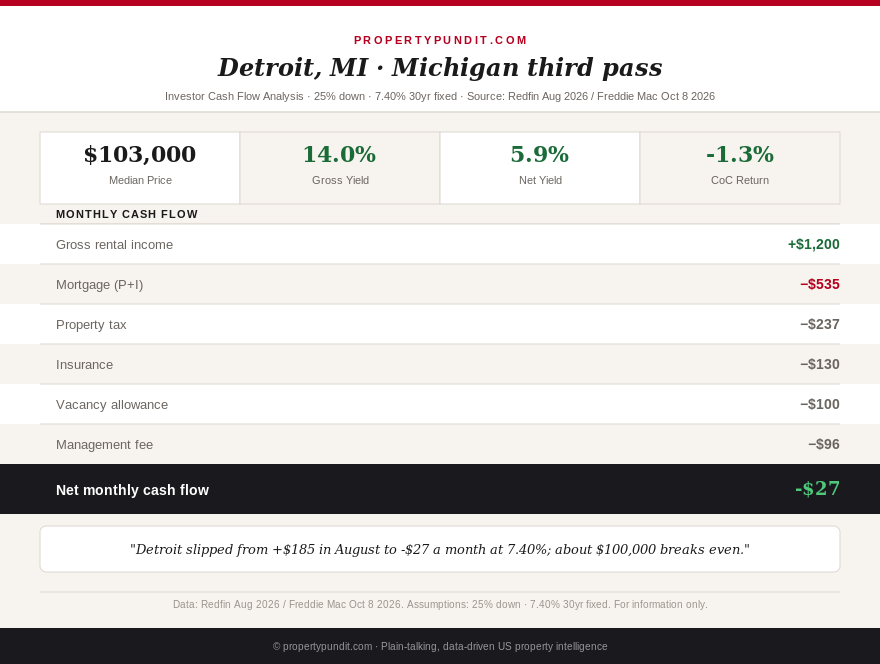
This is our third pass on Michigan, after the June 10 first pass and the August 3 second pass. The benchmark 30-year rate moved from 6.66% to 7.40% since then (Freddie Mac PMMS, July 30 and October 8, 2026), and October 8 was the seventh straight weekly rise (Fox Business, October 8, 2026). I underwrote each market with 25% down, an 8% management fee, one month of vacancy a year and a 1.5% annual maintenance reserve, the same method as yesterday's Massachusetts update. August's published results had no maintenance reserve, so I recomputed August's inputs at today's method before comparing them below.
Three inputs are carried and not refreshed: investor property tax rates (Ownwell, 2026), the insurance estimates of $130, $110 and $140 a month from the August pass, and the Grand Rapids rent, which comes from a Zillow page last updated November 26, 2025. I flag each one where it matters.
Get this in your inbox every Friday.
One email. The number that matters and what it means for you.
Detroit buyers have the upper hand: 50 days on market, 94.7% of list
Redfin puts Detroit's median sale price at $103,000 for August 2026, down 4.6% from a year earlier, on 1,488 sales (down 6.2%). Homes took a median 50 days to sell, up 8 days, and closed at 94.7% of list price, down 1.6 points. Just 23.6% sold above list, down 4.1 points, and 34.0% of homes had a price drop, up 1.9 points (Redfin, August 2026). That's a buyer's market in the cheapest corner of the state. Note that August's pass used about $95,000 from an older Redfin reading, so part of the price change below is a source change and not a market move.
What it means for you: the one Michigan submarket where the numbers can work is also the one where sellers are discounting, so negotiate before you underwrite.
Three Michigan rentals, one table
| Monthly line item | Detroit | Grand Rapids | Ann Arbor |
|---|---|---|---|
| Price (Redfin median sale price, August 2026) | $103,000 | $309,795 | $474,842 |
| Down payment (25%) | $25,750 | $77,449 | $118,711 |
| Rent (house) | $1,200 | $1,844 | $2,058 |
| Principal and interest (7.40%) | $535 | $1,609 | $2,466 |
| Property tax (investor rate) | $237 (2.76%) | $589 (2.28%) | $1,084 (2.74%) |
| Insurance (estimate) | $130 | $110 | $140 |
| Management (8%) | $96 | $148 | $165 |
| Vacancy (one month a year) | $100 | $154 | $172 |
| Maintenance reserve (1.5% a year) | $129 | $387 | $594 |
| Net monthly cash flow | -$27 | -$1,153 | -$2,563 |
| Coverage ratio (rent / PITIA) | 1.33 | 0.80 | 0.56 |
| Rent needed to break even | $1,232 | $3,221 | $5,120 |
The coverage ratio flatters the cheap end. Detroit's 1.33 looks comfortable, yet the house still nets -$27 once operating costs come out. Read our DSCR loan guide for why a passing ratio and positive cash flow are different tests.
What it means for you: ignore the ratio until you've subtracted management, vacancy and a repair reserve from the rent, because that's the money that actually leaves your account.
Detroit: a $27 monthly loss, and $100,000 breaks even
On $103,000, principal and interest at 7.40% is $535, the investor-rate property tax $237 and insurance $130, for $902 of PITIA against $1,200 of rent. Management takes $96, vacancy $100 and the maintenance reserve $129, leaving -$27 a month, or -$324 a year on $25,750 down (a -1.3% cash-on-cash return). Against the $185 gain August showed, the swing came from three sources: the maintenance reserve and a lower management fee netted to about -$106, the 74 basis point rate move cost another $35, and the higher price cost $71.
Detroit is also the most fragile result here, because each input moves it by more than the whole loss. If the house rents for $1,350, the Zillow three-bedroom apartment average (Zillow, September 30, 2026), cash flow turns to +$99. At $1,100 it's -$110. If a real landlord insurance quote comes in at $250 instead of my $130 estimate, the loss becomes $147. Zillow's own page notes that its $1,200 house figure may be an all-property-type average, so treat the rent as a range. At today's method and rate, the price that breaks even on $1,200 of rent is about $99,967, which is 2.9% below the median.
Two taxes aren't in the cash flow. Detroit levies an income tax on Detroit-sourced rental income of 2.4% for residents and 1.2% for nonresidents (city rates carried from our August pass), and Michigan adds a flat 4.25% (Michigan Department of Treasury, April 15, 2026 determination). Both apply to profit, so they bite only if the property earns one.
What it means for you: bid $100,000 or less, get a landlord insurance quote before you make an offer, and treat a Detroit rental as a break-even hold, not income.
Grand Rapids: a $1,153 loss in a market that closes in 7 days
Grand Rapids is the opposite market. Redfin shows a $309,795 median sale price, up 3.0%, with homes selling in a median 7 days at 101.5% of list price on 688 sales, up 2.1% (Redfin, August 2026). Sellers are still winning, which means you're paying full price into a rent that doesn't support it. At $1,844 of rent (Zillow Rental Manager, last updated November 26, 2025), the break-even rent is $3,221, which is 75% higher. The loss runs $13,836 a year on $77,449 down.
The rent is the weakest input, and I tested it. Using Zillow's $1,900 three-bedroom figure, the loss is $1,105. The conclusion holds either way. A house that breaks even at today's rent and rate would cost about $171,742, 45% below the median, and a market closing in a week doesn't have those.
What it means for you: Grand Rapids works only as an appreciation hold you can fund from salary, and you should size the monthly cash gap before you size the offer.
Ann Arbor: $2,563 a month for the University of Michigan address
Ann Arbor's median sale price is $474,842, essentially flat at -0.03% from a year ago, with a median 41 days on market (up 4) and a 99.4% sale-to-list ratio (Redfin, August 2026). Rent of $2,058 (RentCafe, 2026) covers only 56% of the $3,690 PITIA, and the break-even rent is $5,120, up 149%. The yearly loss is $30,756 on $118,711 down.
The tax line is the hidden driver. Michigan's Principal Residence Exemption removes 18 school mills for owner-occupants, so an investor pays about 0.9 percentage points more than a homeowner. On this house that's roughly $356 a month ($1,084 at 2.74%, against about $728 at the 1.84% homestead rate in Washtenaw County, per Ownwell 2026). A listing that quotes the seller's taxes understates your bill.
What it means for you: unless you have a reason to hold Ann Arbor for a decade, spend the $118,711 somewhere it doesn't need a $2,563 monthly subsidy.
What moved since August
| Net monthly cash flow | Detroit | Grand Rapids | Ann Arbor |
|---|---|---|---|
| August 3 as published (6.66%) | +$185 | -$602 | -$1,884 |
| August inputs at today's method (6.66%) | +$79 | -$923 | -$2,470 |
| Today: new price, rent and 7.40% | -$27 | -$1,153 | -$2,563 |
Every Michigan market got worse, and the ordering didn't change. Detroit slid $212 from a positive to a negative; Grand Rapids lost $551 and Ann Arbor $679. In Grand Rapids, $321 of the $551 drop is the new method (the maintenance reserve) and $230 is the rate, a higher price and a higher rent. That rent rose 15%, but the price rose 15% too, so the higher rent bought no relief.
What it means for you: if you underwrote a Michigan deal in August at 6.66%, redo it at 7.40% with a repair reserve before you close.
What this means for you
The math points toward Detroit under about $100,000, and only if you can verify $1,200 or more of rent and an insurance quote at or below $130 a month. That gets you to break-even, not income, so the case has to be appreciation or a lower rate later. Frankly, if you need positive cash flow today, Michigan doesn't have it at median prices: Grand Rapids and Ann Arbor are $14,000 and $31,000 a year of carrying cost. The same pattern showed up in Massachusetts, where the only winner was a $175,000 house. If you're comparing counties, our single-family yield map shows where rent covers cost.
Frequently asked questions
Is Michigan rental property profitable in 2026?
Barely, and only at the bottom. At 7.40% and 25% down, a $103,000 Detroit house loses about $27 a month after management, vacancy and a maintenance reserve. Grand Rapids loses $1,153 and Ann Arbor $2,563 at median prices.
What price makes a Detroit rental break even?
About $99,967 on $1,200 of rent, with 25% down at 7.40%, an 8% management fee, one month of vacancy and a 1.5% maintenance reserve. That's 2.9% below the $103,000 median.
Why does Michigan tax investors more than homeowners?
Owner-occupants get the Principal Residence Exemption, which removes 18 school operating mills. Investors don't, which adds roughly 0.9 percentage points to the effective rate. On an Ann Arbor house that's about $356 a month.
Is Grand Rapids a better rental market than Detroit?
For tenants and appreciation, yes: homes sell in 7 days at 101.5% of list. For cash flow, no. The Grand Rapids median loses $1,153 a month and would need about $3,221 of rent to break even.