 Property
You've probably scrolled past Detroit listings and done a double take at the price, wondering whether a number that low is a typo, a teardown, or an actual chance to buy a cash-flowing rental for less than a used car costs in most other states. Then you look at Ann Arbor, twenty minutes down the road by comparison to the rest of the country, where the University of Michigan anchors one of the steadiest rental demand bases in the Midwest, and the price tag looks like the "safer" pick. Run the actual numbers, and Michigan flips that assumption on its head.
Here's the full underwriting across Detroit, Grand Rapids, and Ann Arbor, the data-source confusion that makes Detroit's pricing look stranger than it is, and the tax trap that hits every investor in the state.
Michigan's $270k statewide figure hides three very different cities
Michigan's statewide home value index sits at $269,972, up 4.2% year over year (Zillow ZHVI, June 30, 2026). That figure is a reasonable planning number for the state as a whole, but it collapses the moment you look at individual metros. Detroit, Grand Rapids, and Ann Arbor sit at wildly different price points and, as you'll see below, produce three completely different investor outcomes at today's 6.66% rate (Freddie Mac PMMS, July 30, 2026), the most recent official reading with the next release due Thursday, August 6.
Treating Michigan as one market is the fastest way to underwrite the wrong city. The state's cheapest major metro is also its only one that cash-flows, and that's not a coincidence you'd catch from the statewide number alone.
Get this in your inbox every Friday.
One email. The number that matters and what it means for you.
Detroit's baffling home value number, and the real price a buyer pays
Detroit's Zillow home value index reads $77,245, down 5.1% year over year (Zillow ZHVI, June 30, 2026), a figure that averages in a large stock of very low-value homes concentrated on the city's east and west sides. Homes that are actually changing hands run higher: Redfin's most recent reading put Detroit's median sale price around $95,000. Zoom out to Metro Detroit, which folds in the higher-priced suburban ring, and the median sale price was $310,000, up 5.4% year over year as of June 2026. All three numbers are correct. They're measuring three different things: an all-property value average, a city-proper transaction median, and a metro-wide transaction median.
For an investor, the practical number is the one homes actually sell for in the city itself, not the citywide value average and not the metro figure. Use Redfin's roughly $95,000 city median for underwriting, and treat the $77,245 Zillow figure as a reminder that Detroit's housing stock is more varied than a single headline price can capture.
Detroit: the cheapest market on this list is the only one that cash-flows
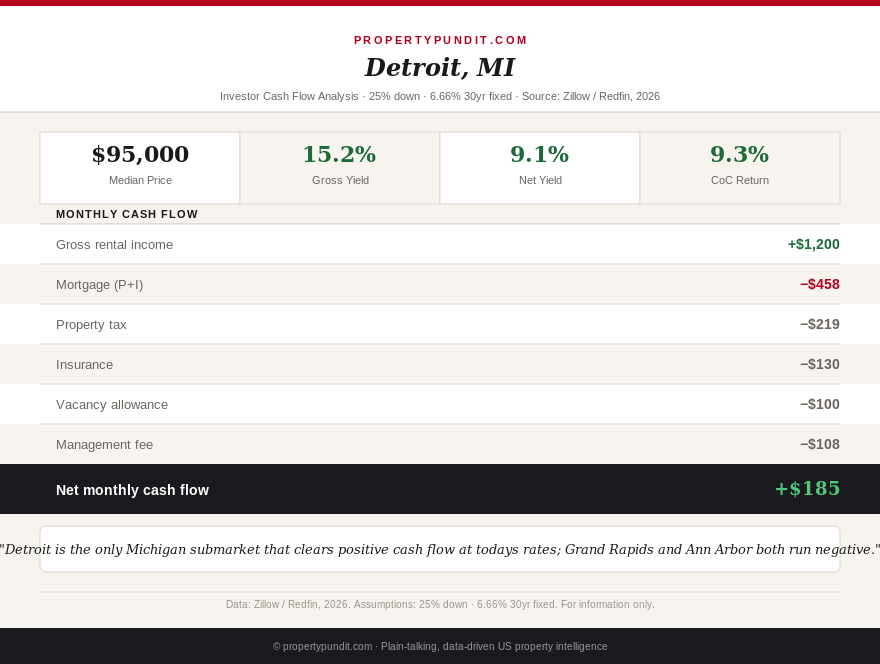
At a $95,000 purchase price with 25% down, a $71,250 loan at 6.66% runs about $458 a month in principal and interest. Detroit's effective property tax rate on an owner-occupied home is roughly 1.86%, the highest in Wayne County, but investors lose the Principal Residence Exemption discussed below, pushing the real investor rate to about 2.76%, or roughly $219 a month. Add an estimated $130 a month in landlord insurance, and total PITIA comes to about $807. Against a conservative $1,200 monthly rent estimate for a Detroit single-family rental (Zillow Rental Manager, 2026), that's a DSCR of 1.49. After a one-month vacancy allowance and a 9% management fee, net monthly cash flow lands at roughly +$185.
That's the strongest number anywhere in this comparison, and it lines up with what several DSCR lenders active in metro Detroit already report: single-family rentals there routinely produce gross yields other Midwest and Sun Belt markets can't match at the same price point. If you're underwriting Michigan on a budget, Detroit's entry-level stock, not the suburbs and not the university towns, is where the actual math works.
Grand Rapids and Ann Arbor: higher prices, weaker math
Grand Rapids sits at a $270,000 home value (Zillow ZHVI, June 30, 2026, up 1.7% year over year). A 25%-down, $202,500 loan at 6.66% runs about $1,302 a month in principal and interest. Kent County's effective tax rate is about 1.38% for homeowners, rising to roughly 2.28% for investors once the Principal Residence Exemption is lost, adding about $513 a month. With an estimated $110 in insurance, PITIA comes to $1,925. Against an estimated $1,600 monthly rent (Zillow, 2026), Grand Rapids posts a DSCR of 0.83 and a net monthly cash flow of about -$602 after vacancy and management. Amway, Steelcase, and the Spectrum Health and Corewell hospital systems anchor solid, diversified employment here, but the price has outrun what that rent base supports.
Ann Arbor is the clearest appreciation-over-cash-flow case in the state. Redfin's own readings on Ann Arbor swing from $445,000 in November 2025 to $525,000 by March 2026, a wide enough gap that it's worth using a working midpoint of about $485,000 rather than treating either figure as settled. At 25% down, a $363,750 loan at 6.66% runs roughly $2,338 a month in principal and interest, and Washtenaw County's investor-adjusted tax rate near 2.74% adds about $1,107 more. With estimated insurance of $140, PITIA reaches $3,585. Against an estimated $2,058 monthly rent (RentCafe, 2026), driven by steady University of Michigan and Michigan Medicine demand, that's a DSCR of just 0.57 and a net monthly cash flow of roughly -$1,884 after vacancy and management, the weakest number anywhere in this comparison.
If you're drawn to Ann Arbor because a university town feels like the safer, more "recession-proof" pick, the cash flow math says otherwise: you'd be paying a steep premium for appreciation potential, not monthly income.
The 18-mill tax trap that catches every Michigan investor
Michigan's Principal Residence Exemption waives an 18-mill school operating tax for a home that's your primary residence, worth roughly $1,800 a year on a $200,000 home at 50% state equalized value. Investment properties, vacation homes, and short-term rentals don't qualify. That 18-mill add-back is why every effective tax rate quoted above jumps by roughly 0.9 percentage points once you model the property as a rental rather than assume the homeowner rate you saw in a listing history applies to you. Michigan's flat 4.25% state income tax, reconfirmed for the 2026 tax year by the state treasurer, applies to rental income the same as any other income, and Detroit adds its own 1.2% nonresident city income tax on top for anyone who doesn't live in the city itself.
Model every Michigan rental at the non-homestead rate from day one, not the lower owner-occupied figure a listing's tax history might show, because that exemption disappears the moment the deed changes to an investor's name.
So what should a Michigan investor actually do
At today's 6.66% rates, Detroit's entry-level single-family stock is the only realistic cash-flow target in Michigan, helped along by roughly 18,000 net new automotive and supplier jobs added in southeast Michigan since 2023 as Stellantis, GM, and Ford expand EV and battery production. Grand Rapids is a manageable, diversified-economy loss rather than a disaster, and worth watching if prices soften further. Ann Arbor only makes sense as a long-horizon appreciation bet backed by University of Michigan demand, not a monthly income property. Frankly, if cash flow is the goal, the math points toward Detroit's cheaper east-side and west-side inventory over the more polished suburbs, the same pattern that's shown up in Wisconsin's Milwaukee market and Illinois's Peoria submarket, where the state's less glamorous, lower-priced city consistently beats its higher-profile neighbors on DSCR.
Before underwriting a specific Michigan address, run it through the DSCR loan investor guide and cross-check the county against the SFR yield county map rather than assuming Michigan's statewide reputation, good or bad, applies evenly across it.
Frequently asked questions
Is Michigan a good state for rental property investment in 2026? It depends entirely on which Michigan you're buying into. Detroit's entry-level single-family stock is the only submarket in this comparison that clears positive cash flow at 6.66% rates, producing roughly $185 a month with a DSCR near 1.5. Grand Rapids and Ann Arbor both run negative cash flow, with Ann Arbor losing well over $1,800 a month at 25% down.
Why is Detroit's Zillow home value so much lower than its median sale price? Zillow's home value index averages every home in the city, including a large stock of very low-value properties concentrated on Detroit's east and west sides, which pulls the citywide figure down to about $77,000. Homes that actually sell tend to run higher, closer to $95,000 in Redfin's most recent reading, while the broader Metro Detroit area, which includes higher-priced suburbs, posted a median sale price of $310,000. All three numbers are accurate; they're just measuring different things.
How much extra property tax do Michigan investors pay versus homeowners? Michigan's Principal Residence Exemption waives an 18-mill school operating tax for owner-occupied homes, a benefit investment properties don't qualify for. On a typical Michigan rental, that adds roughly 0.9 percentage points to the effective property tax rate compared with what an owner-occupant next door pays on an identical home, pushing Detroit's investor-adjusted rate to about 2.76% versus its advertised 1.86%.
Is Ann Arbor a good rental market for investors? Not for cash flow. At an estimated $475,000-$525,000 median, University of Michigan-driven demand supports strong rent, but the price premium is too large for today's rates: a 25%-down purchase runs a DSCR around 0.57 and loses close to $1,900 a month before accounting for appreciation. Ann Arbor is better understood as a long-horizon appreciation play than a cash-flowing rental market.