 Property
You have $61,250 earmarked for a Baltimore rowhome, a coverage ratio that finally clears 1.0, and a nagging sense that something still doesn't add up. It doesn't. At 7.28%, a median Baltimore City rental covers its mortgage, tax and insurance 1.06 times and still loses $508 a month once management, vacancy and a maintenance reserve come out, and the two counties around it lose far more.
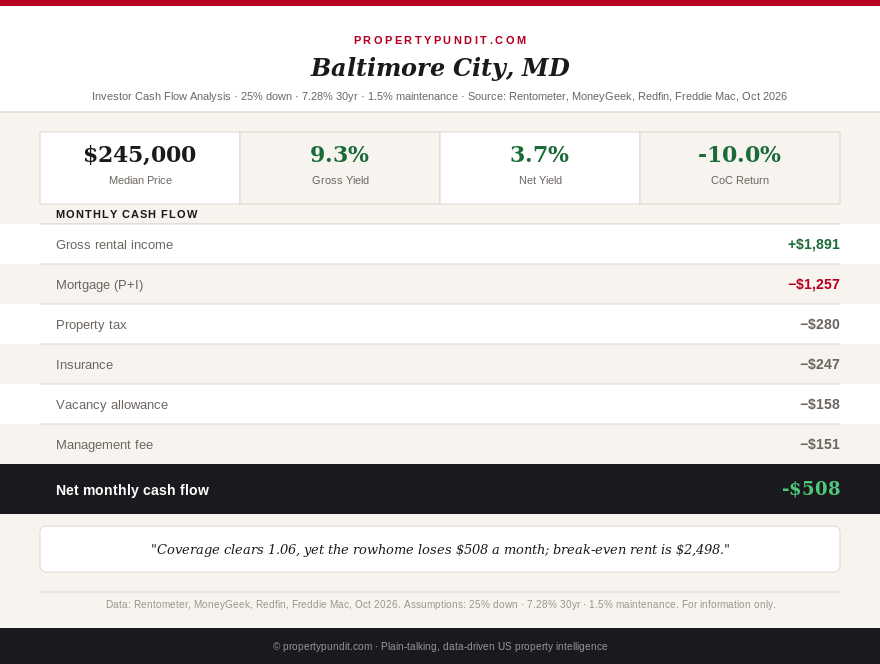
This is our third pass on Maryland, after the June 8 first pass and the July 30 second pass. The benchmark moved from 6.58% to 7.28% (Freddie Mac PMMS, July 23 and October 1, 2026). I underwrote each market with 25% down, an 8% management fee, one month of vacancy a year and a 1.5% annual maintenance reserve, the same method as our other third-pass states. July's published Maryland figures used a 9% fee and no maintenance reserve, so I recomputed July's inputs at today's method before comparing: Baltimore City -$555, Baltimore County -$787 and Montgomery County -$2,614 a month, not the -$264, -$338 and -$1,772 we printed then.
Two inputs moved the most. A Baltimore County three-bedroom house rents for $354 less than the estimate I used in July, and Baltimore insurance runs $247 a month against the $95 I carried. Both are covered below, along with the inputs I couldn't refresh.
Get this in your inbox every Friday.
One email. The number that matters and what it means for you.
Maryland's market has loosened, but less than the nation's
Redfin's August data puts Maryland's median sale price at $443,155, up 1.9% from a year earlier, on 5,467 closed sales, down 3.0%. Homes took 43 days to sell, two days longer than a year ago, and 19.8% of sales had a price cut (Redfin, August 2026). Redfin counts 25,197 homes for sale, up 10.3% year over year, which works out to about 4 months of supply. That's a swing from the 3.2 months and 16.4% inventory decline I logged for May.
The Maryland REALTORS July report tells a tighter story: a $455,000 median, up 2.2%, 16,881 active listings, down 12.9%, new listings down 18.5%, and about 3.0 months of supply against 4.6 nationally (Maryland REALTORS, July 2026). Those two inventory readings point in opposite directions, and I can't reconcile them from public pages because the two sources count listings differently. They agree on one thing: Maryland holds fewer months of supply than the nation's 4.9 months (NAR, August 2026).
The Baltimore metro is the soft spot. Its median is $384,750, down 3.8% from a year earlier, with 36 days on market and active listings up 15.1% (Maryland REALTORS, July 2026). What it means for you: a falling metro median and rising listings give a Baltimore buyer room to ask for a price cut or seller credits that the statewide numbers wouldn't suggest.
Three submarkets, one table
| Monthly line item | Baltimore City | Baltimore County | Montgomery County |
|---|---|---|---|
| Median price | $245,000 | $378,000 | $643,333 |
| Down payment (25%) | $61,250 | $94,500 | $160,833 |
| Rent (3-bedroom house) | $1,891 | $1,946 | $2,600 |
| Principal and interest (7.28%) | $1,257 | $1,940 | $3,301 |
| Property tax | $280 (1.37%) | $337 (1.07%) | $466 (0.87%) |
| Insurance | $247 | $219 | $219 |
| Management (8%) | $151 | $156 | $208 |
| Vacancy (one month a year) | $158 | $162 | $217 |
| Maintenance reserve (1.5% a year) | $306 | $472 | $804 |
| Net monthly cash flow | -$508 | -$1,340 | -$2,616 |
| Coverage ratio (rent / PITIA) | 1.06 | 0.78 | 0.65 |
| Rent needed to break even | $2,498 | $3,548 | $5,726 |
Only Baltimore City clears the 1.0 coverage floor that DSCR lenders use, and the margin is thin: a 1.06 ratio means rent exceeds the mortgage, tax and insurance by $107 a month before any operating cost. What it means for you: coverage tells you whether a lender will approve the loan, and cash flow tells you whether you can afford to keep it, and in Maryland those two answers now differ.
Baltimore City: rent rose $341, and the loss barely moved
Rentometer's April 24, 2026 figure for a Baltimore three-bedroom house is $1,891, with two-bedroom houses at $1,747 (Rentometer, April 2026). July's $1,550 was an estimate I couldn't tie to a house-specific source, so this is the one input that moved in an investor's favor. Add it up from the recomputed July baseline of -$555: the 70-basis-point rate rise costs $86 a month, the higher rent adds $285 after management and vacancy, and insurance costs $152 more. Net: -$508, a $47 improvement that took a $341 rent correction to produce.
Insurance deserves the scrutiny. MoneyGeek puts Baltimore City homeowner coverage at about $2,960 a year, or $247 a month, on a $250,000 dwelling, the highest of Maryland's major cities (MoneyGeek, 2026). Steadily's statewide landlord median is $1,149.50 a year, about $96 a month (Steadily, 2026). A real landlord quote likely lands between the two. At $96, the loss shrinks to -$357 and coverage rises to 1.16, so get a quote on the actual address before you trust either number.
I couldn't refresh the $245,000 price, which is Redfin's three-month median through May 2026 carried forward. The Baltimore metro median fell 3.8% over the year (Maryland REALTORS, July 2026), so it's unlikely to be too low. To break even at $1,891 rent, the house would have to cost about $177,500, 28% less than the median, or the mortgage rate would have to fall to roughly 2.7%. The annual carrying loss is $6,097. What it means for you: Baltimore City is the only Maryland market where an investor loan will probably get approved, but holding it costs about $6,100 a year, so treat it as a bet on a price drop or rent growth and not as income.
Baltimore County: July's rent was $354 too high
Rentometer's August 18, 2026 data shows Baltimore County three-bedroom houses averaging $1,946 and three-bedroom apartments $1,937 (Rentometer, August 2026). July's $2,300 was an estimate that looks about $354 too generous. From the recomputed baseline of -$787, the rate rise costs $133, the lower rent costs $296 and insurance costs $124, which lands at -$1,340. Coverage fell from 1.03 to 0.78, so the suburb I called the nearest runner-up in July no longer passes a lender's test.
The price is the same carried $378,000 (Redfin, three months through May 2026), and the $219 insurance line is MoneyGeek's statewide homeowner average on a $250,000 dwelling (MoneyGeek, 2026), which probably understates the cost on a $378,000 house. Break-even rent is $3,548, 82% above the $1,946 a tenant pays today, and the annual loss is $16,082. What it means for you: a rent number from a listing or a rule of thumb can swing a deal by $300 a month, so pull a house-specific comp for the exact bedroom count before you commit.
Montgomery County: a lower price changed nothing
Zillow puts Montgomery County's median sale price at $643,333 as of July 31, 2026, with a typical home value of $611,206, down 0.6% over the year, and homes going pending in about 16 days (Zillow, August 2026). July used $695,000 from a different source, so part of this pass's price drop is a source change. The cheaper price adds $367 a month, but the rate costs $244 and insurance $124, so the result is -$2,616 against -$2,614 in July. At July's price, the loss would be -$2,983.
Rent is the weak link. I carried $2,600 for a three-bedroom house, but Zillow's county-wide average across all home types is $2,295 (Zillow, August 2026), which would put the loss at -$2,871. Break-even rent is $5,726, 120% above $2,600, and the annual loss is about $31,400. The county has the lowest tax rate in the table and the worst result, because the price premium overwhelms everything else. What it means for you: a price cut alone won't rescue a $643,000 rental at 7.28%, since a 7% drop was fully absorbed by the rate move in a single pass.
What moved since July
| Market | July, recomputed | Today | Biggest driver |
|---|---|---|---|
| Baltimore City | -$555 | -$508 | Rent +$285, insurance -$152 |
| Baltimore County | -$787 | -$1,340 | Rent -$296, rate -$133 |
| Montgomery County | -$2,614 | -$2,616 | Price +$367, rate -$244 |
No market improved by more than $47 a month, and the move in rent estimates mattered more than the move in rates for two of the three. What it means for you: re-check the rent comp before you re-check the rate.
What this means for you
At 7.28% and 25% down, no Maryland market in this pass produces positive cash flow. Baltimore City is the only one that clears lender coverage, and its rowhome would need rent of $2,498, a price near $177,500 or a rate near 2.7% to break even. If you need monthly cash flow, the math points toward a different state: our single-family yield county map shows where yields still clear, and the DSCR loan guide explains why a passing ratio doesn't guarantee a profitable month. Maine's third pass shows the same pattern, with Bangor losing $1,023 a month in our October 6 analysis.
Frankly, if you're set on Maryland, buy it as a long-term hold with cash reserves for roughly $6,000 to $16,000 a year of carrying cost, and use the Baltimore metro's falling median and rising listings to negotiate. Our earlier July Maryland pass covers the non-resident tax and assessment rules, which this pass didn't change.
Frequently asked questions
Is Maryland rental property profitable in 2026?
Not at median prices. At 7.28% and 25% down, a median Baltimore City rental loses about $508 a month, Baltimore County about $1,340 and Montgomery County about $2,616 after management, vacancy and maintenance. Buy only if you can carry the loss.
Which Maryland market has the best investor math?
Baltimore City. Its 1.06 coverage ratio is the only one above the 1.0 DSCR floor, and its monthly loss is the smallest of the three. It still needs $2,498 rent to break even against $1,891 today.
What rent does a Baltimore rowhome need to break even at 7.28%?
About $2,498 a month on a $245,000 purchase with 25% down, after an 8% management fee, one month of vacancy a year and a 1.5% maintenance reserve. That's 32% above the $1,891 average for a three-bedroom house.
Why did Baltimore County's numbers get worse since July?
Three things: the rate rose from 6.58% to 7.28%, rent came in $354 lower than July's estimate, and insurance rose from $95 to $219 a month. Together they took the monthly result from -$787 to -$1,340.