 Property
You've been eyeing the DC suburbs because that's where the jobs and the rent checks both look dependable, and Maryland's mix of federal-government stability and Chesapeake Bay charm makes it feel like a safe bet for a second property. Then you actually run the numbers on a Bethesda-adjacent rental, and the math tells you the "safe" pick is the one losing the most money every single month, while the rowhome market you'd been overlooking in Baltimore City is the closest thing in the entire state to breaking even.
Here's the full underwriting across three Maryland submarkets, the tax traps that catch investors specifically, and what a Maryland rental actually has to look like to clear today's rates.
Maryland's $448k median hides three different investor states
Maryland's statewide median sale price hit $448,407 over the three months ending May 2026, up 2.4% year over year (Redfin). Zillow's broader home value index tells a quieter story: $434,033, up just 0.1% year over year, a reminder that Redfin's sales-based median and Zillow's value index measure different things and can diverge even in a well-covered state. Neither number is useful on its own for underwriting, because Maryland isn't one market. Baltimore City's median sits at $245,000. Baltimore County runs $378,000. Montgomery County, anchored by Bethesda, Rockville, and the federal-worker economy along the DC line, sits at $695,000, nearly triple the city figure inside the same state.
Before you run a single DSCR calculation on a Maryland property, decide which Maryland you're actually buying into. The statewide median won't tell you, and treating it as a single market is the fastest way to underwrite the wrong number.
Get this in your inbox every Friday.
One email. The number that matters and what it means for you.
Baltimore City: the cheapest market comes closest to break-even
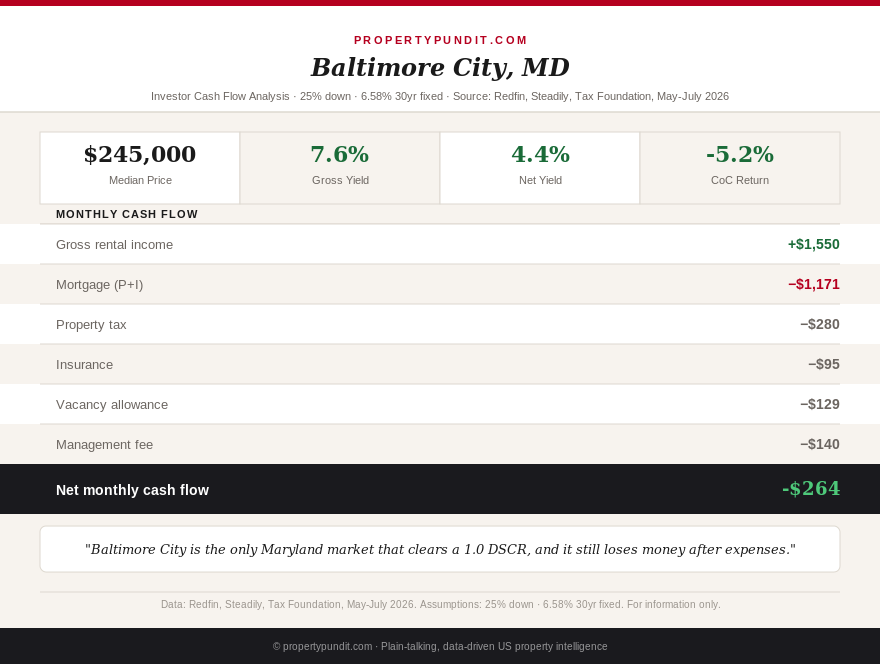
At $245,000 with 25% down, a $183,750 loan at 6.58% runs $1,171/month in principal and interest. Baltimore City's effective property tax rate, 1.37%, the highest of any Maryland jurisdiction, adds $280/month. Landlord insurance runs an estimated $95/month. Total PITIA: $1,546. Against an estimated $1,550/month rent for a Baltimore City rowhome, that's a DSCR of exactly 1.00, the bare minimum most non-QM investor lenders require. Once you subtract a one-month vacancy allowance ($129) and a 9% management fee ($140), net monthly cash flow comes out to -$264.
That's still a loss, but it's the smallest loss anywhere in this comparison, and it's the only submarket where the DSCR math clears the lender floor before expenses. For an investor set on Maryland, Baltimore City rowhomes are the bar every other submarket in the state has to clear, and right now nothing else does.
Baltimore County and Montgomery County: farther from the city, farther from break-even
Baltimore County, the suburban ring around the city, has a median price of $378,000 and a lower effective tax rate than the city itself at 1.07%. At 25% down and 6.58%, PITIA runs $2,239/month against an estimated $2,300/month rent for a mid-size three-bedroom, DSCR 1.03. That looks marginally better than Baltimore City on paper, but the bigger loan means a bigger dollar loss once vacancy and management come out: net cash flow of -$338/month.
Montgomery County is a different story entirely. At a $695,000 median and the state's lowest tax rate in this comparison, 0.87%, a 25%-down loan at 6.58% still produces $3,921/month in PITIA. Against an estimated $2,600/month rent, that's a DSCR of just 0.66, the weakest ratio in the state, and a net monthly cash flow of -$1,772 once vacancy and management are subtracted. The county with the lowest tax rate in this entire comparison produces the worst investor math in Maryland, because Montgomery County's DC-proximity price premium overwhelms anything a lower tax rate could offset. If you're underwriting a Maryland rental on the assumption that the "nicer," higher-priced suburb is automatically the safer bet, this is the number that says otherwise.
Maryland's non-resident investor tax trap
If you don't live in Maryland, the state's rental income tax bill is bigger than the headline rate suggests. Maryland's graduated state income tax runs roughly 2% to 5.75% depending on income, the rate most listings and general tax guides quote. Non-resident investors owe that state rate plus an additional non-resident county-equivalent rate of 1.75% on Maryland-sourced income, for a combined effective rate around 7.5% on rental profit for most out-of-state owners. In-state Maryland residents pay their regular county rate instead of the non-resident add-on, which is typically lower.
If you're modeling a Maryland rental from out of state, use the roughly 7.5% combined figure on your net rental income, not the in-state rate you'll see quoted in most general tax summaries; underestimating this line is an easy way to overstate your real after-tax return.
The 12.7% assessment jump, and why investors get the full hit
Maryland reassesses property values on a rolling three-year cycle, and any increase phases into the actual tax bill gradually across those three years rather than landing all at once. The statewide average assessment increase for the current cycle was 12.7%. That phase-in mechanism applies to every property in Maryland, owner-occupied or not. What doesn't apply to investors is the separate Homestead Tax Credit, which further caps how much an owner-occupied primary residence's taxable assessment can rise each year on top of the phase-in. Investment properties get none of that additional cushion.
Model your Maryland property tax line assuming the full phased-in 12.7% reaches your bill on schedule over the next three years, not the slower, further-capped ramp an owner-occupant next door might see on an otherwise identical house.
So what should a Maryland investor actually do
At today's 6.58% rates, Baltimore City's entry-level rowhome stock is the only realistic underwriting target in Maryland, and even there you're managing a small monthly loss rather than banking positive cash flow. Baltimore County comes close behind it. Montgomery County, and by extension similar high-price DC-adjacent submarkets, need either a materially larger down payment than 25% or a genuine price correction before the DSCR math works at all. Frankly, if you're set on the DC-Baltimore corridor, most people who run these numbers end up starting their search in Baltimore City or its immediately cheaper suburbs, not the county that feels the safest on a map. If you want to see how this same appreciation-versus-cash-flow tension plays out elsewhere along the same corridor, Virginia's investor math only works near a specific military demand base, and it's worth comparing directly before choosing between the two states. Delaware just went through its own overdue reassessment story, and it's the closer regional parallel to Maryland's own phase-in mechanics.
Before you underwrite any specific Maryland deal, run the numbers yourself with the DSCR loan investor guide and cross-check the county against the SFR yield county map rather than assuming Maryland's statewide reputation applies evenly across it.
Frequently asked questions
Is Maryland a good state for rental property investment in 2026? Only in specific submarkets. Baltimore City's lower-priced rowhome stock comes closest to cash-flow neutral at today's rates, with a DSCR right at the 1.0 lender minimum. Montgomery County and other high-priced DC-adjacent suburbs fall well short of that threshold and lose well over a thousand dollars a month at 25% down.
Why does Baltimore City have the highest property tax rate in Maryland? Baltimore City's effective property tax rate runs about 1.37%, the highest of any Maryland jurisdiction, against a 0.92% statewide average and a low of 0.56% in Talbot County. A smaller assessed tax base relative to the city's fixed budget needs pushes the rate up even though home prices there are among the state's lowest.
Do out-of-state investors pay more tax on Maryland rental income? Yes. Non-resident investors owe Maryland's graduated state income tax rate (roughly 2%-5.75%) on Maryland-sourced rental income, plus an additional non-resident county-equivalent rate of 1.75%, for a combined rate around 7.5% for most out-of-state owners.
What is Maryland's property tax assessment phase-in? Maryland reassesses property values on a rolling three-year cycle, and any increase phases into the tax bill gradually over those three years rather than hitting all at once. The statewide average assessment increase for 2026 was 12.7%. Investment properties don't qualify for the separate Homestead Tax Credit that further caps annual increases for owner-occupied homes, so investors see the full phased-in amount reach their bill on schedule.