 Property
If you locked a 3.8% mortgage years ago, you probably read last month's "Fed raises rates" headline, braced for something, and then watched nothing change on your statement. The reason is stranger than most coverage admits: the Fed's target range is a quarter point lower today than it was a year ago, and the 30-year mortgage rate is 0.94 points higher. Both are true at once, and which one touches your money depends on what kind of debt you carry.
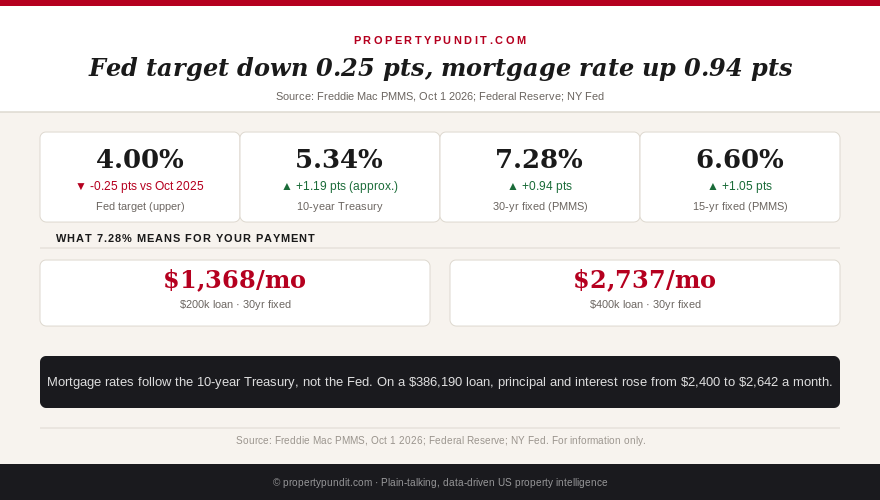
Freddie Mac's 30-year fixed rate averaged 7.28% in the week ending October 1, 2026, against 6.34% a year earlier (Freddie Mac PMMS, October 1, 2026 and October 2, 2025). The Fed's target range on October 2, 2025 was 4.00% to 4.25%. After the Fed cut on October 29, 2025 and hiked 25 basis points on September 16, 2026, it sits at 3.75% to 4.00% (Federal Reserve, October 29, 2025 and September 16, 2026; PCBB FOMC update, October 29, 2025).
Tomorrow's Freddie Mac reading is due Thursday, October 8, so this is a good week to understand which number your money actually follows.
Get this in your inbox every Friday.
One email. The number that matters and what it means for you.
Same month, one year apart: the Fed down, mortgages up
| Measure | Early Oct 2025 | Early Oct 2026 | Change |
|---|---|---|---|
| Fed target range (upper bound) | 4.25% | 4.00% | -0.25 pts |
| Bank prime rate (upper bound + 3) | 7.25% | 7.00% | -0.25 pts |
| 10-year Treasury yield | 4.15% | 5.34% | +1.19 pts |
| 30-year fixed mortgage (PMMS) | 6.34% | 7.28% | +0.94 pts |
| 15-year fixed mortgage (PMMS) | 5.55% | 6.60% | +1.05 pts |
The Treasury figures are from different days, October 7, 2025 for the year-ago reading (New York Fed TMPG, October 7, 2025) and October 1, 2026 for today's (Yahoo Finance, October 3, 2026), so treat the 1.19-point gap as approximate. The direction isn't in doubt: the 10-year sits at its highest level in 24 years while the Fed's own rate is lower than last fall. What it means for you: a rate tied to the Fed is slightly cheaper than a year ago, a rate tied to the 10-year is much more expensive, and the "Fed hiked" headline tells you about the first one only.
Why the mortgage rate follows the 10-year, not the Fed
Lenders price a 30-year fixed loan off the 10-year Treasury yield plus a spread, because investors who buy mortgage bonds compare them to Treasuries, not to overnight lending between banks. The 30-year rate is 7.28% against a 5.34% 10-year, a spread of 1.94 points. A year ago it was roughly 2.2 points (6.34% against about 4.15%). Mortgage rates rose less than the 10-year did: had the spread stayed at last year's level, the 30-year rate would be near 7.5%.
That's also why the September 16 hike barely moved mortgages. The Fed voted 12-0 for the 25-basis-point increase, and rates were essentially flat the next morning because the 10-year had already moved days earlier, a mechanism we walked through in the pre-vote explainer. The bond market has been pricing inflation and government borrowing for months, and the 10-year's climb to 5.34% on October 1, 2026 is the cost of that, which we put in dollar terms in the 10-year yield mortgage math. What it means for you: if you're shopping for a loan, watch the 10-year yield on any finance site each morning, because the mortgage quote will follow it within days.
What 94 basis points costs on the median loan
Take a buyer putting 10% down on the $429,100 national median (NAR, August 2026), a $386,190 loan. At 6.34% the principal and interest payment is $2,400 a month. At 7.28% it's $2,642. That's $242 more a month, or $2,904 a year, for the same house. Using the standard 28% front-end guideline on principal and interest alone, the income needed to qualify rises from about $102,900 to about $113,200, a $10,300 gap.
Run it the other way. A $2,400 monthly payment at 7.28% supports a loan of about $350,800, which is $35,400 less than at last year's rate. The payment factor at today's rate is $684 per $100,000 borrowed, the shortcut explained in our payment rule. What it means for you: set your price ceiling from the 7.28% payment, not from last year's affordability calculator, and treat any rate dip as a bonus rather than the plan.
Who gains and who loses from a lower Fed rate
Variable-rate borrowers gain a little. A home equity line priced off prime costs 0.25 points less than it did last October, which is $10.42 a month per $50,000 drawn (prime at 7.00% against 7.25%). The September hike added that same $10.42 back, as the HELOC cost breakdown showed, so the Fed's net effect on a $50,000 balance is a $10 monthly saving versus a year ago. It's real money, and it's tiny beside the $242 a month a new buyer now pays.
Fixed-rate owners lose nothing, and that's the point. A $300,000 balance at 3.8% costs $1,398 a month in principal and interest, while a new $300,000 loan at 7.28% costs $2,053, a $655 monthly gap that's your lock-in value. Buyers who can't afford the gap are choosing adjustable loans: ARMs took 10.3% of applications in the week ending September 25, the highest share since October 2025, with rates about 80 basis points below fixed (MBA, September 30, 2026). What it means for you: if you hold a 3.8% loan, don't give it up for a move you could delay, and if you carry a HELOC, the Fed is the rate to watch.
What to watch before the October 28 meeting
September payrolls rose only 29,000 and unemployment reached 4.2%, which cut the odds of another hike at the October 28 meeting to roughly one in five (BLS and CME FedWatch via FXStreet, October 2026). A weaker labor market can pull the 10-year down, but a hold from the Fed doesn't guarantee lower mortgage rates, because the 10-year has been driven by inflation and borrowing concerns more than by Fed moves.
The math points toward a simple routine. Ignore the Fed headline on the day it lands, check the 10-year yield and Thursday's Freddie Mac reading, and decide from your own payment ceiling. If a 10-year drop of half a point shows up, that's roughly a 0.4 to 0.5 point cheaper mortgage quote, worth about $100 to $130 a month on the median loan. If it doesn't, you've lost nothing by not guessing. What it means for you: a rate watcher's edge is knowing which series moves the quote, and that series isn't the one on the evening news.
Frequently asked questions
Is the Fed funds rate higher or lower than a year ago?
Lower. The target range is 3.75% to 4.00% after the September 16, 2026 hike, against 4.00% to 4.25% in early October 2025.
Why are mortgage rates up if the Fed cut rates?
Mortgage rates follow the 10-year Treasury yield, which rose from about 4.15% to 5.34%. The 30-year rate went from 6.34% to 7.28%, up 0.94 points, even though the Fed's target is 0.25 points lower.
How much more does a mortgage cost than a year ago?
On a $386,190 loan, principal and interest rose from $2,400 to $2,642 a month, which is $242 more, or $2,904 a year. The same $2,400 payment now supports a loan about $35,400 smaller.
Does a Fed hike raise my fixed-rate mortgage?
No. A fixed rate stays the same for the life of the loan. A hike raises costs on variable debt such as HELOCs and credit cards, and it can nudge new-loan rates only indirectly through the 10-year yield.