 Property
You've been watching your rate quote climb toward 7% and quietly writing off conventional financing as something you'll deal with once rates come back down. Here's the part nobody tells you when you're stressed about a preapproval letter: the loan you've been dismissing as "the expensive government one" is very possibly the cheaper option right now, not the fallback. FHA loans are running noticeably below conventional rates this month, and if you've only been shopping conventional quotes, you've been comparing the wrong number.
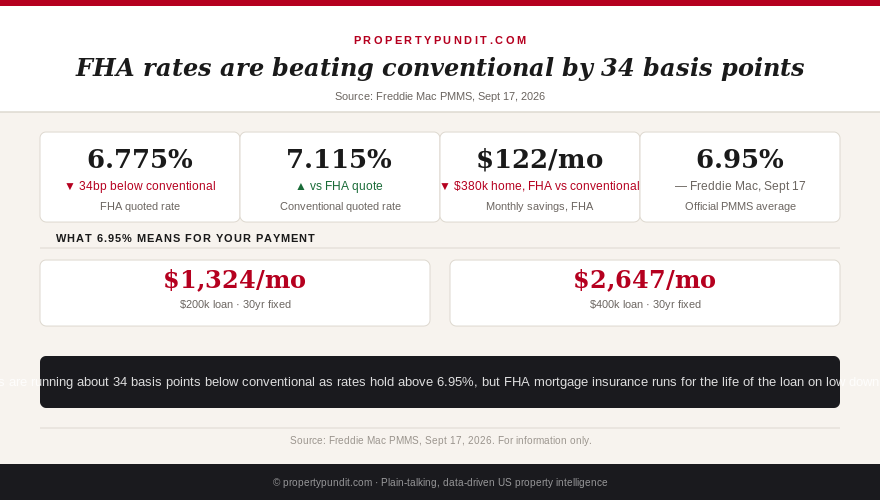
As of September 2026, FHA-quoted rates sat around 6.775% (6.829% APR) against conventional quotes around 7.115% (7.181% APR), a gap of roughly 34 basis points, according to LendingTree's September 2026 rate comparison. Freddie Mac's official PMMS survey, which tracks a broad conventional average, put the 30-year fixed at 6.95% for the week of September 17, 2026, the highest official reading since the rate briefly touched similar levels last year. FHA and VA-backed loans "still beat conventional 30-year quotes above 7%" for eligible borrowers this month, per a separate September 2026 rate roundup. The gap exists because FHA loans carry a federal guarantee that protects the lender if you default, so lenders can price the rate lower even while overall borrowing costs rise. That gap tends to widen exactly when rates are elevated and lender risk appetite tightens, which is precisely where the market sits right now.
The catch: FHA charges you for that lower rate elsewhere
A lower headline rate isn't the same as a lower total cost, and FHA's fine print is where that distinction shows up. Every FHA loan carries a 1.75% upfront mortgage insurance premium, usually rolled into the loan balance rather than paid in cash, plus an annual MIP of 0.50% to 0.55% for most 30-year loans with less than 10% down (2026 FHA guidelines). Conventional loans charge private mortgage insurance instead, typically ranging from about 0.30% to 1.15% of the loan balance a year depending on your credit score and down payment, with a borrower in the 700 to 719 credit tier paying closer to 0.95% on a loan with 5% down. So what for you: the rate you see advertised is only half the comparison. You have to run MIP and PMI against each other, not just the interest rate, before you know which loan is actually cheaper.
Running the real numbers on a $380,000 home
Take a $380,000 purchase. On the FHA side, a 3.5% down payment leaves a base loan of $366,700; the 1.75% upfront MIP financed into the loan brings the working balance to about $373,117. At 6.775%, principal and interest run about $2,426 a month, and the 0.55% annual MIP adds roughly $168 a month, for a total of about $2,594. On the conventional side, a 5% down payment leaves a loan of $361,000; at 7.115%, principal and interest run about $2,430 a month, and PMI at 0.95% for a borrower with a 700 to 719 credit score adds roughly $286 a month, for a total of about $2,716.
That's a gap of about $122 a month in FHA's favor, on a smaller down payment. So what for you: if your credit score is closer to the high 600s than the mid 700s and you're putting down less than 10% either way, the loan type you've been treating as the backup plan is currently the cheaper one on a pure monthly-payment basis.
Get this in your inbox every Friday.
One email. The number that matters and what it means for you.
Why the FHA advantage can flip over time
The monthly math favors FHA today, but the two loans age differently, and that's the piece worth planning around before you sign anything. Conventional PMI cancels automatically once your loan balance reaches 78% of the home's original value, which typically takes seven to nine years of normal amortization, sooner if the home appreciates or you pay extra principal. FHA's MIP on a loan with less than 10% down doesn't cancel at all; it runs for the life of the loan unless you refinance it away. Run both loans out ten years, and even though conventional's PMI likely disappears around year nine while FHA's MIP keeps going, FHA still comes out ahead by roughly $11,200 over that decade on this same $380,000 example, because the monthly gap compounds for nine full years before conventional's insurance line drops off at all. So what for you: don't let "FHA insurance never goes away" scare you out of the math without running the actual numbers for your holding period; a permanent but smaller premium often beats a temporary but larger one.
When conventional still wins
None of this makes FHA the automatic right answer. A borrower with a 740-plus credit score typically qualifies for PMI well under 0.5%, sometimes closer to 0.3%, which can undercut FHA's MIP even before it cancels. And if you're planning to refinance within a few years anyway, either to drop mortgage insurance or to chase a lower rate if the market eases, the FHA MIP's "life of loan" downside matters a lot less, because you won't be carrying it that long regardless. So what for you: your credit score and your realistic timeline in the home are the two inputs that actually decide this, not which loan type sounds more official.
Why this gap widens when rates are high
FHA has pulled ahead of conventional before, and the pattern behind it is worth understanding. The FHA-versus-conventional gap tends to widen specifically during stretches like this one, when the 30-year fixed is elevated and lenders are pricing risk more conservatively across the board. When rates are low and conventional volume is plentiful, lenders compete hard for that business and narrow the spread, sometimes to almost nothing. When rates climb past 7% and conventional applications thin out, as they have this fall, the government backstop behind FHA becomes relatively more valuable to a lender's pricing desk, and the rate gap tends to open back up. That's a pattern worth watching rather than assuming; check both quotes again any time the market moves meaningfully, because a gap this size isn't guaranteed to hold once rates start easing.
It's also worth a quick note for anyone with military service: VA loans, which carry no monthly mortgage insurance at all, are running rates close to FHA's this month and beat both loan types on total cost for an eligible borrower with less than 10% down. If you qualify for VA financing, get that quote alongside FHA and conventional before you compare anything else, since it removes the entire mortgage insurance line from the math.
What this means for your preapproval
The math points toward one clear action: get quoted for both loan types side by side, on the same day, from the same lender, before you assume conventional is the default choice. Most first-time buyers who run this comparison with a mid-600s to low-700s credit score end up choosing FHA once they see the real monthly gap, not because FHA is inherently better, but because the rate advantage it's carrying right now is real and the mortgage insurance cost, while permanent, is currently smaller than PMI on an equivalent conventional loan. If your credit score is comfortably above 740, ask your loan officer to run conventional with your actual score before you rule it out; that's exactly the range where PMI stops being the deciding factor.
For a deeper look at how MIP and PMI actually work loan-by-loan, see our FHA vs. conventional MIP and PMI breakdown. If a bigger down payment is on the table as an alternative to either insurance type, our down payment myth explainer is worth reading first, and our piece on when PMI actually cancels covers the fine print lenders don't always volunteer. Your credit score is also doing more work in this comparison than most buyers realize; see how credit score actually affects your mortgage rate for the fuller picture before you lock either loan in.