 Property
You've got a job offer that could land you in either Kansas City or Omaha, and on the surface they read like the same decision twice: solidly affordable Midwest metro, real employer base, no coastal price tag. Omaha's homes are even $22,000 cheaper on paper, so you're leaning that way before you've run a single number. Then you actually price out homeowners insurance in both places and realize you were comparing the wrong two variables the whole time.
Here's the full monthly cost breakdown at $112,000 income, and the one line item that flips the result.
The price looks like it favors Omaha
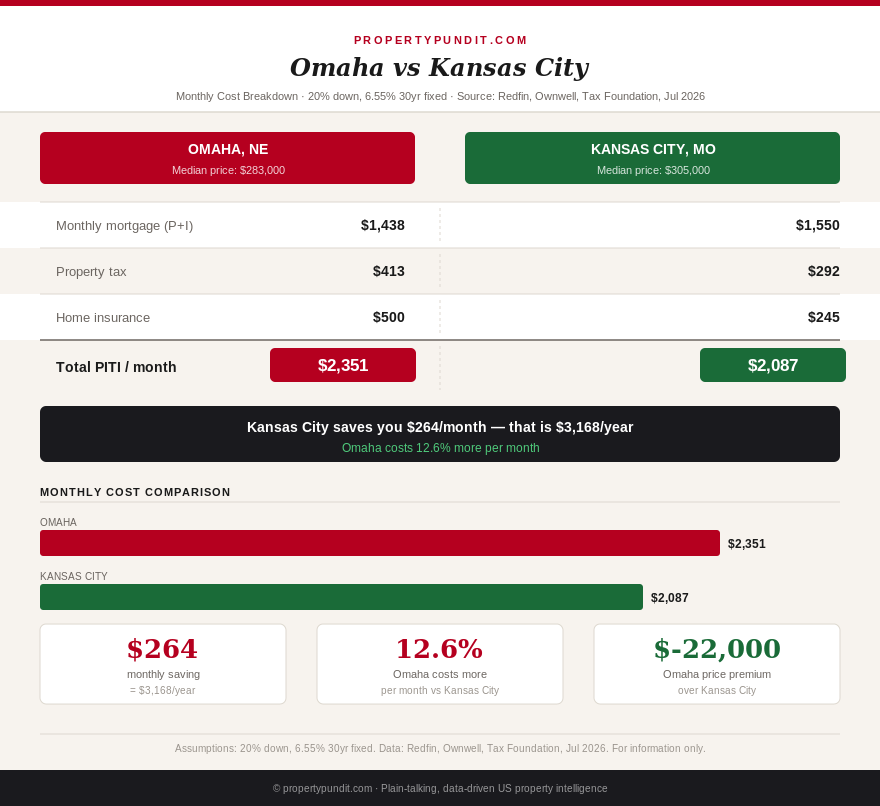
Kansas City, Missouri's median sale price over the three months ending May 2026 was $305,000, up 8.9% year over year (Redfin). Omaha's comparable figure was $283,000, up roughly 9.9% year over year. At 20% down, that's a $61,000 down payment for Kansas City versus $56,600 for Omaha, a real $4,400 difference in cash you need at closing, before you even add closing costs on top. On price and down payment alone, Omaha looks like the easier entry.
Run the principal and interest at 6.55% on each loan and the gap narrows further: Kansas City's $244,000 loan carries a P&I of about $1,550 a month; Omaha's $226,400 loan runs about $1,438. That 6.55% rate assumes a strong credit score; either payment moves meaningfully if yours isn't. Omaha is still ahead by roughly $112 a month on the mortgage payment alone. If you stopped the analysis here, Omaha would win clearly. Most buyers do stop here, which is exactly the problem.
Get this in your inbox every Friday.
One email. The number that matters and what it means for you.
Property tax closes some of the gap
Jackson County, Missouri, where most of Kansas City sits, carries an effective property tax rate around 1.15%. Douglas County, Nebraska, home to Omaha, runs closer to 1.75%, more than 50% higher. On the two purchase prices in question, that works out to roughly $292 a month in Kansas City versus $413 a month in Omaha, a $121 swing that already erases most of Omaha's mortgage-payment advantage. This is the same down payment math trap that shows up in a lot of city comparisons: the sticker price and the closing-day cash requirement tell you almost nothing about what you'll actually pay every month for the next 30 years.
The number nobody checks: homeowners insurance
This is where the comparison actually turns. Nebraska ranks among the most expensive states in the country for homeowners insurance, driven by frequent, severe hail and wind events across the Great Plains. On a typical dwelling near these purchase prices, Nebraska premiums average close to $500 a month. Missouri, despite its own tornado and hail exposure, averages closer to $245 a month for comparable coverage. That's a $255-a-month gap on insurance alone, larger than the entire mortgage-payment advantage Omaha had going in.
Add it up and the total PITI flips: Kansas City comes to roughly $2,087 a month (P&I $1,550, tax $292, insurance $245). Omaha comes to roughly $2,351 a month (P&I $1,438, tax $413, insurance $500). The city with the lower purchase price now costs $264 more a month to actually live in.
Income tax barely moves the needle
Missouri's graduated income tax tops out at 4.7%, with an effective rate around 4.55-4.6% at $112,000 income, roughly $428 a month. Nebraska's newly simplified three-bracket system tops out at 4.55% as well, but because its brackets compress so quickly, the effective rate at $112,000 comes out slightly lower, around 4.28%, or roughly $400 a month. That's a $28 monthly difference in Omaha's favor, nowhere near enough to offset the insurance gap. All-in, Kansas City runs about $2,515 a month (PITI plus income tax) against Omaha's roughly $2,751, a $236 monthly difference, or $2,832 a year, in Kansas City's favor.
Both cities clear the 28% rule, but not by the same margin
At $112,000 income, gross monthly pay is about $9,333, and the standard 28% housing-cost ceiling is $2,613. Kansas City's PITI of $2,087 sits at 22.4% of gross income, a comfortable $526-a-month buffer. Omaha's PITI of $2,351 comes in at 25.2% of gross, still under the ceiling but with only $262 of breathing room. If a job loss, a rate reset, or an unplanned repair hits either budget, Kansas City's buyer has roughly double the cushion Omaha's buyer has. For a first-time buyer at $112,000 income, that margin matters as much as the headline monthly number.
What this means for your decision
Both cities have real, durable employer bases: Kansas City runs on Cerner/Oracle Health, T-Mobile, and H&R Block; Omaha runs on Berkshire Hathaway, Union Pacific, Mutual of Omaha, and the Offutt Air Force Base/U.S. Strategic Command corridor in nearby Bellevue. Neither is the weak link here. Omaha has also been appreciating slightly faster, 9.9% year over year versus Kansas City's 8.9%, so if you're weighing this as a five-plus-year hold, some of that $236-a-month gap gets clawed back in equity over time. But if your decision is about the monthly number you can actually afford right now, the math points toward Kansas City. Most buyers who run these numbers themselves are surprised that the cheaper house on paper turns out to be the more expensive one to own, and insurance, not price or tax, is almost always the reason why.
Frequently asked questions
Is Kansas City or Omaha cheaper to buy a home? Omaha's purchase price is lower, but Kansas City's total monthly cost is about $236 lower once property tax, insurance, and income tax are included, mainly because Nebraska's insurance rates run roughly double Missouri's.
Why is homeowners insurance so expensive in Omaha? Nebraska ranks among the most expensive states nationally for homeowners insurance due to frequent, severe hail and wind events. Average premiums run close to $500 a month versus roughly $245 in Missouri.
Does Kansas City or Omaha have lower property taxes? Kansas City, Missouri's effective rate (about 1.15%) is meaningfully lower than Omaha's Douglas County rate (about 1.75%).
Which city is a better long-term investment? Omaha has appreciated slightly faster recently. If your priority is the lowest monthly payment today, Kansas City wins; if you're weighing years of appreciation against a few hundred dollars a month, Omaha's growth narrows that gap over time.