Fed Hike Adds $10.42 a Month per $50,000 of HELOC Debt
By The Property Pundit·Published: ·Data last verified: September 30, 2026·6 min read
Key points
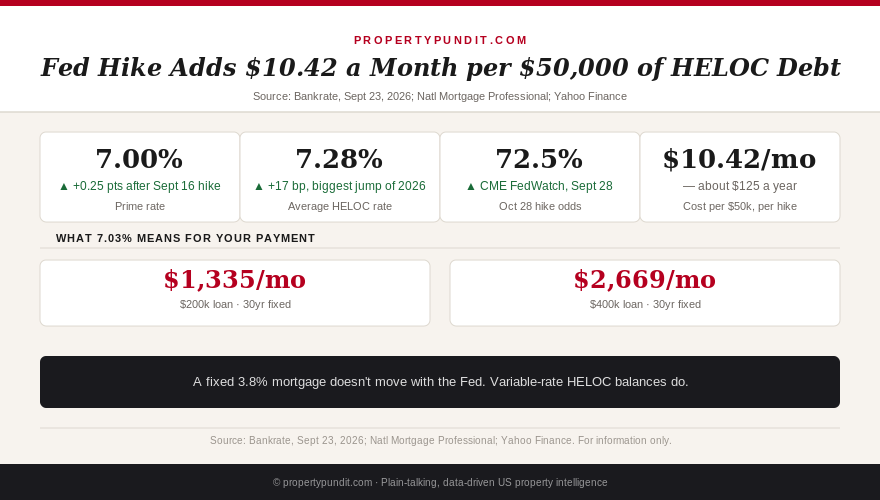
Prime rose from 6.75% to 7.00% after the September 16 Fed hike, adding $10.42 a month per $50,000 of variable-rate HELOC debt.
Bankrate's average HELOC rate hit 7.28% on September 23, up 17 basis points, its biggest jump of the year.
CME FedWatch puts the odds of an October 28 hike at 72.5%; a fixed 3.8% mortgage doesn't move, but a HELOC does.
You locked in 3.8% years ago, so when the Federal Reserve hiked on September 16, you probably shrugged. On the mortgage, you were right. If you have a home equity line of credit open, though, or you're thinking about drawing one for a roof, a kitchen, or a kid's tuition, the hike already landed on your bill. Every 0.25-point Fed move adds $10.42 a month per $50,000 of variable-rate balance, and traders now put the odds of another one on October 28 at 72.5%.
The FOMC voted 12-0 to lift its target range to 3.75%-4.00%, its first hike since 2023. Banks raised their prime rate from 6.75% to 7.00% afterward, and most HELOCs are priced as prime plus a margin, so they typically reset on the next billing cycle (National Mortgage Professional, September 2026).
What the hike did to HELOC rates
Bankrate's national average HELOC rate stood at 7.28% on September 23, up 17 basis points, the biggest jump of its 2026 survey. Lenders range from about 3.99% on short introductory offers to 11.60%, and homeowners now hold roughly $11.5 trillion in accessible equity, or about $310,000 per borrower (Bankrate, September 2026). That's a large pool of borrowers exposed to a floating rate.
The average moved 17 basis points, not the full 25, because some lenders adjust on the next statement. If the pass-through completes, expect the average to settle near 7.36% before any further hike. If you carry a balance, budget for that rate now, even if no more hikes come.
Get this in your inbox every Friday.
One email. The number that matters and what it means for you.
The payment math at three balance sizes
HELOCs usually charge interest only during the draw period, so the monthly cost is balance times rate divided by 12. Here's what today's 7.28% average costs, and what each additional quarter-point hike adds.
HELOC balance
At 7.28% (today)
After one hike (7.53%)
After two hikes (7.78%)
$25,000
$151.67
$156.88
$162.08
$50,000
$303.33
$313.75
$324.17
$100,000
$606.67
$627.50
$648.33
The market is pricing the first of those hikes as more likely than not. CME FedWatch showed a 72.5% chance of a hike on October 28 as of September 28, and the two reports that will move it are the August PCE inflation report on September 30, expected at +0.4% for the month, and the September jobs report on October 2, expected at about 100,000 jobs with unemployment rising to 4.2% (Yahoo Finance and TheStreet, September 28, 2026). Inflation ran 3.4% in July, driven by a 14.7% jump in energy prices (S&P Cotality, September 2026), so a hot print is plausible. Run your own balance through the table today so an October hike doesn't surprise your budget.
Your 3.8% mortgage is the asset here
The Fed doesn't set your fixed mortgage rate, and it barely sets new ones either. Mortgage rates follow the 10-year Treasury, which hit its highest close since July 2007 near 5% (Yahoo Finance, September 28, 2026). Freddie Mac's benchmark 30-year rate was 7.03% on September 24, while daily trackers ran 7.455% on September 30 (Fortune) and 7.50% on September 28 (Mortgage News Daily). If you'd like the mechanism, our Fed vote explainer walks through why the 10-year matters more than the funds rate.
That gap is the reason a HELOC beats a cash-out refinance for most owners with a low first mortgage. Say you owe $250,000 at 3.8% and need $60,000. Approximate first-year interest looks like this:
Option
Rate
First-year interest (approx.)
Keep $250,000 at 3.8%, add $60,000 HELOC at 7.28%
3.8% and 7.28%
$13,868
Cash-out refinance to $310,000 at 7.03%
7.03%
$21,793
Difference
$7,925 more a year (about $660 a month)
The refinance figure uses the 7.03% benchmark, and cash-out loans typically price higher, so the true gap is likely wider. Even if the HELOC rose to 8.28% after four more hikes, its blended cost would still be lower than the refinance for years. Interest-only figures ignore principal paydown and are for comparison only. Your takeaway: keep the low first mortgage and borrow against equity with a HELOC rather than a refinance, unless you can lock a fixed home equity rate.
Other places the hike shows up
HELOCs are the most direct exposure, but they aren't the only one. Adjustable-rate mortgages move with market indexes rather than the prime rate, and borrowers have been drifting toward them: ARM share reached 9.8% of applications in the MBA's mid-September survey, and a 5/1 ARM quoted 6.10% against 7.03% for a 30-year fixed (PropertyPundit's September 25 decision guide). Credit cards and personal lines tied to prime also rose a quarter point. If you carry a card balance next to a HELOC, the card is the more expensive one, and it deserves the first extra dollar.
One more feature catches people off guard. Most HELOCs have a draw period, often about a decade, followed by a repayment period in which principal is added to interest. The table above shows draw-period payments only. When repayment starts, the payment on a $50,000 balance can rise well beyond the $10.42 hike effect, so check the date your line converts and plan the payoff around it.
What this means for you
If you have an open HELOC balance, find your margin over prime on the latest statement and calculate what one and two more hikes would cost, using the table above. Then ask your lender two questions: does the account allow you to convert part of the balance to a fixed rate, and what does that rate look like today? Fixed-rate conversions are worth pricing now, before an October hike gets folded into the quote.
If you're planning a draw, decide the size before the October 28 meeting rather than after. Every quarter-point costs $10.42 a month per $50,000, so borrowing $50,000 instead of $100,000 saves about $10 to $21 per hike, and paying down a balance faster with any spare cash earns an assured 7.28% at the current average. Above all, leave the 3.8% mortgage alone. The move that hurts, a cash-out refinance at today's rates, is the one that costs about $660 a month more than a HELOC on this example.
Keep a simple record of three numbers for each variable-rate account: the current rate, the margin over prime, and the payment date your draw period ends. With those three in hand, every future Fed statement takes you about two minutes to translate into dollars, using the $10.42 per $50,000 rule of thumb. Multiply it by your balance divided by $50,000 and you have the monthly cost of each quarter-point move.
If you have no HELOC and no plan to borrow, this hike costs you nothing. Watch the September 30 PCE print and the October 2 jobs report only if you carry variable-rate debt.
Plain-talking US property market analysis. Data-driven. Slightly contrarian. No agenda except the numbers.
Read next
Data sourced from National Mortgage Professional (September 2026), Bankrate (September 23, 2026), CME FedWatch via Yahoo Finance and TheStreet (September 28, 2026), S&P Cotality (September 2026), Mortgage News Daily and Fortune daily rate trackers (September 28 and 30, 2026), and Freddie Mac PMMS as of September 24, 2026. HELOC payments shown assume interest-only draw-period payments and no lender margin change. This article is for information only and is not financial or investment advice.
Get the weekly Market Pulse
One email, Friday. The number that matters and what it means for you.
 Property