 Property
The 5/1 ARM is quietly one of the better trades in mortgage lending right now: 6.10% against a 30-year fixed rate that closed last week at 7.03%, one of the widest gaps between the two loan types this rate cycle (Mortgage Bankers Association and Freddie Mac PMMS, September 2026). On a $400,000 loan, that gap is worth about $245 a month, real money for a decision that used to be considered too risky to seriously weigh against a fixed rate. Nearly 1 in 10 mortgage applications is now an ARM, the highest share in years. But the reason ARMs used to make sense, that you'd sell or refinance long before the rate ever adjusted, doesn't hold the way it used to, and the newest data on how long people actually stay in their homes is exactly why.
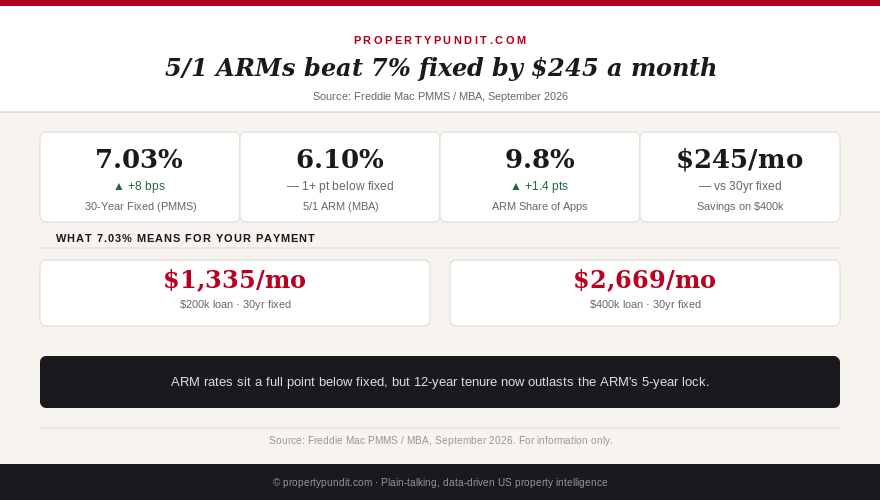
Freddie Mac's official 30-year rate hit 7.03% this week, up from 6.95% the week before and the highest reading since the Fed's September 16 hike pushed rates broadly higher (Freddie Mac PMMS, September 24, 2026). The Mortgage Bankers Association's own weekly survey, which samples slightly differently and typically runs a touch hotter, put the 30-year contract rate at 7.12% for the week ending September 18, with the average 5/1 ARM rate at 6.10%, over a full percentage point lower (MBA, September 2026). ARM applications climbed to 9.8% of the mix that same week, up from 8.4% just seven days earlier, the fastest one-week jump this year.
The math on that gap is straightforward. The question that actually matters is what happens after year five, and that's where most of the online ARM debate gets it wrong.
Get this in your inbox every Friday.
One email. The number that matters and what it means for you.
The savings are real, and they add up fast
On the national median home price of $429,100 with 10% down, the loan amount comes to $386,190. At this week's 7.03% fixed rate, principal and interest run about $2,577 a month. The same loan at a 6.10% 5/1 ARM rate costs about $2,340, a savings of roughly $237 a month, or about $2,840 a year. Stretch that across the ARM's five-year fixed period and a borrower keeps close to $14,210 that a fixed-rate buyer paid instead, money that could go toward extra principal payments, a stronger emergency fund, or simply a lower monthly obligation while rates this high strain every other line in a household budget. On a rounder $400,000 balance, the gap runs about $245 a month, or roughly $14,720 across five years, using the same math. Either way, an ARM at today's rates isn't a marginal discount. It's a genuine, material difference in what a household pays every month for as long as the introductory rate holds.
What actually happens when the rate adjusts
A 5/1 ARM's rate is fixed for five years, then adjusts annually based on an index plus a margin, subject to caps that limit how much it can move at each reset and over the life of the loan (caps vary by lender and program, but a 2% initial cap and a 5% lifetime cap are typical on conforming ARMs). Nobody, including the lender who approved the loan, can promise what that adjusted rate will be five years from now. One example making the rounds this month shows a $400,000 remaining balance resetting from 5.5% to 7.5%, a jump from about $2,456 to $2,956 a month, close to $500 more overnight (illustrative example reported September 2026). Being approved for an ARM was never proof a household could afford the home at whatever rate it resets to. It was proof they could afford the introductory rate, on the assumption, often unstated, that something would change before the five years were up: a move, a refinance, a raise.
The assumption that used to make ARMs safe just broke
That assumption rested on how long people actually keep a mortgage before selling or refinancing, and the newest data says it's no longer a safe bet. The median US homeowner now stays in a home 12 years, up from 11.8 years in 2024 and the longest tenure since 2022, driven by the rate lock-in effect: owners sitting on 3% to 4% mortgages have little financial reason to sell into a market where the replacement loan costs nearly double (Redfin, 2026, covered in more detail in our look at how 12-year tenure changed the math on mortgage points). A 5/1 ARM's fixed period covers less than half of that. Take one out today and follow the same pattern as the median owner, and you won't sell or refinance before the first adjustment. You'll very likely still be in the home for the second, third, and possibly fourth one, each a fresh roll of the dice on wherever rates happen to sit that year. The old logic, that you'd be gone before the reset ever mattered, was built for a housing market where people moved every five to seven years. That market doesn't exist anymore, at least not for the typical owner.
Who should still take the trade
None of this makes an ARM a bad loan for everyone. It makes it a bad loan for someone borrowing on the old assumption instead of the current data. An ARM still makes sense with a genuinely high-confidence reason to expect a move or a refinance inside five years, a job relocation already in motion, a fixed-length assignment, or a starter home deliberately sized to outgrow. It also makes sense for a borrower with enough income cushion or savings to absorb a several-hundred-dollar payment increase without it changing their financial picture, treating the introductory savings as a bonus rather than money already spent. What no longer makes sense is taking the lower rate purely because it's lower, with no specific plan for year five, given that the typical outcome now is staying well past it. Buyers weighing an ARM against a bigger down payment instead should also check our breakdown of what a larger down payment actually buys you and how your credit profile changes the rate you're quoted on either loan type, since both shift this math before you ever compare ARM to fixed.
What this means for you
The math favors the ARM in the short run, and the data argues against it in the long run, so the honest answer depends on which one describes your actual plans, not your hopes. If you can say with real confidence that you'll move or refinance within five years, the roughly $245-a-month savings on a typical loan is worth taking. If you're buying a home you intend to stay in, and most buyers now do stay, closer to 12 years than 5, the math points toward locking the fixed rate and treating today's gap as the price of certainty. Most people who run this decision honestly end up choosing based on how long they actually expect to live in the house, not on which rate looks better on the first page of a loan estimate, and that's the question worth answering before you sign anything. If you're negotiating with a seller instead on a rate buydown, our recent breakdown of why a permanent buydown beats an equal-dollar price cut runs the same kind of math on a different lever entirely.