 Property
You looked at Idaho because the headline numbers read like a gift: a property tax rate near 0.5%, statewide prices up 7.9%, and Boise homes selling in 12 days. Then you priced an actual rental, and the spreadsheet said something else. At Freddie Mac's 7.03% and 25% down, all four Idaho markets we underwrote lose money every month, from -$1,258 in Pocatello to -$2,187 in Boise.
That includes Pocatello, the college town that came within a rounding error of breakeven in our July Idaho pass. It doesn't come close now, and the biggest reason is the 1.5% maintenance reserve this site now applies to every state, which accounts for roughly two-thirds of Boise's deterioration since July, more than the mortgage rate itself.
The market itself is hot. Idaho's median sale price hit $512,859 in August 2026, up 7.9% from a year earlier, while homes for sale fell 16.1% to 10,378 (Redfin, August 2026). Rents haven't kept pace with prices, and at a 7.03% mortgage rate that gap has become the whole story.
Get this in your inbox every Friday.
One email. The number that matters and what it means for you.
Idaho is running the opposite market from the rest of the country
Nationally, months of supply hit 4.9, the most in over a decade (NAR, August 2026). Idaho sits at 3.0 months (Redfin, August 2026), with 16.1% of homes selling above list price, up 4.0 points from last year, and a sale-to-list ratio of 99.1%. Homes sold rose 10.1% to 2,758 and median time on market fell five days to 48. The fastest movers are Hayden (+21.7%), Eagle (+12.5%), and Caldwell (+7.2%), none of which is Boise. Boise's own median rose a more modest 3.7% to $544,640, with 967 homes sold, 12 days on market, and 28.6% of homes closing above list (Redfin, August 2026). Seattle led net migration into Boise with 1,054 net inflows, followed by Los Angeles at 773 (Redfin migration data). Demand is real and supply is tight, which means an Idaho purchase is an appreciation bet by definition, not an income play. If you're buying for rent, that difference matters more than any price trend.
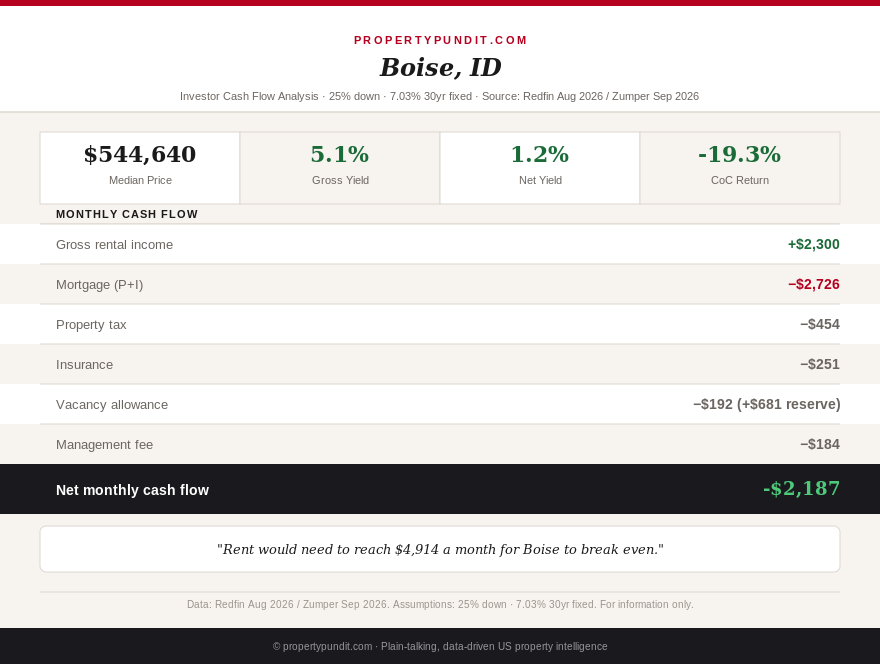
Boise: $544,640 buys a $2,187 monthly loss
Put 25% down and the loan is $408,480. At 7.03%, principal and interest run $2,726 a month. Property tax at a 1.0% investor rate adds $454, and insurance adds $251, for a total PITIA of $3,431 against an assumed rent of $2,300, a debt service coverage ratio of 0.67. Lenders generally want 1.0 or better. Here's the full monthly picture.
| Line item (Boise, monthly) | Amount |
|---|---|
| Gross rent (assumed) | $2,300 |
| Principal and interest (7.03%, 25% down) | -$2,726 |
| Property tax (1.0% investor rate) | -$454 |
| Insurance | -$251 |
| Property manager (8%) | -$184 |
| Vacancy (one month a year) | -$192 |
| Maintenance reserve (1.5% of price a year) | -$681 |
| Net cash flow | -$2,187 |
Rent is the most debatable input. Zumper's September 2026 data shows a $2,137 median for three-bedrooms and $2,922 for houses overall, with houses flat year over year. Even at the higher $2,922 figure, Boise loses $1,667 a month. To break even at today's price and rate, rent would need to reach $4,914, which is 114% above our assumption. Alternatively, at $2,300 in rent, a rental here only breaks even at a price near $236,000, about 57% below today's median. A break-even rent more than double the market rate is a clear sign the price isn't built on rental income.
Nampa, Idaho Falls, and Pocatello: cheaper, but still red
Dropping down the price ladder helps, but doesn't fix it. Nampa's median is $417,724, up 1.7%, with 653 homes sold and 31 days on market. Idaho Falls sits at $364,759, essentially flat (-0.07%), with sales down 9.7% (Redfin, August 2026). Pocatello's mid-year review put its median at $348,561, down 0.5% (Stacker mid-year review, 2026). Here's how the four compare.
| Market | Median price | Rent | PITIA | DSCR | Monthly cash flow | Breakeven rent |
|---|---|---|---|---|---|---|
| Boise | $544,640 | $2,300 | $3,431 | 0.67 | -$2,187 | $4,914 |
| Nampa | $417,724 | $1,900 | $2,690 | 0.71 | -$1,622 | $3,839 |
| Idaho Falls | $364,759 | $1,750 | $2,381 | 0.74 | -$1,372 | $3,390 |
| Pocatello | $348,561 | $1,749 | $2,286 | 0.77 | -$1,258 | $3,253 |
Rents for Nampa ($1,900), Idaho Falls ($1,750), and Pocatello ($1,749) are carried forward from our July pass and weren't independently re-verified today, so treat those three rows as directional. One caution on Pocatello: our July pass used an estimated $299,000, and this pass uses $348,561 from a different source. The gap is partly method, not just price growth. At the old $299,000 price, Pocatello would still lose $907 a month at today's rate and reserve, so the sign doesn't change. Idaho Falls and Pocatello are the closest to workable, and even they need rents around 94% and 86% above current levels to break even. If you're screening Idaho for cash flow, none of these four qualifies today.
What changed since July: the reserve, then the rate
In July, at 6.55% and without a maintenance reserve, Boise's model showed a loss of about $1,123 a month. Today it's $2,187, a swing of roughly $1,064. Re-running the numbers one variable at a time, the 1.5% maintenance reserve adds about $681 of that swing, the rise to 7.03% adds about $126, and Boise's higher price adds about $115. The remaining $142 comes from refreshed tax and insurance inputs. Two-thirds of the gap comes from an accounting fix rather than a market move: every landlord pays that cost eventually, and the July math left it out. Read every earlier state number on this site with that in mind.
The tax trap that makes Idaho's low rate misleading
Idaho's Homeowner's Exemption cuts taxable value by the lesser of 50% or $125,000, but it applies only to an owner-occupied primary residence. Rentals and second homes don't qualify (Idaho State Tax Commission; Good News Realty Group, 2026). On a $544,640 Boise home taxed at roughly 1.0%, that exemption is worth about $1,250 a year to an owner-occupant, which is why an investor's bill runs around $454 a month here. Ownwell puts the median Boise effective rate at 0.59%, and that median likely reflects owner-occupied homes that get the exemption. Idaho's flat 5.3% income tax applies on top of that. The 2026 legislature passed roughly $100 million in ongoing property tax relief (HB 304, per Good News Realty Group's summary), but we haven't confirmed whether any of it reaches non-owner-occupied rentals, so we haven't counted it. It's the same owner-only pattern we've documented in Arkansas and other states. Model the investor rate, not the advertised one.
Insurance and wildfire: two sources, a $1,300 disagreement
MoneyGeek's 2026 analysis puts the average Idaho homeowners policy at $3,016 a year, while the same article's city-level figures run only $1,634 to $1,747, likely reflecting different coverage assumptions. We used the higher $251 a month figure, which is a conservative call. Redfin rates 63% of Boise properties at severe wildfire risk over 30 years, and Nampa at 38%. Standard policies also exclude earthquake damage, which needs a separate endorsement. If your insurance quote lands at the lower figure, Boise's loss shrinks by about $105 to $115 a month, which barely dents a $2,187 loss. Get a real quote before you trust either figure.
What this means for you
If you're weighing an Idaho rental, underwrite it as an appreciation hold and budget for a real monthly loss, somewhere between about $1,258 and $2,187 at today's rate, for as long as you own it. The state's tight inventory and 7.9% price growth may reward that patience, but nothing in the rent side of the math supports it. If cash flow is the goal, our Boise versus Colorado Springs comparison is a reminder that other markets are cheaper to carry, though none of them look easy at 7.03% either. Before you write an offer, get a real insurance quote, confirm the tax bill at the non-homestead rate, and check that you can carry roughly $26,246 a year of negative cash flow in Boise without pressure to sell. Our DSCR loan guide explains why a lender approving your loan and a property paying for itself are two different questions.