 Property
You've narrowed it down to two cities, and every time you talk yourself into one, a friend or a listing agent talks you right back out of it. Boise keeps showing up on "best places to live" lists and the mountains are real, but the price tag keeps climbing every time you check back. Colorado Springs feels like the practical choice, cheaper on paper, and prices there are actually falling, but "cheaper" doesn't always mean "affordable" once you run your actual income through the math. At $112,000 a year, here's what the two cities really cost you, side by side, and which one clears the bar.
The sticker price isn't the full story
Boise's median sale price ran $525,000 over the three months ending May 2026, up 1.9% year over year. Colorado Springs sat lower at $450,000 over the same period, and its prices are actually falling, down 3.3% year over year (Redfin). That's a $75,000 gap in sticker price alone, and it shows up immediately in the down payment: 20% down on Boise is $105,000, versus $90,000 in Colorado Springs, a $15,000 difference before you've paid a single mortgage bill.
So what for you: if your down payment savings are the binding constraint on when you can buy, that $15,000 gap alone could be the difference between a purchase this year and a purchase next year.
Get this in your inbox every Friday.
One email. The number that matters and what it means for you.
The monthly math at 6.55%
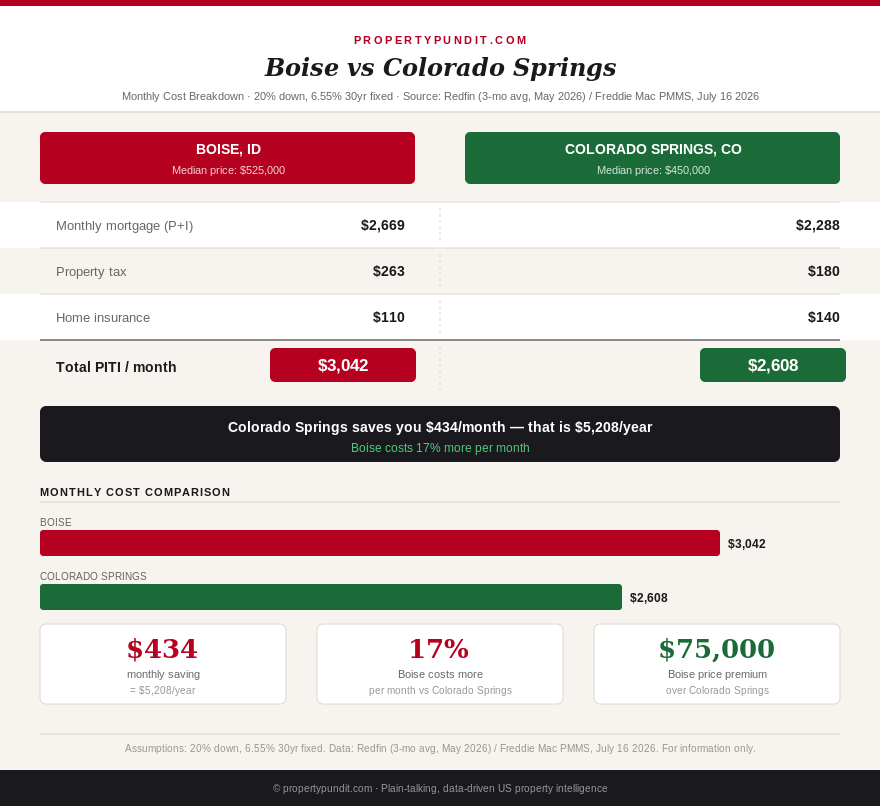
At 20% down and today's 6.55% rate (Freddie Mac PMMS, July 16, 2026), a $420,000 Boise loan carries $2,669 a month in principal and interest. Add Idaho's owner-occupied property tax rate, roughly 0.60% after the homestead exemption ($263/month), and insurance (about $110/month), and Boise's total PITI lands at $3,042.
Colorado Springs' $360,000 loan carries $2,288 a month in principal and interest. Its property tax rate is lower still, 0.48% ($180/month), though insurance runs a bit higher, an estimated $140/month, given the region's hail exposure. Total PITI: $2,608. That's a $434-a-month gap, with Boise costing 17% more every single month, before either state's income tax even enters the picture.
| Monthly cost | Boise, ID | Colorado Springs, CO |
|---|---|---|
| Median price | $525,000 | $450,000 |
| 20% down payment | $105,000 | $90,000 |
| Principal & interest | $2,669 | $2,288 |
| Property tax | $263 | $180 |
| Insurance | $110 | $140 |
| Total PITI | $3,042 | $2,608 |
| State income tax (monthly, $112k income) | $495 | $411 |
| All-in monthly cost | $3,537 | $3,019 |
So what for you: the $434 monthly PITI gap is real money, roughly a car payment, sitting on top of an already-larger down payment requirement in Boise.
The 28% rule only one city clears
Lenders and most financial planners use 28% of gross monthly income as the standard ceiling for a housing payment. At $112,000 a year, that's $9,333 a month in gross income and a $2,613 PITI cap. Colorado Springs' $2,608 PITI clears that bar, barely, with about $5 a month of room. Boise's $3,042 PITI blows through it by $429 a month, the kind of gap that forces either a smaller down payment elsewhere in your budget or a lender-approved but genuinely uncomfortable debt-to-income ratio.
So what for you: if you're underwriting yourself the way a lender eventually will, Boise requires you to already be earning meaningfully more than $112,000, or to bring a down payment well above 20%, before the math stops being a stretch.
Idaho vs Colorado: the income tax layer
Both states use a flat income tax, which makes this an easy add-on: Idaho taxes at 5.3%, Colorado at 4.4%. At $112,000 income, that's roughly $495 a month in Idaho versus $411 a month in Colorado, an $84-a-month edge for Colorado Springs. Stack that on top of the $434 PITI gap and the full, all-in monthly cost difference comes to about $518 in Colorado Springs' favor.
So what for you: even before you weigh anything else about the two cities, Colorado Springs is the cheaper place to live every single month, not just the cheaper place to buy into.
What you're actually buying into
The price trend lines matter too. Boise's slower 1.9% appreciation reflects a market still digesting a wave of California transplants that pushed prices up sharply earlier in the decade; the growth has cooled, but the base price never came back down. Colorado Springs, meanwhile, is one of the few Western metros where prices are still falling, down 3.3% year over year, even as roughly 30,000 military and defense jobs anchored by Fort Carson, Peterson Space Force Base, and NORAD keep local employment and rental demand steadier than the price chart alone suggests. For an investor's read on how that same tax and rate environment plays out for a landlord instead of an owner-occupant, our Colorado spotlight and Idaho spotlight both run the DSCR numbers on these two states in detail.
So what for you: a falling price in a market with a stable, defense-anchored job base is a very different signal than a falling price in a market with no anchor at all, and it's part of why Colorado Springs' math still works even as the headlines call it a soft market.
Run the five-year picture and the gap compounds rather than closes. The $518-a-month all-in saving in Colorado Springs adds up to roughly $31,000 over five years, money that could instead go toward extra principal payments, a rate buydown, or simply a larger cash cushion. Add the $15,000 smaller down payment and Colorado Springs frees up about $46,000 of your capital over that stretch compared with Boise, even before either home has appreciated a single dollar.
The call
Frankly, if you're earning $112,000 and choosing strictly on affordability, the math points toward Colorado Springs: it clears the 28% rule, needs $15,000 less down, and saves you about $518 a month all-in versus Boise. Most buyers who run these numbers side by side end up making the same choice, not because Boise is a bad city, but because a budget that's already stretched to the ceiling leaves no room for the next rate move, the next insurance renewal, or the next unplanned repair. If your down payment plan still feels tight either way, our breakdown of the down payment myth and the real closing costs you'll owe on top of it are worth reading before you write an offer on either city.