 Property
Hilo was the one market in Hawaii that worked. Back in July 2026, at a then-estimated median near $380,000 and a 6.55% mortgage rate, Big Island's largest town was the only place in this site's entire Hawaii coverage area that cleared a 1.0 debt service coverage ratio on its own rent. Every other market in the state, Honolulu's condos, Oahu's single-family homes, all of it, failed the lender's own bar. Hilo passed.
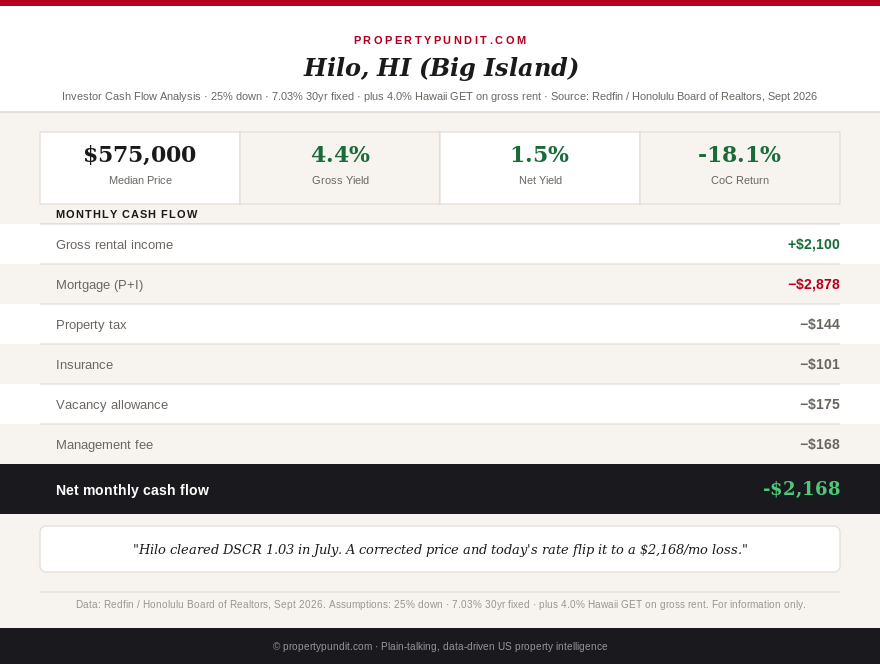
It doesn't anymore. A fresh Redfin reading puts the area's three-month median at $575,000, well above this site's earlier estimate, and combined with today's 7.03% mortgage rate and a maintenance reserve this site now applies consistently across every state pass, Hilo's math flips to a $2,168-a-month loss. That's the headline from Hawaii's third full investor underwrite: the cheapest, most reliable market in the state just joined every other Hawaii submarket in the red.
Meanwhile, Oahu's own numbers kept climbing in the opposite direction. The island's single-family median hit $1,240,000 in the three months ending August 2026, up 12.17% year over year (Honolulu Board of Realtors), while its condo median held closer to flat at $510,000, down 0.97% year over year over the same window. Houses are selling in a median of just 13 days. Whatever is happening in Hawaii's housing market, it isn't slowing down for anyone's underwriting spreadsheet.
Get this in your inbox every Friday.
One email. The number that matters and what it means for you.
None of this is a Hawaii-specific rate story. It's what happens when a state that was already the most expensive housing market in the country keeps appreciating at a rate most mainland metros would call a boom, while the state's own General Excise Tax (GET), a cost most investors elsewhere never encounter, keeps taking a direct cut of the rent before a single expense is paid.
Hilo: the market that used to work
At $575,000 and 25% down, a 30-year loan at 7.03% runs $2,878 a month in principal and interest alone. Hawaii County's roughly 0.30% effective property tax rate adds $144, and statewide homeowners insurance, one of the cheapest in the country at roughly $1,207 a year, adds another $101. That's a PITI of $3,123 against a typical three-bedroom rent of $2,100, for a debt service coverage ratio of 0.67, a market that would have cleared 1.03 at last year's lower price and rate now misses by a wide margin. Layer in an 8% property manager, one month of vacancy, Hawaii's 4.0% neighbor-island GET on gross rent, and the 1.5% maintenance reserve this site now applies everywhere, and the property loses $2,168 a month. Our DSCR loan investor guide walks through why a lender's approval threshold and a landlord's actual monthly math are two different questions, and Hilo is as clean an example as this site has published of how fast a market you were counting on can stop working underneath you.
Oahu's single-family homes: a $5,777 monthly gap
Nobody is buying an Oahu single-family home for cash flow, and the numbers make that explicit. At $1,240,000 and 25% down, the mortgage alone runs $6,207 a month. Honolulu's Residential A property tax class charges 0.40% on the first $1 million of value and 1.14% on everything above it, which adds $561 a month on this specific price point, and insurance adds roughly $230. Against a typical three-bedroom asking rent of $3,500, that's a debt service coverage ratio of 0.50, the rent covers half the housing payment before a single other expense is counted. After management, vacancy, the 4.5% Oahu GET, and the maintenance reserve, the property loses $5,777 a month. An investor buying here is underwriting land scarcity and long-run appreciation, full stop, not a rental spreadsheet.
Oahu's condos: the closest thing to a middle ground, and it still loses $1,973
A $510,000 Oahu condo splits the difference between Hilo and an Oahu house, and it still doesn't work. The mortgage runs $2,553 a month, property tax adds $170, insurance about $50, and the average $700-a-month HOA fee on a Honolulu condo (a cost single-family rentals here don't carry) brings PITIA to $3,473 against a typical $2,700 two-bedroom rent, a 0.78 debt service coverage ratio. After the same management fee, vacancy allowance, Oahu's 4.5% GET, and maintenance reserve, the loss lands at $1,973 a month. The HOA fee alone is nearly a third of the total housing payment, and it buys building insurance, maintenance, and amenities the owner has no control over and can't opt out of, which is exactly why a condo's advertised lower entry price rarely translates into the cash-flow cushion it appears to on paper.
The General Excise Tax most investors don't see coming
Every other state analyzed in this series taxes an investor's net income. Hawaii's GET taxes the gross rent check itself, 4.5% on Oahu and 4.0% on the neighbor islands, before a single expense, mortgage payment, or repair bill is subtracted. On the Oahu single-family example above, that's $157.50 a month gone before the landlord has covered a cent of the actual mortgage. It functions closer to a sales tax on rent than an income tax, and because it's baked into gross revenue rather than net profit, it hits hardest exactly when a property is already losing money, there's no offsetting deduction that makes it disappear in a bad year. Combined with Hawaii's graduated income tax, which runs up to 11%, on top of GET rather than instead of it, this is one of the least favorable state tax structures for a landlord anywhere in this site's coverage, and it's a cost you should model separately from your income tax return before you assume Hawaii's low property tax rate is telling you the whole story.
Tight inventory, and one bill worth watching
Oahu's single-family inventory sat at just 2.9 months of supply as of the most recent reading, a seller's market by any standard definition, while Oahu condos ran looser at 6.5 months (Honolulu Board of Realtors). That split explains why single-family prices keep climbing while condo prices sit closer to flat: buyers are competing hardest for the scarcer product. Separately, a statewide rent control bill, SB 2539, capping annual rent increases at 3%, was introduced in January 2026 and referred to committee, and as of this pass it has not been signed into law or advanced further. It's worth tracking for any investor underwriting a multi-year hold here, since a 3% statutory cap on rent growth would directly cut into the appreciation-and-rent-growth thesis this analysis already depends on to make Hawaii's math work at all.
What this means for you
If you're underwriting a Hawaii rental as a cash-flow investment, the math points toward walking away, or at minimum, reframing the purchase entirely as an appreciation and equity-paydown play with a five-to-ten-year horizon, not a spreadsheet that's supposed to pay for itself from month one. Every market this site tested here, Hilo included, loses money on a straight rental basis at today's price and rate, and Hilo's flip from the state's one working market to its worst percentage miss should be a warning about how quickly a "safe" number can stop being safe once a real reserve line and a corrected price get applied. If Hawaii's appeal is genuinely about long-run land scarcity and appreciation, underwrite it on that basis explicitly, budget for four figures of monthly negative cash flow while you hold, and stress-test that number against your own reserves before you commit, because on rent alone, nothing in this analysis pays for itself. For a mainland market where the math currently works better, our most recent Georgia investor pass and Florida's entry-tier breakdown are both worth reading before you write a Hawaii offer.