 Property
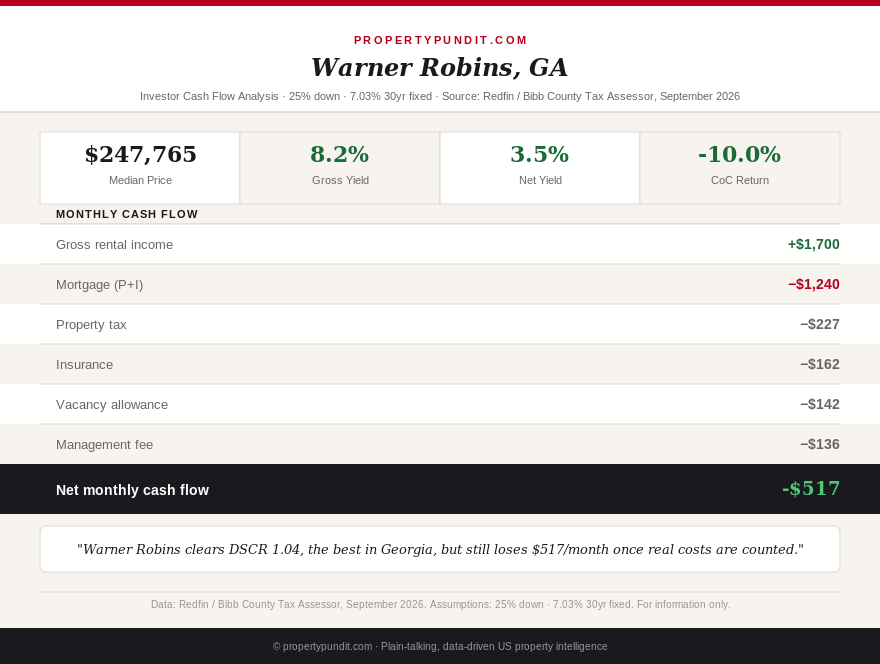
Warner Robins and Augusta, Georgia's two military-anchored secondary markets, are the only cities in this analysis that clear a 1.0 debt service coverage ratio at today's 7.03% mortgage rate. That's the same conclusion this site reached in July. What's different this time is what happens next: add the property management fee, a month of vacancy, and the maintenance reserve every landlord actually budgets for, and both markets lose money anyway, $517 a month in Warner Robins and $472 in Augusta.
This is a third look at Georgia for PropertyPundit, following passes in May and July 2026. Two things changed since July: the mortgage rate climbed from 6.55% to 7.03%, and this site adopted a stricter underwriting standard, a 1.5%-of-price annual maintenance reserve, that the July pass left out entirely. That single missing line is a big part of why a market that looked close to breakeven three months ago has gotten worse, not better.
Statewide, Georgia's median sale price is $371,663, up a modest 1.8% year over year, with 5 months of supply and homes taking a median 59 days to sell (Redfin, July 2026). That calm topline hides a state split into two very different investment stories: a metro core where prices are climbing faster than rents can follow, and two smaller, military-anchored cities where the fundamentals are close, but not quite there.
Get this in your inbox every Friday.
One email. The number that matters and what it means for you.
Atlanta's 9.1% jump doesn't help the math
Atlanta's median sale price hit $427,467 in the three months ending August 2026, up a striking 9.1% year over year, and a sharp reversal from the 4.7% year-over-year decline this site logged for Atlanta back in May (Redfin, September 2026). A swing that large in a few months deserves some caution, the same pattern this site has already flagged in Pittsburgh and Tampa, where a jump in luxury-tier closings can push a headline median up without broad-based appreciation underneath it. Whatever the true trend turns out to be, the investment math at today's advertised price doesn't work: at 25% down and 7.03%, the mortgage alone runs $2,139 a month, and property tax and insurance add another $481, for a debt service coverage ratio of 0.90 against a typical single-family asking rent of about $2,350. After the management fee, vacancy allowance, and maintenance reserve, the property loses $1,189 a month. Buying in Atlanta right now means underwriting appreciation, not cash flow, and the case for that appreciation just got harder to trust.
Savannah's correction hasn't gone far enough
Savannah's median sale price fell 3.1% year over year to $331,603 in the three months ending August 2026, continuing the pullback from its pandemic-era peak that this site first flagged in July (Redfin, September 2026). Lower prices should help the math, and they do, marginally, but Chatham County's 1.05% effective property tax rate and coastal insurance running anywhere from $3,100 to $4,800 a year, sources disagree meaningfully here, with the gap driven by how much hurricane and flood exposure each carrier prices in, keep the numbers upside down. At 25% down and 7.03%, DSCR comes in at 0.90 and the property loses $978 a month, worse than the $411 loss logged in July even though the price fell, because the rate increase and the new maintenance reserve line both cut the wrong way. The Hyundai Metaplant's ramp toward full production 25 miles west of the city is a genuine long-term demand driver for tenants, but it hasn't shown up in the cash-flow math yet, and a five-to-seven-year hold thesis needs a buyer who can absorb four figures of monthly loss for a while.
Warner Robins and Augusta: closest to breakeven, still red
Warner Robins, the city that sits closest to Robins Air Force Base's roughly 23,000 military and civilian personnel, posted a median sale price of $247,765 in the three months ending June 2026, up a modest 0.4% year over year (Redfin). At 25% down and 7.03%, the mortgage runs $1,240 a month, with Bibb County's 1.10% effective property tax rate adding $227 and insurance $162, for a debt service coverage ratio of 1.04 against a typical asking rent of $1,700, a number a DSCR lender would approve without blinking. It's also the same trap this site has now documented in Arizona, Florida, and half a dozen other states: DSCR only measures whether rent covers principal, interest, tax, and insurance. Add back the 8% management fee, one month of vacancy, and the 1.5% maintenance reserve, and the property loses $517 a month.
Augusta tells almost the same story. Steady demand from Fort Eisenhower's roughly 30,000 personnel, including the Army's Cyber Command headquarters, supports a median sale price around $225,000 and a DSCR of 1.04 against a typical rent of $1,500. Richmond County's 0.84% effective property tax rate is the lowest of the four markets in this analysis, but it isn't enough to offset the same reserve and vacancy math that sank Warner Robins: net cash flow lands at negative $472 a month. Military-anchored demand is real, and it's the reason both cities clear DSCR when Atlanta and Savannah don't, but a lender's approval threshold was never a promise of positive cash flow, and the gap only shows up once you run the numbers a real landlord has to run. For a deeper look at why lenders and landlords measure a deal so differently, see our full DSCR loan investor guide.
The tax bill an owner-occupant never sees
Every effective property tax rate cited above, Fulton's 0.88%, Chatham's 1.05%, Bibb's 1.10%, and Richmond's 0.84%, reflects what a typical owner-occupied home actually pays after Georgia's standard homestead exemption and the local exemptions each county layers on top of it. None of those exemptions apply to a non-owner-occupied rental. An investor buying the identical house pays property tax on a higher taxable base than the homeowner next door, the same homestead-exemption-excludes-rental pattern this site has now confirmed in more than 40 states. It's a smaller effect in Georgia than in states with steeper assessment-ratio splits, but it's one more reason the advertised "low-tax state" pitch undersells what an investor, specifically, will pay. Buyers weighing how a rental purchase compares to owning their own home should also check our breakdown of what down payment size actually gets you and what closing costs really include, since both change the cash you need on day one regardless of which Georgia market you're underwriting.
What this means for you
Run the numbers before you run the marketing pitch. Georgia's statewide story, a modest 1.8% median gain and 5 months of supply, sounds like a market in balance, but not one of the four cities in this analysis clears positive cash flow as a buy-and-hold rental once you underwrite it the way a landlord actually operates one, with a manager, a vacancy allowance, and money set aside for the roof. Warner Robins and Augusta come closest, and the case for either rests on the same thing it did in July: a stable, military-anchored tenant base that doesn't disappear when rates rise, not a spreadsheet that pencils out today. If you're set on Georgia, the math points toward budgeting for several hundred dollars a month of negative cash flow at purchase and underwriting the deal on rent growth and equity paydown over a five-to-seven-year hold, not on day-one income, and stress-testing that same $517 or $472 loss against your own reserves before you sign anything. For comparison against another state's investor math this month, see our third-pass look at Florida, where the same maintenance reserve line just did similar damage to a very different set of cities.